



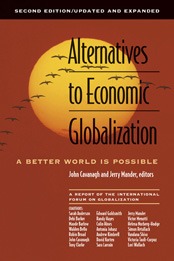
Alternatives to Economic Globalization 2nd Edition
A Better World Is Possible
John Cavanagh (Author) | Jerry Mander (Author)
Publication date: 10/10/2004
Bestseller over 35,000+ copies sold
Written by a premier group of 21 thinkers from around the world, the second edition of Alternatives to Economic Globalization lays out democratic, ecologically sound, socially just alternatives to corporate globalization more fully, specifically, and thoughtfully than has ever been done before. Focusing on constructive, achievable goals, the authors present ten governing principles for establishing truly sustainable societies and describe alternatives to the World Bank, the IMF, and the WTO that would better serve the needs of the planet. They offer detailed proposals for protecting vital goods and services from corporate exploitation, limiting corporate privileges and power, rebuilding economies to make them more responsive to human needs, and more.
This revised and expanded edition features a new opening chapter on the global balance of power, a new section on the media and globalization, and a new final chapter on what ordinary citizens can do to fight the injustices of globalization. It also includes many new charts, sidebars, and other updated information.
This revised and expanded edition features a new opening chapter on the global balance of power, a new section on the media and globalization, and a new final chapter on what ordinary citizens can do to fight the injustices of globalization. It also includes many new charts, sidebars, and other updated information.
- The definitive document of the anti-corporate globalization movement-the consensus report of an alliance of leading activists, scholars, economists, researchers, and writers
- Offers a constructive, coherent, positive alternative to globalization-the very thing that the anti-corporate globalization movement is always accused of not putting forward
- The International Forum on Globalization consists of the leaders of over 60 organizations in 25 countries -including such prominent organizations as Friends of the Earth, the Third World Network, the Sierra Club, the Institute for Policy Studies, Public Citizen, Rainforest Action Network, and Food First
Formats
Paperback - $22.95 - Members: $20.66
Paperback - $22.95 - Members: $20.66
PDF eBook - $22.95 - Members: $16.07
ePub - $22.95 - Members: $16.07
Find out more about our Bulk Buyer Program
- 10-49: 20% discount
- 50-99: 35% discount
- 100-999: 38% discount
- 1000-1999: 40% discount
- 2000+ Contact Leslie Davis ( [email protected] )
Orders of 10+ copies shipping to one address receive free ground shipping
within the U.S. Shipping to separate individual addresses via USPS media mail will be applied a handling fee:
Book Details
Overview
Written by a premier group of 21 thinkers from around the world, the second edition of Alternatives to Economic Globalization lays out democratic, ecologically sound, socially just alternatives to corporate globalization more fully, specifically, and thoughtfully than has ever been done before. Focusing on constructive, achievable goals, the authors present ten governing principles for establishing truly sustainable societies and describe alternatives to the World Bank, the IMF, and the WTO that would better serve the needs of the planet. They offer detailed proposals for protecting vital goods and services from corporate exploitation, limiting corporate privileges and power, rebuilding economies to make them more responsive to human needs, and more.
This revised and expanded edition features a new opening chapter on the global balance of power, a new section on the media and globalization, and a new final chapter on what ordinary citizens can do to fight the injustices of globalization. It also includes many new charts, sidebars, and other updated information.
This revised and expanded edition features a new opening chapter on the global balance of power, a new section on the media and globalization, and a new final chapter on what ordinary citizens can do to fight the injustices of globalization. It also includes many new charts, sidebars, and other updated information.
- The definitive document of the anti-corporate globalization movement-the consensus report of an alliance of leading activists, scholars, economists, researchers, and writers
- Offers a constructive, coherent, positive alternative to globalization-the very thing that the anti-corporate globalization movement is always accused of not putting forward
- The International Forum on Globalization consists of the leaders of over 60 organizations in 25 countries -including such prominent organizations as Friends of the Earth, the Third World Network, the Sierra Club, the Institute for Policy Studies, Public Citizen, Rainforest Action Network, and Food First
About the Authors
Table of Contents
Excerpt