
Virtual Summer Sidewalk Sale


Price: $16.95
Paperback
ISBN 9781576753194
Available Now
Price: $16.95
PDF Download

Other books you might enjoy:

Great Turning, The

Emotional Value

Affluenza

Amazon Reviews


56 of 57 people found the following review to be helpful:

Enlightening analysis of corporate influence,  February 10, 2005

By M. Veiluva

As an attorney and former college agitator (long, long ago), I read with profound interest Ted Nace's "Gangs of America", which along the line of Howard Zinn's "People's History of the United States" challenges us to imagine an economic and legal universe other than the one we live in. Most Americans, and especially attorneys who are the high priests to the corporations, take it for granted (kind of like the inhabitants of the "Matrix") that multi-billion dollar corporations should enjoy and have always enjoyed preferential tax treatment, tort immunity, and government handouts by the gazoo.

What is valuable about such authors as Nace and Zinn is that they break free from the trap of blaming our current social and economic inequalities on a select group of evil men in the White House or Congress. While alternative historical analysis became an endangered species when Berlin Wall fell, the need for other voices did not go away. It is not enough to simply bash the current Administration a la Michael Moore, Jim Hightower and Al Franken, although such rants have their place. Nace tells us instead that it is vital to understand that such governments are organic to the same economic and legal system which allows Wall-Marts, Enrons and Worldcoms to flourish. If a non-entity such as Bush were not around to elect, there would be plenty others to take his place to service the machinery. If we do not get the government we deserve, at least we get the best goverment corporate money can buy. This power is enabled by a steadly-built array of laws to establish the modern limited liability corporation and its holding companies as a superior economic and legal entity ahead of the individual, despite the fact that the Constitution nowhere provides such status.

"Gangs of America" stakes out the historical origins of the status of the modern corporation as a preferential legal entity enjoying rights and freedoms superior to that of the individual. This is all true. While I was familiar with the late 19th century cases which gave recognition to the corporation as a "person", Nace adds additional color to the facts of these decisions, which I certainly did not hear in law school. Rather, in corporations class, liberals devoted their time to debating the nuances of "shareholder democracy", a concept which, applied to giant megaliths such as Pepsico, has all the relevance of Stalin's Inner Circle...

It takes considerable courage to tackle such a subject on a macro level without clinging to the conventional icons of either capitalist or Marxian theory, or conventional legal analysis. Rather, what is being attempted is close to a pure historical analysis which follows the paths of money and influence in a very practical way. This is, ultimately, a very important book.


33 of 33 people found the following review to be helpful:

Highly Recommended!,  March 1, 2004

By Rolf Dobelli

This interesting book traces the history and development of corporations from the time of Queen Elizabeth I to the present day. Much of the book focuses on little-known episodes in the corporate chronicle - the cruel Jamestown settlement in Virginia, for example, or the British East India Company's depredations in India. About midway through, the book shifts from such tales to a close examination of Supreme Court justices who tilted the playing field in favor of corporate power. Breezily written and accessible, this book puts a lengthy and complicated history easily within reach of ordinary readers. Its bias is clear - the subtitle leaves no doubt that author Ted Nace is a foe of corporate power - and the closer to the present the story comes, the more accusatory the author's conclusions may seem. Nonetheless, We find this is a worthwhile read for those who seek background information on the dark side of the American corporate success story.


33 of 34 people found the following review to be helpful:

Smart White Men,  November 13, 2003

By Rolf Dobelli

If the hijacking of the 2000 presidential election by Stupid White Men incensed you, then take heed of the Smart White Men who have dealt a thousand blows to democracy over the past century. Ted Nace's "Gangs of America" is an intense history of corporate America's deliberate and relentless effort to empower itself aided by congressmen and judges entrenched in a sea of vested interests.

In a Matrix-like prequel, Nace carefully chronologizes the efforts of corporations to gain freedoms and protections as "persons" at the very expense of the people the U.S. Constitution was designed to protect. Even the self-serving ACLU cannot see the "real slippery slope is the ever-increasing tendency to treat corporations as though they were human beings."

Nace's witty and engaging tale compels the reader to follow the roller-coaster ride of corporate dominance which begins by going down the murky path by which the courts came to treat corporations as "persons." As the author of "Be Careful Who You SLAPP" I especially enjoyed Nace's treatment of corporate Strategic Lawsuits Against Public Participation (SLAPPs).

Nace points the reader to the success of this concerted corporate effort to dominate as measured by the public image of the CEO who is once seen as the dutiful bureaucrat and is now transformed into the swashbuckling dot-com "hero" in the likes of Bill Gates. But as the corporate juggernaut rolls forward we find this local boy does good is soon testifying at his company's anti-trust hearing, one of the most egregious examples of corporate abuse of power of the 20th century.

Are we doomed to an Orwellian future where a large unaccountable "modern" entity enjoys more rights and freedom than the citizens who work its factories and offices? Can the same legal system that allowed corporations to add "field to field, and power to power" now check its unfettered growth? Can we as citizens tap into our human propensity for creativity and utilize the restraints that will morph the corporations into welcomed tools of society? Or is our future to be trapped in "The Matrix" where corporations and machines now control our reality?

Nace's answer is practical and inspiring. Just as corporations have bit by bit turned the tables on us, we citizens can take back our liberties by chipping away at the same old block - the legal institutions that have empowered them. One beginning is for each State to simply enact charter revocation by which modern day corporations can be tamed with the threat of dissolution as they once were.

Nace's "Gangs of America" is an insightful view of the basis for the sense of invincible arrogance that fueled Enron, WorldCom and others yet to appear on the public radar. Thanks to Nace, we know the trajectory of corporate America. It's not too late to redirect the flight plan.


20 of 20 people found the following review to be helpful:

Glad I picked this up...,  December 27, 2005

By Mera

I bought this book at the airport with the intention of reading a "good" but perhaps not "great" account of the rise of Corporate America. I was in for a nice surprise as quite the opposite happened, the book was great.

Ted Nace does a brilliant job of giving a clear and concise picture of how corporations managed to gain such a strong and uncompromising foothold to become corporate America as we recognize it today. We are given an in-depth look at the landmark Santa Clara supreme court decision, individual amendments that were passed to grant corporations "rights" -that at times weren't even accorded to individuals and the breakdown in the democratic process the led to such outcomes.

These central ideas are nicely integrated in a well-written book that is straight-forward and to the point without being dull. It's definitley a book that can be kept and referenced years down the road. A keeper without a doubt.


18 of 18 people found the following review to be helpful:

Corporate Gangsters,  July 11, 2005

By Dr. Gary B. Brumback

Nace's confrontations with the destructive actions of PCA (my shorthand for "Powerful Corporate America") when he was the staff director for the Dakota Resource Council, assisting rural communities to cope with the adverse effects of strip mining and power plants, and then his experiences later on in creating and running a publishing business, eventually selling it to a larger corporation, caused him to ponder the question of how corporations became so powerful, to research the answer, and to share it with us in this book.

The author tells how early corporations in America were tightly controlled by state charters. Gradually, however, state legislators, eager to attract new business, began liberalizing their strict charters. Corporations were slowly given yet more power from 1886 forward by the U.S. Supreme Court in a series of illogical decisions influenced by business friends and interests, which would have turned our Nation's founders over in their graves.

Three of the constitutional and quasi-constitutional rights granted to PCA and addressed by Nace are personhood, limited liability, and immortality. Let's look at each briefly.

The highest court has been mindlessly treating an otherwise legal piece of paper, the corporate entity, as a real person. An opinion in 1819 by Chief Justice John Marshall that any sensible person knows that a corporation is an artificial entity,
and subsequent dissenting opinions, equally acerbic and pointed, have all failed to dissuade the court from anthropomorphizing the corporation. Corporations have exploited the artificial personhood right and its other judicial derivatives to the considerable detriment of the rest of us and our environment. One example is how corporations, by relying on the substantive due process clause of the 14th Amendment, can stiff their workers toiling under dangerous conditions and thwart government regulators intent on catching the offenders in the act.

Shareholders are liable for twice the value of their investment should the corporation be sued for any harmful wrongdoing. Say what? Yes, it's true, but only in the 19th century. Gradually, the states lifted that obligation and handed public corporations and their shareholders a big gift, limited liability. Consequently, shareholders are spared liability for whatever misdeeds and crimes are committed by the corporation. No matter how much harm it causes, a corporation is liable for damages only up to an amount that can't exceed its assets. And, because of the next right overviewed, if the assets are exceeded, the corporation can always escape by filing for bankruptcy and then morph into the same business under a different name, probably with the same scoundrels in charge.

When people die, their bodies die. That's not the way it works with "Mr." or (rarely) "Ms." public corporation. This "person" can be raised from the dead like Lazarus, courtesy of states dropping the requirement that a chartered corporation had to reapply periodically to extend its limited lifespan, thereby making it much harder to hold a firm accountable for its wrongdoing. Moreover, as Nace notes, corporations in perpetuity can "benefit indefinitely" from their wrongdoing, as in the case of IBM when it gave technical assistance to the Nazi's regime in "implementing its genocidal policies."

Occasionally, PCA's abuse of its power does create a public backlash, as happened in the late 1960s and early 1970s. Nace gives an absorbing account of how a "pep talk" (actually it was a memorandum) by Lewis Powell to the U.S. Chamber of Commerce triggered the formation of the elitist Business Roundtable, which mobilized an unbelievable blitzkrieg of a counter attack against the public backlash. In the meantime, Powell moved up to the Supreme Court, giving PCA yet another inside track. This
account alone of PCA's resurgence, including its grip on both state and federal judiciary, is worth the price of the book.

Nace later goes on to tell how PCA's hegemony is extending globally through more recent international agreements that heavily favor business interests over the welfare of the host countries.

So, how is democracy to be rescued from domination by PCAs? Nace makes several suggestions. One, for example, is to mount efforts to revoke a scoflaw corporation's state charter. He describes a case that while it wasn't successful its lessons learned could lead eventually to a successful revocation some day in some state court.

Historical accounts can be snail paced and dull. Not Nace's His orderly and thorough documentation is never slow or dull because he's a skillful story teller, keeping you engrossed in a chapter and then baiting you with the next chapter's intriguing title: "Why the Colonists Feared Corporations," "The Court Reporter," "Judicial Yoga," "The Revolt of the Bosses," and "Fighting Back," to name a few.

My only criticism of the book is the author's misdiagnosing "the roots of the scandals of 2002," which also causes him to overlook an important remedy. He attributes the scandals to "overwhelming corporate influence in democratic government," an attribution that is, of course, in keeping with the general thesis of the book. You would think, therefore, that he would tie Enron and the 40-some other scoundrel corporations directly to their exploitation of one or more of their corporate rights. He doesn't. And he can't, at least directly.

The reason is that corporate rights, although indeed a significant problem, aren't really a root cause of corporate wrongdoing. They're more like a safety net or insurance policy for corporations' wrongdoings. If I had to pick the one primary root cause of them-and I've studied this matter extensively-it would be corruptible executives cutting ethical corners to increase profits every quarter while reaping undeserving, unconscionably huge personal rewards.

Despite my criticism, I like the book. It's well crafted, insightful, and very informative. Nace thoughtfully tabulates the many historical events to help readers keep track of them. There's also an appendix with very readable and short synopses of nearly 40 U.S. Supreme Court cases.

In conclusion, I would recommend this book to anyone who wants to know more about the rise of corporate power, its abuse in America, and what concerned citizens might try to do about it.


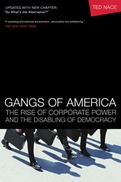
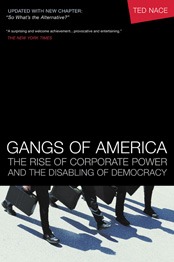
  • Just as Fast Food Nation revealed the sordid underside of the fast-food industry, Gangs of America tells the hidden story of how corporations gained their unprecedented power --- and what it means for you
  • Written in an accessible, personable style that reflects the author's unique background as both a successful businessman and an engaged activist

The corporation has become the core institution of the modern world. Designed to seek profit and power, it has pursued both with endless tenacity, steadily bending the framework of law and even challenging the sovereign status of the state. Where did the corporation come from? How did it get so much power? What is its ultimate trajectory?

After he sold his successful computer book publishing business to a large corporation, Ted Nace felt increasingly driven to find answers to these questions. In Gangs of America he details the rise of corporate power in America through a series of fascinating stories, each organized around a different facet of the central question: "How did corporations get more rights than people?" Beginning with the origin of the corporation in medieval Great Britain, Nace traces both the events that shaped the evolution of corporate power and the colorful personalities who played major roles. Gangs of America is a uniquely accessible synthesis of the latest scholarly research, a compelling historical narrative, and a distinctive personal voice.