


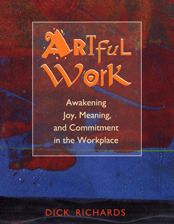
Artful Work
Awakening Joy, Meaning, and Commitment in the Workplace
Dick Richards (Author)
Publication date: 02/01/1995
Work and art are not, as we have come to believe, mutually exclusive. The industrial revolution, it can be said, drove art out of work. Our new-found ability for mass production robbed workers of their art, forcing them to find "jobs." Work quickly came to be viewed as something we do to survive and art merely something to hang on our walls. The reward for work became extrinsic rather than intrinsic. Instead of pursuing joy within work, we began to pursue it in leisure and in the external rewards of employment.
In Artful Work, Dick Richards reminds us that all work can be artful, and that artfulness is the key to passion and commitment. He applies the assumptions of artists about work and life to the challenges facing people and organizations in today's rapidly changing world. This book provides a new perspective on those challenges that is both practical and visionary, singing a provocative new tune for those journeying to make work more meaningful and joyful, and organizations more committed to their purposes. Readers will learn to take an inspired approach to their work, renewing their experience of it as a creative, participative, and purposeful endeavor.
There are seven basic assumptions of the concept of Artful Work:
o All Work Can Be Artful
o The Reward for Artful Work Is In the Doing
o The Ambition of Artful Work Is Joy
o All Work Is Spiritual Work
o Artistry Demands That the Artist Own the Work Process
o Artful Work Requires Consistent and Conscious Use of the Self
o As the Artist Makes the Work, the Work Makes the Artist
Artful Work sets forth an entirely new way of thinking about all of the work we do, and the organizations that contain our work. It offers a compelling guide to honoring artistry in our work, organizations, and leadership roles, and creating workplaces that truly honor our passion. It speaks to the courageous and hopeful among us who seek to make our work and workplaces more joyful and productive.
- Applies an artistic perspective to the challenges facing people and organizations today
- Shows how to bring all four human energies-physical, intellectual, emotional, and spiritual-together in our workplaces
Find out more about our Bulk Buyer Program
- 10-49: 20% discount
- 50-99: 35% discount
- 100-999: 38% discount
- 1000-1999: 40% discount
- 2000+ Contact Leslie Davis ( [email protected] )
Work and art are not, as we have come to believe, mutually exclusive. The industrial revolution, it can be said, drove art out of work. Our new-found ability for mass production robbed workers of their art, forcing them to find "jobs." Work quickly came to be viewed as something we do to survive and art merely something to hang on our walls. The reward for work became extrinsic rather than intrinsic. Instead of pursuing joy within work, we began to pursue it in leisure and in the external rewards of employment.
In Artful Work, Dick Richards reminds us that all work can be artful, and that artfulness is the key to passion and commitment. He applies the assumptions of artists about work and life to the challenges facing people and organizations in today's rapidly changing world. This book provides a new perspective on those challenges that is both practical and visionary, singing a provocative new tune for those journeying to make work more meaningful and joyful, and organizations more committed to their purposes. Readers will learn to take an inspired approach to their work, renewing their experience of it as a creative, participative, and purposeful endeavor.
There are seven basic assumptions of the concept of Artful Work:
o All Work Can Be Artful
o The Reward for Artful Work Is In the Doing
o The Ambition of Artful Work Is Joy
o All Work Is Spiritual Work
o Artistry Demands That the Artist Own the Work Process
o Artful Work Requires Consistent and Conscious Use of the Self
o As the Artist Makes the Work, the Work Makes the Artist
Artful Work sets forth an entirely new way of thinking about all of the work we do, and the organizations that contain our work. It offers a compelling guide to honoring artistry in our work, organizations, and leadership roles, and creating workplaces that truly honor our passion. It speaks to the courageous and hopeful among us who seek to make our work and workplaces more joyful and productive.
- Applies an artistic perspective to the challenges facing people and organizations today
- Shows how to bring all four human energies-physical, intellectual, emotional, and spiritual-together in our workplaces