



Download PDF Excerpt
Rights Information
ISBNs
Paperback 9781576754252
ePub 9781605093161
PDF eBook 9781576755150
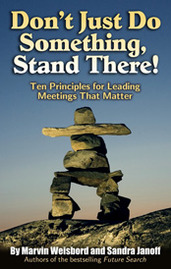
Don't Just Do Something, Stand There!
Ten Principles for Leading Meetings that Matter
Marvin Weisbord (Author) | Sandra Janoff (Author)
Publication date: 07/16/2007

Presents often contrarian insights into how to design meetings that actually accomplish something
Filled with case examples and exercises
Draws on the authors' decades of experience working with businesses, nonprofits, and government agencies worldwide
This practical guide details ten key principles that will profoundly change the way you think about, organize, and lead the meetings that matter most. Rather than trying to change anyone's behavior, Weisbord and Janoff show you how to change the conditions under which people interact. By doing less, you help others do more. With examples from around the world, and practical tips and exercises in every chapter, Don't Just Do Something, Stand There! gives you many new techniques for helping people discover common ground, make productive use of dissension, and take responsibility for action.
- Presents often contrarian insights into how to design meetings that actually accomplish something
- Filled with case examples and exercises
- Draws on the authors' decades of experience working with businesses, nonprofits, and government agencies worldwide
Formats
Paperback - $26.95 - Members: $24.26
Paperback - $26.95 - Members: $24.26
ePub - $26.95 - Members: $18.87
PDF eBook - $26.95 - Members: $18.87
Quantity
Find out more about our Bulk Buyer Program
- 10-49: 20% discount
- 50-99: 35% discount
- 100-999: 38% discount
- 1000-1999: 40% discount
- 2000+ Contact Leslie Davis ( [email protected] )
Orders of 10+ copies shipping to one address receive free ground shipping
within the U.S. Shipping to separate individual addresses via USPS media mail will be applied a handling fee:
Book Details
Overview
Presents often contrarian insights into how to design meetings that actually accomplish something
Filled with case examples and exercises
Draws on the authors' decades of experience working with businesses, nonprofits, and government agencies worldwide
This practical guide details ten key principles that will profoundly change the way you think about, organize, and lead the meetings that matter most. Rather than trying to change anyone's behavior, Weisbord and Janoff show you how to change the conditions under which people interact. By doing less, you help others do more. With examples from around the world, and practical tips and exercises in every chapter, Don't Just Do Something, Stand There! gives you many new techniques for helping people discover common ground, make productive use of dissension, and take responsibility for action.
- Presents often contrarian insights into how to design meetings that actually accomplish something
- Filled with case examples and exercises
- Draws on the authors' decades of experience working with businesses, nonprofits, and government agencies worldwide
About the Authors
Marvin Weisbord (Author)
Marvin Weisbord consulted with business firms, medical schools, and hospitals from 1969 to 1992. He was a partner in the consulting firm Block Petrella Weisbord for 20 years and is a fellow of the World Academy of Productivity Science. Productive Workplaces (2012), now in its third edition, is considered a classic. He also authored Organizational Diagnosis (1978) and Discovering Common Ground (1992).
He is co-director, along with Sandra Janoff, of Future Search Network (formerly SearchNet), an international non-profit dedicated to community service, colleagueship, and learning. For more information, please visit www.futuresearch.net.
Sandra Janoff (Author)
Sandra Janoff, Ph.D., is an international consultant, psychologist, and coauthor, with Marvin Weisbord, of Future Search: An Action Guide. Weisbord and Janoff are co-directors of the Future Search Network, a global volunteer service collaborative.
Excerpt
Making Every Meeting Matter
I want to see progress . . . or it is a waste of time. But that
isn't the meeting's fault. That is the fault of the person calling
and leading the meeting.
—DARIN HAMER, IT professional, Topeka, Kansas (2006)
Our purpose in writing this book is to help you become more effective in the world through the meetings you lead. You will have a chance to master a few simple practices to enhance whatever works for you now. You will learn to recognize procedures that no longer get results. Above all, you will come face to face with the assumptions you make about meetings. If you are going through the motions anyway, why perpetuate cynicism when you can succeed every time?
If you adopt our principles, you will become fanatical about make-or-break matters like matching participants to purposes; and you will manage the daylights out of mundane matters like time frames, rooms, and seating. You also will develop a new awareness of key factors few people notice. You'll pay more attention, for example, to the emergence of informal subgroups that can derail your meeting in an eye blink. You'll become more aware of what people expect from leaders and of the demands you make on yourself.
What you will not do is fret over people's motives, attitudes, and personal quirks. In other words, instead of managing other people's behavior, you will manage structure-the conditions under which people interact. The only individual you will seek to manage is you.
We began switching our focus from behavior to structure many years ago. Early in our careers, we noticed some recurring patterns that defeated our aspirations for engagement, outcomes, and follow-up. We found, for example, that the “wrong people” often were in the room. Among them they lacked the expertise, authority, or information to act. That's a structural phenomenon certain to alienate even those with the best intentions. People grew sick and tired of adding more meetings to their calendars. For those who had to show up anyway, we turned ourselves inside out dealing with skepticism at the expense of action. We found it easy to diagnose bad behavior. While diagnosis brings with it the heady illusion of control, most people can't be fixed, no matter how many prescriptions you write. People did, however, fix themselves when we changed the conditions under which they interacted.
We believe that structure becomes more critical the greater the range of differences in the room. If you treat differences as a problem crying for resolution, you undertake an anxious hunt for an elusive quarry. Differences— few of us like them—often divert people from doing their best. Think of difference as a fact of life you can learn to live with. Think of structure as a menu of choices you have for providing people opportunities to take responsibility.
In managing diverse groups, we realized as we crossed cultural boundaries that we could no longer diagnose individual or group needs. We had to learn how to honor differences while building on what people have in common, in particular-the indisputable validity (for every person) of their own experience.
Paradoxically, when you emphasize structure rather than behavior, you may be at your best in situations you once dreaded. You will come to see different worldviews, assumptions, and stereotypes as normal. Perhaps the most liberating discovery we have made is how to enhance a diverse group's capability for action by accepting rather than fixing anybody's shortcomings. If you train yourself to work with people the way they are, you will free yourself from endless suffering.
You will become more effective in two ways.
First, you will pay more attention to organizing meetings based on purposes. You will discover the increased capability of those involved to reach goals they once thought unreachable.
Second, you will develop keener instincts for when you need to shift structure and when you don't. As your capability grows for letting people find their own voices, so will your self-confidence in handling new situations no matter what a group chooses to do.
HOW WE CAME TO WRITE THIS BOOK
When a cat chases its tail, success always hurts more than failure. Early in our careers each of us acquired a repertoire essential to our work-for goal setting, team building, problem solving, visioning, strategic planning, conflict management, and self-awareness. We had the unusual privilege of working with many pioneers of group effectiveness. They created a rich storehouse of methods that influenced generations of practitioners.
A Legacy—Ours and Yours
We trace our influences back to the first study ever to document the notable differences among democratic, autocratic, and laissez-faire leaders (Lewin, Lippitt, & White, 1939). This research with young boys doing arts and crafts projects opened up a new vista for action that came to be called “group dynamics.”
The practices we advocate were inspired by Ronald Lippitt and Eric Trist, among the founders, respectively, of National Training Laboratories (NTL Institute) in the United States and The Tavistock Institute of Human Relations in Great Britain, and their collaborators Eva Schindler-Rainman and Fred Emery; John Weir (1975) and Joyce Weir, pioneers of personal growth laboratories in “Self-Differentiation”; Yvonne Agazarian (1997), developer of a “Theory of Living Human Systems” of functional subgrouping; Claes Janssen (2005), creator of the “four-room apartment” model of personal and group development; Paul Lawrence, who with Jay Lorsch (Lawrence & Lorsch, 1967) showed how differentiation/integration theory applies to organizations; and the late Gunnar Hjelholt (Madsen & Willert, 2006), a Danish social scientist who inspired us to connect meetings to larger purposes that help people transcend their differences.
To this wonderful legacy we quickly appended more techniques and variations like a cat spinning ever-faster toward its elusive goal. As the world grew more diverse and the pace of change went ballistic, we lined our bookshelves with more methods than we could use in two lifetimes. We were managing our own anxiety by creating higher hurdles, believing that the bigger the tool kit, the better carpenters we would be. By the late 1980s, we realized we would never have at our fingertips the right procedure for all the variations on culture and personal style that we ran into. Nobody could devise all-purpose hammers fast enough to bang away at the emerging multiple dilemmas of escalating complexity. The only way to exit this obstacle course was to stop chasing techniques.
Image
RETHINKING EVERYTHING
Thus, we began a transition that took some years. We decided that if the goals were too big for the people, we would not run the meeting. We began turning down requests to squeeze a day's worth of work into 2 hours. We pared down our repertoire to a few structural procedures nearly anybody could follow. We determined to manage meetings in such a way that people could use the experience, skills, and aspirations they already had. Thus, action would be inevitable unless people consciously chose not to act. We adopted a theory about when to jump in and when to just stand there. We committed to a philosophy based on accepting people as we found them, not as we wished them to be.
Along the way, we poured our early experiences into a strategic planning book we called Future Search (Weisbord & Janoff, 2000). There we told how we dropped one by one most of the meeting procedures we once relied on. Some of our changes were heretical. We did away with hallowed concepts like conflict management and priority setting. For these we substituted common ground (agreement by all) and voting-with-your-feet (setting priorities based on willing actors rather than good ideas). We focused on dialogue—having all views heard without needing to act on them. We became alert to those moments when people might scapegoat one another with careless comments, diverting everybody from the task.
We dropped labels like “resistance” and “defensiveness,” choosing instead to see people doing their best with what they had. We stopped listing problems as the first step, building instead toward a comprehensive picture of the whole and a preferred future before deciding what needed to be done. We stopped asking what went wrong and how to fix it. Instead, we substituted “What are the possibilities here, and who cares?”
Managing large groups of dozens or hundreds, we made our unit of change the capacity of the whole for action, not the satisfaction of each person's needs or the perfection of every small group's process skills. We encouraged breakout groups to self-manage, precluding the need to have them led by expert facilitators. We stopped assuming that people who said nothing supported the goals and decisions. We paid the most attention to those critical moments when groups were at risk of fragmenting, fighting, or running away.
Under these conditions, people got more done in less time and with greater satisfaction than they ever did when we tried to manage all the details ourselves. The less we did, the more others took over. They did not need to be coaxed into action or provided with complex follow-up strategies. We never tried to change anybody. What we changed were the conditions under which people met. To our surprise, the more we practiced structural change, the better people managed their relationships. Changing a meeting's structure, we found, was the shortcut for people wanting to change their own behavior.
LEARNING TO STAND THERE
Most of all, we changed ourselves. We let go needing to have all the answers, figure out each group's problems and blockages, and keep everybody happy all the time. We taught ourselves to act less and pay attention more. Ours became an alert form of “just standing there,” observing, listening, and inviting people to say what was on their minds without prompting them to be positive, negative, or any way except the way they chose to be.
Recently our friend Dawn Rieken gave us a wonderful description of this way of being-quiet on the outside, active inside. Active on the inside is what we are most of the time. The trick is to change the inner dialogue from anxiety to observing without having to fix everything. Instead, we rely on a theory about what it takes for people to manage themselves. Our theory, which we will get to in a moment, is our security blanket.
There are times, however, when people want to fight or flee the goals, the task, the problem, or decision. At those moments we become visibly active. We move in, saying and doing the least that will interrupt a potential fight, clarify an elusive goal, or pose a choice. In those moments, we learned, we are at our best when we can contain our own anxiety and quiet ourselves inside.
In short, when people work the task, we do nothing overt. When they put themselves at risk of fighting or running away, we calm ourselves and become as active as we need to be to get the meeting back on track.
DISCOVERING DIFFERENTIATION/ INTEGRATION THEORY
Early in our collaboration, we had a rewarding “aha” that made possible this book. Each of us, Sandra in education and psychology, Marv in business and organizational consulting, had relied on versions of the same structural theory. We both were applying differentiation/integration (D/I) theory to our work with students, clients, and even ourselves. This is not to say that we had the legendary “all-purpose hammer.” A theory is not a method. It's a way of interpreting reality that helps you act with more certainty. D/I theory helped us make sense of puzzling complexities in a world of increasing diversity, multiple agendas, and nonstop change. For what we aspired to do, that was quite enough.
D/I Defined
Noah Webster's big dictionary says that differentiating means “to distinguish and classify”-that is, to group similar things together. It also can mean to “isolate, ostracize and segregate.” Likewise, integrating has two faces. In a positive sense, it means “to make one or harmonize”; in the negative, “to centralize and orchestrate.”
To become better meeting leaders, we decided our challenge was to help people differentiate their stakes without excluding anybody and integrate their goals without our forcing unity. Moreover, we came to understand that unless people differentiate their stakes, they are unlikely to act together. Wanting harmony, wholeness, cooperation, and shared goals, we had to start by validating differences. Seeking integrated action, we could not avoid polarities. We had to learn to make them legitimate.
Key D/I Principles
D/I theory has a long history in biology, mathematics, social psychology, and developmental psychology. To begin at the beginning, D/I applies to your earliest moments on Earth. You started life as a single cell that divided and subdivided. Your cells evolved to perform different functions—a beating heart, a thinking brain, a digestive system, each unique in purpose and structure, integrated into a one-of-a-kind working model of a human being.
The organizational analogies should be obvious. Imagine a company that exists to deliver any product or service. Its functions could include research and development, manufacturing, sales, and information systems. They are differentiated, each with its own structural needs. None can accomplish the mission alone. They are faced with a tricky D/I task: holding onto their differences and integrating toward a result bigger than any of them. They cannot afford to act in ways that deny the necessity of each.
Our job as leaders/managers/facilitators is to set things up so that people can accept their differences and integrate their capabilities for the good of all. Making the leap from “D” to “I” is at the core of effective meeting management.
Many Practical Uses
In this book, we show you some of the many practical applications of D/I theory that we have made. You can use it to understand why some systems function better than others. You can use it when you plan a meeting, figuring out who to invite and how to use “breakout” groups. From D/I theory, you can derive practical procedures for handling conflict, reaching decisions, and implementing action plans. The first time you apply it, you may come to appreciate key meeting dynamics that were not on your radar screen. You will learn more about when to keep quiet, when to speak, and what to say. You'll be able to prove to yourself that a few simple actions can keep groups working in the face of inevitable differences.
Nor is this all. From D/I theory, you will gain insight into your own potential for personal growth. You will learn to use it as a lens for your own projections, helping you contain your anxiety in new situations. You will be in a better position to avoid exchanges that “hook” you into responding in ways you later regret. In short, D/I theory will help you gain a new measure of influence over any system. We intend to make the journey easy and illuminating for you.
HOW THE BOOK IS ORGANIZED
This book has two parts, “Leading Meetings” and “Managing Yourself.” In each chapter, we show you the D/I rationale, give examples of effective action, and suggest things for you to try and pitfalls to avoid.
Part One, “Leading Meetings,” covers six principles. “Get the Whole System in the Room” (Principle 1) may change forever the way you organize meetings when fast, committed action is called for. Here we show you how to put those with authority, resources, expertise, information, and need in the same conversation. Whether they act or not, they cannot avoid responsibility.
“Control What You Can, Let Go What You Can't” (Principle 2) offers guidance on how you can optimize output by managing a meeting's boundaries-its purposes, time frames, meeting conditions, list of invitees, working group size, shifting coalitions, agenda, and spectrum of views.
“Explore the ‘Whole Elephant'” (Principle 3) can save you endless time and the misunderstandings that occur when people leap into problem solving and talk past one another. We show you ways to look at all aspects of a situation before acting on any one part.
“Let People Be Responsible” (Principle 4) provides you with a key philosophical perspective that will help you manage meetings without feeling the pressure to diagnose group norms or to “pysch out” people's motives as a condition for building commitment.
“Find Common Ground” (Principle 5) offers advice on helping people discover values, ideals, and purposes shared by everyone present regardless of differences. We suggest a new approach to problems and conflicts when common ground is your goal. We treat them as information rather than action items, getting them into the open, validating them, and moving on without resolving them.
“Master the Art of Subgrouping” (Principle 6) will put into your hands a little-known structural method that keeps groups whole, on task, and open to new ideas. You will learn to tell the difference between functional subgroups and those based on stereotypes and how to use informal subgroups to head off conflict.
Part Two, “Managing Yourself,” contains four principles to help you make yourself a better leader. We write about the benefits of mastering them and some ways to practice the new behavior implied by “just standing there.”
“Make Friends with Anxiety” (Principle 7) redefines an unpleasant dynamic as “blocked excitement.” You will learn the benefits and procedures for containing anxiety in yourself and in a group, turning it to creative action.
“Get Used to Projections” (Principle 8) presents a practical, albeit unusual, program for managing yourself. We will help you accept your “projections,” the loved and hated parts of yourself that you find reflected in other people. The more parts you know, the greater the variety of human beings you can work with. This is a key step to not “taking it personally,” that facile advice we give ourselves, often to no avail. We will show you how to use this awareness to ease your path when working with diverse groups whose members are projecting onto you and each other.
“Be a Dependable Authority” (Principle 9) differentiates the authority that leadership confers from authoritarian behavior. One pitfall we will help you avoid is responding inappropriately when other people project their concerns onto you, making you the (unwitting) stand-in for parents, teachers, bosses, siblings, and others they may have once idolized or loathed.
“Learn to Say No If You Want Yes to Mean Something” (Principle 10) provides support for a vastly underrated skill-saying no to unrealistic requests and expectations for “outcomes” and “deliverables” any time you suspect them to be unreachable.
In the conclusion, “Changing the World One Meeting at a Time,” we summarize some of the benefits of the philosophy, theory, and practices we have presented. Also included is a bibliography of all referenced authors.
I want to see progress . . . or it is a waste of time. But that
isn't the meeting's fault. That is the fault of the person calling
and leading the meeting.
—DARIN HAMER, IT professional, Topeka, Kansas (2006)
Our purpose in writing this book is to help you become more effective in the world through the meetings you lead. You will have a chance to master a few simple practices to enhance whatever works for you now. You will learn to recognize procedures that no longer get results. Above all, you will come face to face with the assumptions you make about meetings. If you are going through the motions anyway, why perpetuate cynicism when you can succeed every time?
If you adopt our principles, you will become fanatical about make-or-break matters like matching participants to purposes; and you will manage the daylights out of mundane matters like time frames, rooms, and seating. You also will develop a new awareness of key factors few people notice. You'll pay more attention, for example, to the emergence of informal subgroups that can derail your meeting in an eye blink. You'll become more aware of what people expect from leaders and of the demands you make on yourself.
What you will not do is fret over people's motives, attitudes, and personal quirks. In other words, instead of managing other people's behavior, you will manage structure-the conditions under which people interact. The only individual you will seek to manage is you.
We began switching our focus from behavior to structure many years ago. Early in our careers, we noticed some recurring patterns that defeated our aspirations for engagement, outcomes, and follow-up. We found, for example, that the “wrong people” often were in the room. Among them they lacked the expertise, authority, or information to act. That's a structural phenomenon certain to alienate even those with the best intentions. People grew sick and tired of adding more meetings to their calendars. For those who had to show up anyway, we turned ourselves inside out dealing with skepticism at the expense of action. We found it easy to diagnose bad behavior. While diagnosis brings with it the heady illusion of control, most people can't be fixed, no matter how many prescriptions you write. People did, however, fix themselves when we changed the conditions under which they interacted.
We believe that structure becomes more critical the greater the range of differences in the room. If you treat differences as a problem crying for resolution, you undertake an anxious hunt for an elusive quarry. Differences— few of us like them—often divert people from doing their best. Think of difference as a fact of life you can learn to live with. Think of structure as a menu of choices you have for providing people opportunities to take responsibility.
In managing diverse groups, we realized as we crossed cultural boundaries that we could no longer diagnose individual or group needs. We had to learn how to honor differences while building on what people have in common, in particular-the indisputable validity (for every person) of their own experience.
Paradoxically, when you emphasize structure rather than behavior, you may be at your best in situations you once dreaded. You will come to see different worldviews, assumptions, and stereotypes as normal. Perhaps the most liberating discovery we have made is how to enhance a diverse group's capability for action by accepting rather than fixing anybody's shortcomings. If you train yourself to work with people the way they are, you will free yourself from endless suffering.
You will become more effective in two ways.
First, you will pay more attention to organizing meetings based on purposes. You will discover the increased capability of those involved to reach goals they once thought unreachable.
Second, you will develop keener instincts for when you need to shift structure and when you don't. As your capability grows for letting people find their own voices, so will your self-confidence in handling new situations no matter what a group chooses to do.
HOW WE CAME TO WRITE THIS BOOK
When a cat chases its tail, success always hurts more than failure. Early in our careers each of us acquired a repertoire essential to our work-for goal setting, team building, problem solving, visioning, strategic planning, conflict management, and self-awareness. We had the unusual privilege of working with many pioneers of group effectiveness. They created a rich storehouse of methods that influenced generations of practitioners.
A Legacy—Ours and Yours
We trace our influences back to the first study ever to document the notable differences among democratic, autocratic, and laissez-faire leaders (Lewin, Lippitt, & White, 1939). This research with young boys doing arts and crafts projects opened up a new vista for action that came to be called “group dynamics.”
The practices we advocate were inspired by Ronald Lippitt and Eric Trist, among the founders, respectively, of National Training Laboratories (NTL Institute) in the United States and The Tavistock Institute of Human Relations in Great Britain, and their collaborators Eva Schindler-Rainman and Fred Emery; John Weir (1975) and Joyce Weir, pioneers of personal growth laboratories in “Self-Differentiation”; Yvonne Agazarian (1997), developer of a “Theory of Living Human Systems” of functional subgrouping; Claes Janssen (2005), creator of the “four-room apartment” model of personal and group development; Paul Lawrence, who with Jay Lorsch (Lawrence & Lorsch, 1967) showed how differentiation/integration theory applies to organizations; and the late Gunnar Hjelholt (Madsen & Willert, 2006), a Danish social scientist who inspired us to connect meetings to larger purposes that help people transcend their differences.
To this wonderful legacy we quickly appended more techniques and variations like a cat spinning ever-faster toward its elusive goal. As the world grew more diverse and the pace of change went ballistic, we lined our bookshelves with more methods than we could use in two lifetimes. We were managing our own anxiety by creating higher hurdles, believing that the bigger the tool kit, the better carpenters we would be. By the late 1980s, we realized we would never have at our fingertips the right procedure for all the variations on culture and personal style that we ran into. Nobody could devise all-purpose hammers fast enough to bang away at the emerging multiple dilemmas of escalating complexity. The only way to exit this obstacle course was to stop chasing techniques.
Image
RETHINKING EVERYTHING
Thus, we began a transition that took some years. We decided that if the goals were too big for the people, we would not run the meeting. We began turning down requests to squeeze a day's worth of work into 2 hours. We pared down our repertoire to a few structural procedures nearly anybody could follow. We determined to manage meetings in such a way that people could use the experience, skills, and aspirations they already had. Thus, action would be inevitable unless people consciously chose not to act. We adopted a theory about when to jump in and when to just stand there. We committed to a philosophy based on accepting people as we found them, not as we wished them to be.
Along the way, we poured our early experiences into a strategic planning book we called Future Search (Weisbord & Janoff, 2000). There we told how we dropped one by one most of the meeting procedures we once relied on. Some of our changes were heretical. We did away with hallowed concepts like conflict management and priority setting. For these we substituted common ground (agreement by all) and voting-with-your-feet (setting priorities based on willing actors rather than good ideas). We focused on dialogue—having all views heard without needing to act on them. We became alert to those moments when people might scapegoat one another with careless comments, diverting everybody from the task.
We dropped labels like “resistance” and “defensiveness,” choosing instead to see people doing their best with what they had. We stopped listing problems as the first step, building instead toward a comprehensive picture of the whole and a preferred future before deciding what needed to be done. We stopped asking what went wrong and how to fix it. Instead, we substituted “What are the possibilities here, and who cares?”
Managing large groups of dozens or hundreds, we made our unit of change the capacity of the whole for action, not the satisfaction of each person's needs or the perfection of every small group's process skills. We encouraged breakout groups to self-manage, precluding the need to have them led by expert facilitators. We stopped assuming that people who said nothing supported the goals and decisions. We paid the most attention to those critical moments when groups were at risk of fragmenting, fighting, or running away.
Under these conditions, people got more done in less time and with greater satisfaction than they ever did when we tried to manage all the details ourselves. The less we did, the more others took over. They did not need to be coaxed into action or provided with complex follow-up strategies. We never tried to change anybody. What we changed were the conditions under which people met. To our surprise, the more we practiced structural change, the better people managed their relationships. Changing a meeting's structure, we found, was the shortcut for people wanting to change their own behavior.
LEARNING TO STAND THERE
Most of all, we changed ourselves. We let go needing to have all the answers, figure out each group's problems and blockages, and keep everybody happy all the time. We taught ourselves to act less and pay attention more. Ours became an alert form of “just standing there,” observing, listening, and inviting people to say what was on their minds without prompting them to be positive, negative, or any way except the way they chose to be.
Recently our friend Dawn Rieken gave us a wonderful description of this way of being-quiet on the outside, active inside. Active on the inside is what we are most of the time. The trick is to change the inner dialogue from anxiety to observing without having to fix everything. Instead, we rely on a theory about what it takes for people to manage themselves. Our theory, which we will get to in a moment, is our security blanket.
There are times, however, when people want to fight or flee the goals, the task, the problem, or decision. At those moments we become visibly active. We move in, saying and doing the least that will interrupt a potential fight, clarify an elusive goal, or pose a choice. In those moments, we learned, we are at our best when we can contain our own anxiety and quiet ourselves inside.
In short, when people work the task, we do nothing overt. When they put themselves at risk of fighting or running away, we calm ourselves and become as active as we need to be to get the meeting back on track.
DISCOVERING DIFFERENTIATION/ INTEGRATION THEORY
Early in our collaboration, we had a rewarding “aha” that made possible this book. Each of us, Sandra in education and psychology, Marv in business and organizational consulting, had relied on versions of the same structural theory. We both were applying differentiation/integration (D/I) theory to our work with students, clients, and even ourselves. This is not to say that we had the legendary “all-purpose hammer.” A theory is not a method. It's a way of interpreting reality that helps you act with more certainty. D/I theory helped us make sense of puzzling complexities in a world of increasing diversity, multiple agendas, and nonstop change. For what we aspired to do, that was quite enough.
D/I Defined
Noah Webster's big dictionary says that differentiating means “to distinguish and classify”-that is, to group similar things together. It also can mean to “isolate, ostracize and segregate.” Likewise, integrating has two faces. In a positive sense, it means “to make one or harmonize”; in the negative, “to centralize and orchestrate.”
To become better meeting leaders, we decided our challenge was to help people differentiate their stakes without excluding anybody and integrate their goals without our forcing unity. Moreover, we came to understand that unless people differentiate their stakes, they are unlikely to act together. Wanting harmony, wholeness, cooperation, and shared goals, we had to start by validating differences. Seeking integrated action, we could not avoid polarities. We had to learn to make them legitimate.
Key D/I Principles
D/I theory has a long history in biology, mathematics, social psychology, and developmental psychology. To begin at the beginning, D/I applies to your earliest moments on Earth. You started life as a single cell that divided and subdivided. Your cells evolved to perform different functions—a beating heart, a thinking brain, a digestive system, each unique in purpose and structure, integrated into a one-of-a-kind working model of a human being.
The organizational analogies should be obvious. Imagine a company that exists to deliver any product or service. Its functions could include research and development, manufacturing, sales, and information systems. They are differentiated, each with its own structural needs. None can accomplish the mission alone. They are faced with a tricky D/I task: holding onto their differences and integrating toward a result bigger than any of them. They cannot afford to act in ways that deny the necessity of each.
Our job as leaders/managers/facilitators is to set things up so that people can accept their differences and integrate their capabilities for the good of all. Making the leap from “D” to “I” is at the core of effective meeting management.
Many Practical Uses
In this book, we show you some of the many practical applications of D/I theory that we have made. You can use it to understand why some systems function better than others. You can use it when you plan a meeting, figuring out who to invite and how to use “breakout” groups. From D/I theory, you can derive practical procedures for handling conflict, reaching decisions, and implementing action plans. The first time you apply it, you may come to appreciate key meeting dynamics that were not on your radar screen. You will learn more about when to keep quiet, when to speak, and what to say. You'll be able to prove to yourself that a few simple actions can keep groups working in the face of inevitable differences.
Nor is this all. From D/I theory, you will gain insight into your own potential for personal growth. You will learn to use it as a lens for your own projections, helping you contain your anxiety in new situations. You will be in a better position to avoid exchanges that “hook” you into responding in ways you later regret. In short, D/I theory will help you gain a new measure of influence over any system. We intend to make the journey easy and illuminating for you.
HOW THE BOOK IS ORGANIZED
This book has two parts, “Leading Meetings” and “Managing Yourself.” In each chapter, we show you the D/I rationale, give examples of effective action, and suggest things for you to try and pitfalls to avoid.
Part One, “Leading Meetings,” covers six principles. “Get the Whole System in the Room” (Principle 1) may change forever the way you organize meetings when fast, committed action is called for. Here we show you how to put those with authority, resources, expertise, information, and need in the same conversation. Whether they act or not, they cannot avoid responsibility.
“Control What You Can, Let Go What You Can't” (Principle 2) offers guidance on how you can optimize output by managing a meeting's boundaries-its purposes, time frames, meeting conditions, list of invitees, working group size, shifting coalitions, agenda, and spectrum of views.
“Explore the ‘Whole Elephant'” (Principle 3) can save you endless time and the misunderstandings that occur when people leap into problem solving and talk past one another. We show you ways to look at all aspects of a situation before acting on any one part.
“Let People Be Responsible” (Principle 4) provides you with a key philosophical perspective that will help you manage meetings without feeling the pressure to diagnose group norms or to “pysch out” people's motives as a condition for building commitment.
“Find Common Ground” (Principle 5) offers advice on helping people discover values, ideals, and purposes shared by everyone present regardless of differences. We suggest a new approach to problems and conflicts when common ground is your goal. We treat them as information rather than action items, getting them into the open, validating them, and moving on without resolving them.
“Master the Art of Subgrouping” (Principle 6) will put into your hands a little-known structural method that keeps groups whole, on task, and open to new ideas. You will learn to tell the difference between functional subgroups and those based on stereotypes and how to use informal subgroups to head off conflict.
Part Two, “Managing Yourself,” contains four principles to help you make yourself a better leader. We write about the benefits of mastering them and some ways to practice the new behavior implied by “just standing there.”
“Make Friends with Anxiety” (Principle 7) redefines an unpleasant dynamic as “blocked excitement.” You will learn the benefits and procedures for containing anxiety in yourself and in a group, turning it to creative action.
“Get Used to Projections” (Principle 8) presents a practical, albeit unusual, program for managing yourself. We will help you accept your “projections,” the loved and hated parts of yourself that you find reflected in other people. The more parts you know, the greater the variety of human beings you can work with. This is a key step to not “taking it personally,” that facile advice we give ourselves, often to no avail. We will show you how to use this awareness to ease your path when working with diverse groups whose members are projecting onto you and each other.
“Be a Dependable Authority” (Principle 9) differentiates the authority that leadership confers from authoritarian behavior. One pitfall we will help you avoid is responding inappropriately when other people project their concerns onto you, making you the (unwitting) stand-in for parents, teachers, bosses, siblings, and others they may have once idolized or loathed.
“Learn to Say No If You Want Yes to Mean Something” (Principle 10) provides support for a vastly underrated skill-saying no to unrealistic requests and expectations for “outcomes” and “deliverables” any time you suspect them to be unreachable.
In the conclusion, “Changing the World One Meeting at a Time,” we summarize some of the benefits of the philosophy, theory, and practices we have presented. Also included is a bibliography of all referenced authors.