



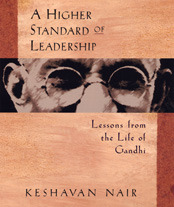
A Higher Standard of Leadership
Lessons from the Life of Gandhi
Keshavan Nair (Author)
Publication date: 12/01/1996
Bestseller over 70,000+ copies sold
o How to embody the values of service, truth, and personal responsibility in leadership roles
o Insights about management, leadership, and purpose from a successful businessman and perceptive student of Gandhi's life and writings
Though Gandhi is one of the most written-about figures of the twentieth century, this is the first book to apply lessons from his life to the practical tasks faced by contemporary leaders-from corporate managers and executives to government administrators, nonprofit professionals, educators, and others.
In times shaped by colonialism, dictatorships, and two World Wars, Gandhi demonstrated that an idealist could also be a practical and effective leader. In our times of increasing cynicism about the quality of leadership we can expect and aspire to, Keshavan Nair reminds us that, "We are all engaged in leadership, in practicing it and selecting those who will lead." In A Higher Standard of Leadership, he offers a pragmatic guide based on the concepts Gandhi exemplified:
o leadership is service, not a path to power and privilege;
o effective goals, decisions, and strategies can be guided by moral principles;
o a single standard of conduct, based on absolute values, should be maintained in both public and private life.
A lifelong student of Gandhi's teachings and a businessman with more than 25 years of experience in corporate and governmental leadership development, Nair is uniquely positioned to bridge the two worlds. Using illustrative examples from Gandhi's life and writings, he identifies commitments-to conscience, openness, service, values, and reduced attachments-and describes the courage and determination necessary to work and lead by them. In simple and direct language, he explores the process of making decisions, setting goals, and implementing actions guided by the spirit of service and commitment to values that is essential to the realization of a higher standard of leadership in our workplaces and communities.
- Shows America's economic system to be at odds with its social and political goals and proposes a system designed to increase personal freedom
- Questions the most basic assumptions that drive our economic system, and argues that its entire structure must be challenged
Find out more about our Bulk Buyer Program
- 10-49: 20% discount
- 50-99: 35% discount
- 100-999: 38% discount
- 1000-1999: 40% discount
- 2000+ Contact ( [email protected] )
o How to embody the values of service, truth, and personal responsibility in leadership roles
o Insights about management, leadership, and purpose from a successful businessman and perceptive student of Gandhi's life and writings
Though Gandhi is one of the most written-about figures of the twentieth century, this is the first book to apply lessons from his life to the practical tasks faced by contemporary leaders-from corporate managers and executives to government administrators, nonprofit professionals, educators, and others.
In times shaped by colonialism, dictatorships, and two World Wars, Gandhi demonstrated that an idealist could also be a practical and effective leader. In our times of increasing cynicism about the quality of leadership we can expect and aspire to, Keshavan Nair reminds us that, "We are all engaged in leadership, in practicing it and selecting those who will lead." In A Higher Standard of Leadership, he offers a pragmatic guide based on the concepts Gandhi exemplified:
o leadership is service, not a path to power and privilege;
o effective goals, decisions, and strategies can be guided by moral principles;
o a single standard of conduct, based on absolute values, should be maintained in both public and private life.
A lifelong student of Gandhi's teachings and a businessman with more than 25 years of experience in corporate and governmental leadership development, Nair is uniquely positioned to bridge the two worlds. Using illustrative examples from Gandhi's life and writings, he identifies commitments-to conscience, openness, service, values, and reduced attachments-and describes the courage and determination necessary to work and lead by them. In simple and direct language, he explores the process of making decisions, setting goals, and implementing actions guided by the spirit of service and commitment to values that is essential to the realization of a higher standard of leadership in our workplaces and communities.
- Shows America's economic system to be at odds with its social and political goals and proposes a system designed to increase personal freedom
- Questions the most basic assumptions that drive our economic system, and argues that its entire structure must be challenged