


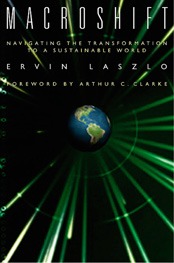
Macroshift
Navigating the Transformation to a Sustainable World
Ervin Laszlo (Author) | Arthur Charles Clarke (Foreword by)
Publication date: 09/01/2001
Bestseller over 20,000+ copies sold
We live in the midst of one of the greatest technological revolutions in history, an era of deep-seated transformation-a macroshift in civilization, says preeminent scholar and futurist Ervin Laszlo. Its signs and manifestations are all around us, from the deadly HIV/AIDS epidemic sweeping Africa and the dangerous fire-trap sweatshops routinely killing workers in Bangladesh, to the environmental havoc created by genetic engineering, power plant pollution and mechanized agriculture. The application of new technologies has turned into a double-edged sword.
The world is growing together in some respects, but is coming apart in others. Worldwide economic globalization, another sign of the macroshift, all too often benefits the few rather than the many. Hundreds of millions live at a higher material standard of living, but thousands of millions are pressed into abject poverty. The richest 20% earn ninety times the income of the poorest 20%, consume eleven times as much energy, and eat eleven times as much meat.
There have been other macroshifts in human history, but they spanned centuries, allowing cultural values, beliefs, and change to occur gradually. Today, technology has reduced our time to adapt; the entire critical period of change is compressed into the lifetime of a generation.
Today's macroshift, explains Laszlo, harbors great promise, as well as grave danger. He outlines two possible scenarios: "The Breakdown," where we choose to drift without a change in our current direction toward chaos, anarchy, and destruction, or "The Breakthrough," where we collectively transform our thinking and behavior to produce creative, sustainable solutions to dangerous global problems. And he shows what each of us can do-politically, professionally, and privately-to bring about the Breakthrough and shape a humane and sustainable global future.
While technology is what drives the unprecedented speed of this macroshift, it is our vision, values, and actions now that will ultimately determine the outcome. The choice is up to us-the power is in our hands.
The world is growing together in some respects, but is coming apart in others. Worldwide economic globalization, another sign of the macroshift, all too often benefits the few rather than the many. Hundreds of millions live at a higher material standard of living, but thousands of millions are pressed into abject poverty. The richest 20% earn ninety times the income of the poorest 20%, consume eleven times as much energy, and eat eleven times as much meat.
There have been other macroshifts in human history, but they spanned centuries, allowing cultural values, beliefs, and change to occur gradually. Today, technology has reduced our time to adapt; the entire critical period of change is compressed into the lifetime of a generation.
Today's macroshift, explains Laszlo, harbors great promise, as well as grave danger. He outlines two possible scenarios: "The Breakdown," where we choose to drift without a change in our current direction toward chaos, anarchy, and destruction, or "The Breakthrough," where we collectively transform our thinking and behavior to produce creative, sustainable solutions to dangerous global problems. And he shows what each of us can do-politically, professionally, and privately-to bring about the Breakthrough and shape a humane and sustainable global future.
While technology is what drives the unprecedented speed of this macroshift, it is our vision, values, and actions now that will ultimately determine the outcome. The choice is up to us-the power is in our hands.
- Foreword by Arthur C. Clarke
- The critical crossroad we face at the threshold of the millennium revealed by one of the world's preeminent futurists
- Comments on today's global crisis and the challenge of change from Thomas Berry, Gary Zukav, Riane Eisler, Edgar Mitchell, and others
- Draws on the author's profound understanding of systems theory to provide practical guidance for shaping and directing our future
Formats
Hardcover - $24.95 - Members: $22.46
Hardcover - $24.95 - Members: $22.46
ePub - $24.95 - Members: $17.47
PDF eBook - $24.95 - Members: $17.47
Find out more about our Bulk Buyer Program
- 10-49: 20% discount
- 50-99: 35% discount
- 100-999: 38% discount
- 1000-1999: 40% discount
- 2000+ Contact Leslie Davis ( [email protected] )
Orders of 10+ copies shipping to one address receive free ground shipping
within the U.S. Shipping to separate individual addresses via USPS media mail will be applied a handling fee:
Book Details
Overview
We live in the midst of one of the greatest technological revolutions in history, an era of deep-seated transformation-a macroshift in civilization, says preeminent scholar and futurist Ervin Laszlo. Its signs and manifestations are all around us, from the deadly HIV/AIDS epidemic sweeping Africa and the dangerous fire-trap sweatshops routinely killing workers in Bangladesh, to the environmental havoc created by genetic engineering, power plant pollution and mechanized agriculture. The application of new technologies has turned into a double-edged sword.
The world is growing together in some respects, but is coming apart in others. Worldwide economic globalization, another sign of the macroshift, all too often benefits the few rather than the many. Hundreds of millions live at a higher material standard of living, but thousands of millions are pressed into abject poverty. The richest 20% earn ninety times the income of the poorest 20%, consume eleven times as much energy, and eat eleven times as much meat.
There have been other macroshifts in human history, but they spanned centuries, allowing cultural values, beliefs, and change to occur gradually. Today, technology has reduced our time to adapt; the entire critical period of change is compressed into the lifetime of a generation.
Today's macroshift, explains Laszlo, harbors great promise, as well as grave danger. He outlines two possible scenarios: "The Breakdown," where we choose to drift without a change in our current direction toward chaos, anarchy, and destruction, or "The Breakthrough," where we collectively transform our thinking and behavior to produce creative, sustainable solutions to dangerous global problems. And he shows what each of us can do-politically, professionally, and privately-to bring about the Breakthrough and shape a humane and sustainable global future.
While technology is what drives the unprecedented speed of this macroshift, it is our vision, values, and actions now that will ultimately determine the outcome. The choice is up to us-the power is in our hands.
The world is growing together in some respects, but is coming apart in others. Worldwide economic globalization, another sign of the macroshift, all too often benefits the few rather than the many. Hundreds of millions live at a higher material standard of living, but thousands of millions are pressed into abject poverty. The richest 20% earn ninety times the income of the poorest 20%, consume eleven times as much energy, and eat eleven times as much meat.
There have been other macroshifts in human history, but they spanned centuries, allowing cultural values, beliefs, and change to occur gradually. Today, technology has reduced our time to adapt; the entire critical period of change is compressed into the lifetime of a generation.
Today's macroshift, explains Laszlo, harbors great promise, as well as grave danger. He outlines two possible scenarios: "The Breakdown," where we choose to drift without a change in our current direction toward chaos, anarchy, and destruction, or "The Breakthrough," where we collectively transform our thinking and behavior to produce creative, sustainable solutions to dangerous global problems. And he shows what each of us can do-politically, professionally, and privately-to bring about the Breakthrough and shape a humane and sustainable global future.
While technology is what drives the unprecedented speed of this macroshift, it is our vision, values, and actions now that will ultimately determine the outcome. The choice is up to us-the power is in our hands.
- Foreword by Arthur C. Clarke
- The critical crossroad we face at the threshold of the millennium revealed by one of the world's preeminent futurists
- Comments on today's global crisis and the challenge of change from Thomas Berry, Gary Zukav, Riane Eisler, Edgar Mitchell, and others
- Draws on the author's profound understanding of systems theory to provide practical guidance for shaping and directing our future
About the Authors
Table of Contents
Excerpt