


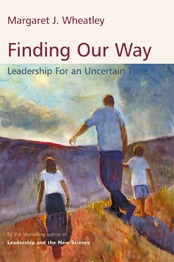
Finding Our Way
Leadership for an Uncertain Time
Margaret Wheatley (Author)
Publication date: 02/13/2007
Bestseller over 60,000+ copies sold
For years, Margaret Wheatley has written eloquently about humanizing our organizations and helping people to work together more effectively and compassionately. She has shown how breakthroughs in chaos theory and quantum physics can enable organizations to function more like responsive, self-organizing living systems, rather than cold mechanisms of control. And she has gradually expanded these ideas into the wider arena of human society.
In short, Margaret Wheatley is one of the most innovative and influential organizational thinkers of our time, and Finding Our Way brings together her shorter writings for the first time, touching on all the topics she has addressed throughout her career, showing how she has applied the ideas in her books s in many different situations. “The pieces presented here”, she writes, “represent ten years of work, of how I took the ideas in my books and applied them in practice in many different situations. However, this is not a collection of articles. I updated, revised, or substantially added to the original content of each one. In this way, everything written here represents my current views on the subjects I write about.”
Provocative, challenging, at times poetic, and often deeply moving, Finding Our Way sums up Wheatley's thinking on a diverse scope of topics from leadership and management to education and raising children in turbulent times; from societal commentary to specific organizational techniques and more.
In short, Margaret Wheatley is one of the most innovative and influential organizational thinkers of our time, and Finding Our Way brings together her shorter writings for the first time, touching on all the topics she has addressed throughout her career, showing how she has applied the ideas in her books s in many different situations. “The pieces presented here”, she writes, “represent ten years of work, of how I took the ideas in my books and applied them in practice in many different situations. However, this is not a collection of articles. I updated, revised, or substantially added to the original content of each one. In this way, everything written here represents my current views on the subjects I write about.”
Provocative, challenging, at times poetic, and often deeply moving, Finding Our Way sums up Wheatley's thinking on a diverse scope of topics from leadership and management to education and raising children in turbulent times; from societal commentary to specific organizational techniques and more.
- By the author of the bestsellers Leadership and the New Science (over 300,000 copies sold) and Turning to One Another, and the coauthor of A Simpler Way
- Wheatley is one of the most innovative and influential organizational thinkers of our time, and this is the first collection of her articles and essays--completely revised and rewritten for this volume
- Covers a wide and diverse scope of topics--leadership, management, education, parenting, social commentary, creativity, spirituality, and more
Formats
ePub - $21.95 - Members: $15.37
ePub - $21.95 - Members: $15.37
PDF eBook - $21.95 - Members: $15.37
Paperback - $21.95 - Members: $19.76
Hardcover - $50.95 - Members: $45.86
Find out more about our Bulk Buyer Program
- 10-49: 20% discount
- 50-99: 35% discount
- 100-999: 38% discount
- 1000-1999: 40% discount
- 2000+ Contact Leslie Davis ( [email protected] )
Orders of 10+ copies shipping to one address receive free ground shipping
within the U.S. Shipping to separate individual addresses via USPS media mail will be applied a handling fee:
Book Details
Overview
For years, Margaret Wheatley has written eloquently about humanizing our organizations and helping people to work together more effectively and compassionately. She has shown how breakthroughs in chaos theory and quantum physics can enable organizations to function more like responsive, self-organizing living systems, rather than cold mechanisms of control. And she has gradually expanded these ideas into the wider arena of human society.
In short, Margaret Wheatley is one of the most innovative and influential organizational thinkers of our time, and Finding Our Way brings together her shorter writings for the first time, touching on all the topics she has addressed throughout her career, showing how she has applied the ideas in her books s in many different situations. “The pieces presented here”, she writes, “represent ten years of work, of how I took the ideas in my books and applied them in practice in many different situations. However, this is not a collection of articles. I updated, revised, or substantially added to the original content of each one. In this way, everything written here represents my current views on the subjects I write about.”
Provocative, challenging, at times poetic, and often deeply moving, Finding Our Way sums up Wheatley's thinking on a diverse scope of topics from leadership and management to education and raising children in turbulent times; from societal commentary to specific organizational techniques and more.
In short, Margaret Wheatley is one of the most innovative and influential organizational thinkers of our time, and Finding Our Way brings together her shorter writings for the first time, touching on all the topics she has addressed throughout her career, showing how she has applied the ideas in her books s in many different situations. “The pieces presented here”, she writes, “represent ten years of work, of how I took the ideas in my books and applied them in practice in many different situations. However, this is not a collection of articles. I updated, revised, or substantially added to the original content of each one. In this way, everything written here represents my current views on the subjects I write about.”
Provocative, challenging, at times poetic, and often deeply moving, Finding Our Way sums up Wheatley's thinking on a diverse scope of topics from leadership and management to education and raising children in turbulent times; from societal commentary to specific organizational techniques and more.
- By the author of the bestsellers Leadership and the New Science (over 300,000 copies sold) and Turning to One Another, and the coauthor of A Simpler Way
- Wheatley is one of the most innovative and influential organizational thinkers of our time, and this is the first collection of her articles and essays--completely revised and rewritten for this volume
- Covers a wide and diverse scope of topics--leadership, management, education, parenting, social commentary, creativity, spirituality, and more
About the Author
Excerpt