



Download PDF Excerpt
Rights Information
This landmark book draws on Mintzberg's observations of twenty-nine managers, in business, government, health care, and the social sector, working in settings ranging from a refugee camp to a symphony orchestra. What he saw—the pressures, the action, the nuances, the blending—compelled him to describe managing as a practice, not a science or a profession, learned primarily through experience and rooted in context.
But context cannot be seen in the usual way. Factors such as national culture and level in hierarchy, even personal style, turn out to have less influence than we have traditionally thought. Mintzberg looks at how to deal with some of the inescapable conundrums of managing, such as, How can you get in deep when there is so much pressure to get things done? How can you manage it when you can't reliably measure it?
This book is vintage Mintzberg: iconoclastic, irreverent, carefully researched, myth-breaking. Managing may be the most revealing book yet written about what managers do, how they do it, and how they can do it better.
Find out more about our Bulk Buyer Program
- 10-49: 20% discount
- 50-99: 35% discount
- 100-999: 38% discount
- 1000-1999: 40% discount
- 2000+ Contact ( [email protected] )
This landmark book draws on Mintzberg's observations of twenty-nine managers, in business, government, health care, and the social sector, working in settings ranging from a refugee camp to a symphony orchestra. What he saw—the pressures, the action, the nuances, the blending—compelled him to describe managing as a practice, not a science or a profession, learned primarily through experience and rooted in context.
But context cannot be seen in the usual way. Factors such as national culture and level in hierarchy, even personal style, turn out to have less influence than we have traditionally thought. Mintzberg looks at how to deal with some of the inescapable conundrums of managing, such as, How can you get in deep when there is so much pressure to get things done? How can you manage it when you can't reliably measure it?
This book is vintage Mintzberg: iconoclastic, irreverent, carefully researched, myth-breaking. Managing may be the most revealing book yet written about what managers do, how they do it, and how they can do it better.
—Fast Company
“Henry Mintzberg's views are a breath of fresh air which can only encourage the good guys.”
—The Observer
“Over the years I have asked many groups of managers what happened the day they became managers. First I get puzzled looks and then shrugs. Nothing, they report. You are supposed to figure it out—like sex, I suppose, usually with the same dire initial consequences. And from there, while we can find plenty of effective managers—if we can figure out what that means—we see a great deal of dysfunctional and often bizarre managerial behavior too. The costs are immense.”
—Henry Mintzberg
A Note to the Reader
CHAPTER 1: MANAGING AHEAD
CHAPTER 2: DYNAMICS OF MANAGING
CHAPTER 3: A MODEL OF MANAGING
CHAPTER 4: THE UNTOLD VARIETIES OF MANAGING
CHAPTER 5: THE INESCAPABLE CONUNDRUMS OF MANAGING
CHAPTER 6: MANAGING EFFECTIVELY
APPENDIX: EIGHT DAYS OF MANAGING
Bibliography
Index
About the Author
1
Managing Ahead
We know more about the motives, habits, and most intimate arcana of the primitive people of New Guinea or elsewhere, than we do of the denizens of the executive suites in Unilever House.
Roy Lewis and Rosemary Stewart (1958:17)
A half century has passed since the words above were written, and they still hold true. Yet it is easy enough to find out what managers do. Observe an orchestra conductor, not in performance but during rehearsal, to break through the myth of the manager on a podium. Sit in as the managing director of a high-technology company joins the discussion of a new project. Take a walk with the manager of a refugee camp as he scans attentively for signs of impending violence.
Finding out what managers do is not the problem; interpreting it is. How do we make sense of the vast array of activities that constitute managing?
A half century ago Peter Drucker (1954) put management on the map. Leadership has since pushed it off the map. We are now inundated with stories about the grand successes and even grander failures of the great leaders. But we have yet to come to grips with the simple realities of being a regular manager.
This is a book about managing, pure if not simple. I have given it a broad title, Managing, 1 because it is meant to be basic and comprehensive, about this fundamental practice in its untold variety. We consider the characteristics, contents, and varieties of the job, as well as the conundrums faced by managers and how they become effective. My objective is straightforward. Managing is important for anyone affected by its practice, which in our world of organizations means all of us. We need to understand it better, in order for it to be practiced better.
Those befuddled by some or all of this practice—which hardly excludes managers themselves—should be able to reach for a book that provides insights from evidence, comprehensively, on the big questions. Few books even try; this one does. It addresses questions such as these:
• Are managers too busy managing to contemplate the meaning of management?
• Are leaders really more important than managers?
• Why is so much managing so frenetic? And is the Internet making this better or worse?
• Is the whole question of management style overrated?
• How are managers to connect when the very nature of their job disconnects them from what they are managing?
• Where has all the judgment gone?
• How is anyone in this job to remain confident without becoming arrogant? Or to keep success from becoming failure?
• Should managing be restricted to managers?
Whatever Happened to Managing?
I began my career on this subject: for my doctoral thesis, I observed one week in the working life of five chief executives. This led to a book called The Nature of Managerial Work (1973) and an article called “The Manager’s Job: Folklore and Fact” (1975). Both were well received. My research also led to a stream of replication studies. 2
But that stream died out, and today we find remarkably little systematic study of managing. Many books are labeled “management,” but not much of their contents are about managing (Brunsson 2007:7; Hales 1999:339). 3 Look for the best evidence-based books on the subject, and you will likely settle on Len Sayles’s Leadership: What Effective Managers Really Do and How They Do It (1979), John Kotter’s The General Managers (1982), Robert Quinn et al.’s Becoming a Master Manager (1990), and Linda Hill’s Becoming a Manager (first edition, 1992). Notice the dates.
As a consequence, our understanding of managing has not advanced. In 1916, the French industrialist Henri Fayol published General and Industrial Administration (English translation, 1949), in which he described managing as “planning, organizing, commanding, coordinating, and controlling.” Eighty years later, a Montreal newspaper reported the job description of the city’s new director-general: “responsible for planning, organizing, directing, and controlling all city activities” (Lalonde 1977:1). So remains our prevalent understanding as well.
For years I have been asking groups of people in this job, “What happened the day you became a manager?” The response is almost always the same: puzzled looks, then shrugs, and finally comments such as “Nothing.” You are supposed to figure it out for yourself, like sex, I suppose, usually with equivalently dire initial consequences. Yesterday you were playing the flute or doing surgery; today you find yourself managing people who are doing these things. Everything has changed. Yet you are on your own, confused. “The new managers learned through experience what it meant to be a manager” (Hill, second edition, 2003:9).
Accordingly, in this book I revisit the nature of managerial work, retaining some of my earlier conclusions (in Chapter 2), reconceiving others (in Chapters 3 and 4), and introducing new ones (in Chapters 5 and 6).
Some Sobering Reality
• Because he was Sales Manager for Global Computing and Electronics at BT in the U.K., you might have expected Alan Whelan to have been meeting customers, or at least working with his people to help them sell to customers. On this day, Alan was selling, all right, but to an executive of his own company, who was reluctant to sign off on his biggest contract. Was Alan planning, organizing, commanding, coordinating, or controlling?
• “Top” managers take the long view, see the “big picture”; “lower”-level managers deal with the narrower, immediate things. So why was Gord Irwin, Front County Manager of the Banff National Park, so concerned with the environmental consequences of a parking lot expansion at a ski hill, while back in Ottawa, Norman Inkster, Superintendent of the whole Royal Canadian Mounted Police, was watching clips of last night’s television news to head off embarrassing questions to his minister in Parliament that day?
• And why was Jacques Benz, Director-General of GSI, a high-technology company in Paris, sitting in on a meeting about a customer’s project? He was a senior manager, after all. Shouldn’t he have been back in his office developing grand strategies? Paul Gilding, Executive Director of Greenpeace International, was trying to do just that, with considerable frustration. Who had it right?
• Fabienne Lavoie, Head Nurse on 4 Northwest, a pre- and postoperation surgical ward in a Montreal hospital, was working from 7:20 A.M. to 6:45 P.M. at a pace that exhausted her observer. At one point, in the space of a few minutes, she was discussing a dressing with a surgeon, putting through a patient’s hospital card, rearranging her scheduling board, speaking with someone in reception, checking on a patient who had a fever, calling to fill in a vacancy, discussing some medication, and chatting with a patient’s relative. Is managing supposed to be that hectic?
• Finally, what about the famous metaphor of the manager as orchestra conductor, magnificently in charge so that the whole team can make beautiful music together? Bramwell Tovey of the Winnipeg Symphony Orchestra stepped off his podium to talk about the job. “The hard part,” he said, “is the rehearsal process,” not the performance. That’s less grand. And how about being in such control? “You have to subordinate yourself to the composer,” he said. So, does the orchestra “director” actually direct the orchestra—exercise that famous leadership? “We never talk about ‘the relationship,’” was the response. So much for that metaphor.
Twenty-nine Days of Managing
I could go on. This is the tip of the managerial iceberg. I spent a day with each of these and other managers—twenty-nine in all—observing, interviewing, reviewing their diaries over a week or a month, to interpret what was going on. The evidence from that research informs this book.
As shown in Table 1.1, these managers came from business, government, health care, and the social sector (nongovernmental organizations [NGOs], not-for-profits, etc.), 4 and from all sorts of organizations, including banking, policing, filmmaking, aircraft production, retailing, telecommunications. Some of these organizations were tiny, others huge (from 18 to 800,000 employees). These managers spanned all the conventional levels of the hierarchy, from the so-called top and middle to the base. Some worked in major urban centers (London, Paris, Amsterdam, Montreal); others, in more out-of-the-way places (N’gara, Tanzania; New Minas, Nova Scotia; the Banff National Park in western Canada). Some were observed singly; others, in clusters (e.g., three managers of the Canadian parks, who reported to each other, on three successive days).
For each day (or cluster of days), I described what I saw and then interpreted it in conceptual terms. I let each speak for itself. And speak they did—for example, about how old-fashioned managing by exception can be very up-to-date; about how the managers of Greenpeace have to give as much attention to the sustainability of their organization as to the sustainability of our environment; about how the real politics of government may happen on the ground, where the bears meet the tourists. These days also spoke to the wide variety of contexts in which management happens: I found myself holding on the back of a motorcycle for dear life at it raced through Paris, from one press interview to another; sitting alone in a concert hall of 2,222 velvet seats watching a conductor rehearsing an orchestra; lunching once in a restaurant established by an enterprising refugee in an African camp, and another time freezing in the Greenpeace cafeteria in Amsterdam; walking in a pristine park discussing “bear jams” (traffic jams caused by motorists who stop to see the bears that have ambled down to the highway). All of this, I assure you, provides a wonderful setting to contemplate management and life—since managing is about so much of life.
Table 1.1 THE TWENTY-NINE MANAGERS OBSERVED*
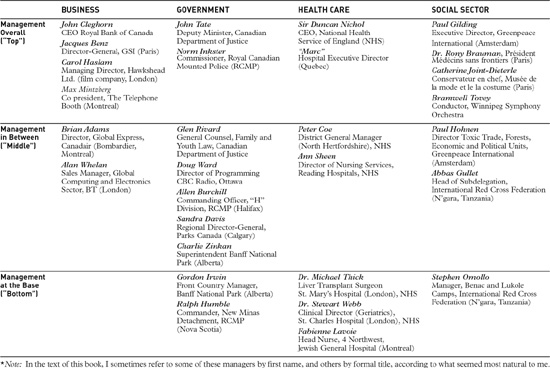
A single day, albeit reinforced by discussion of other days, is hardly a long time. But it is remarkable what can come from straight and simple observation, with no agenda other than letting reality hit you in the face. As Yogi Berra, the sage of American baseball, put it: “You can observe a lot just by watching.” Combine all twenty-nine days, and you have a good deal of evidence about the practice of managing.
Throughout the book, I weave in illustrations from these twenty-nine days, both the descriptions of what happened and the conceptual interpretations of why it happened. Eight of these descriptions are reproduced in the appendix, to anchor the book. The descriptions and interpretations of all twenty-nine days have been made available on a Web site (www.mintzberg-managing.com). To give a sense of this, let me quote some of the titles of the write-ups that appear on the site and figure in the later chapters:
• “Managing on the Edges”—about the political pressures experienced by those managers in the Canadian parks
• “Managing Up, Down, In, and Out”—about the effects of hierarchical level on five managers of the huge National Health Service (NHS) of England, from the chief executive to two head clinicians in hospitals
• “Hard Dealing and Soft Leading”—about the contrast in the work of the head of a film company, between managing externally and internally
• “The Yin and Yang of Managing”—contrasting the work of two chief executives, one of a fashion museum, the other of Doctors Without Borders, both in Paris but worlds apart
• “Managing Exceptionally”—about two Red Cross managers in that refugee camp in Tanzania, managing by exception in exceptional ways
Before proceeding, it will be helpful in this opening chapter to revisit three other myths that get in the way of seeing managing for what it is: that it is somehow separate from leadership; that it is a science, or at least a profession; and that managers, like everyone else, live in times of great change.
Leadership Embedded in Management and Communityship
It has become fashionable to distinguish leaders from managers (Zaleznik 1977, 2004; Kotter 1990a, 1990b). One does the right things, copes with change; the other does things right, copes with complexity. So tell me, who are the leaders and who are the managers in the examples described earlier? Was Alan Whelan merely managing at BT, and Bramwell Tovey merely leading on, and off, the podium? How about Jacques Benz in that project meeting at GSI? Was he doing the right things or doing things right?
Frankly, I don’t understand what this distinction means in the everyday life of organizations. Sure, we can separate leading and managing conceptually. But can we separate them in practice? Or, more to the point, should we even try?
How would you like to be managed by someone who doesn’t lead? That can be awfully dispiriting. Well, then, why would you want to be led by someone who doesn’t manage? That can be terribly disengaging: how are such “leaders” to know what is going on? 5 As Jim March put it: “Leadership involves plumbing as well as poetry” (2004:173).
I observed John Cleghorn, Chairman of the Royal Bank of Canada, who developed a reputation in his company for calling the office on his way to the airport to report a broken ATM machine and such things. This bank has thousands of such machines. Was John micromanaging? Maybe he was setting an example that others should keep their eyes open for such problems.
In fact, today we should be more worried about “macroleading”—people in senior positions who try to manage by remote control, disconnected from everything except “the big picture.” It has become popular to talk about us being overmanaged and underled. I believe we are now overled and undermanaged.
Konosuke Matsushita, who founded the company that carries his name, claimed, “Big things and little things are my job. Middle level arrangements can be delegated.” In other words, leadership cannot simply delegate management; instead of distinguishing managers from leaders, we should be seeing managers as leaders, and leadership as management practiced well.
Whether in the confines of academia or the columns of newspapers, it is a lot easier to muse about the glories of leadership than it is to come to grips with the realities of management. Obviously this comes at the expense of management, but it has also undermined leadership itself. The more we obsess about leadership, the less of it we seem to get. In fact, the more we claim to develop leadership in courses and programs (I counted the words leader and leadership over fifty times on the Harvard MBA Web site in 2007), the more we get hubris. That is because leadership is earned, not anointed.
Moreover, by putting leadership on a pedestal separated from management, we turn a social process into a personal one. No matter how much lip service is paid to the leader empowering the group, leadership still focuses on the individual: whenever we promote leadership, we demote others, as followers. Slighted, too, is the sense of community that is important for cooperative effort in all organizations. What we should be promoting instead of leadership alone are communities of actors who get on with things naturally, leadership together with management being an intrinsic part of that. Accordingly, this book puts managing ahead, seeing it together with leadership as naturally embedded in what can be called communityship.
Managing as a Practice
After years of seeking these Holy Grails, it is time to recognize that managing is neither a science nor a profession; it is a practice, learned primarily through experience, and rooted in context. 6
Certainly Not a Science Science is about the development of systematic knowledge through research. That is hardly the purpose of management, which is about helping to get things done in organizations. Management is not even an applied science, because that is still a science. Management certainly applies science: managers have to use all the knowledge they can get. And they certainly use analysis, rooted in the scientific method (meaning here scientific proof more than scientific discovery).
But effective managing is more dependent on art, and is especially rooted in craft. Art produces the “insights,” and “vision,” based on intuition. 7 (Peter Drucker wrote in 1954 that “the days of the ‘intuitive’ manager are numbered” [p. 93]. Half a century later, we are still counting.) And craft is about learning from experience—working things out as the manager goes along.
Thus, as shown in Figure 1.1, managing can be seen to take place within a triangle when art, craft, and the use of science meet. Art brings in the ideas and the integration; craft makes the connections, building on tangible experiences; and science provides the order, through systematic analysis of knowledge. 8
Most of the work that can be programmed in an organization need not concern its managers directly; specialists can do it. That leaves the managers with much of the messy stuff—the intractable problems, the complicated connections. This is what makes the practice of managing so fundamentally “soft,” and why labels such as experience, intuition, judgment, and wisdom are so commonly needed to describe it. Put together a good deal of craft with the right touch of art alongside some use of science, and you end up with a job that is above all a practice. There is no “one best way” to manage; it depends on the situation.
Nor a Profession It has been pointed out that engineering, too, is not a science or an applied science so much as a practice in its own right (Lewin 1979). But engineering does apply a good deal of science, codified and certified as to its effectiveness. And so it can be called a profession, which means that it can be taught in advance of practice, out of context. In a sense, a bridge is a bridge, or at least steel is steel, even if its use has to be adapted to the circumstances at hand. The same can be said about medicine. But not about management:
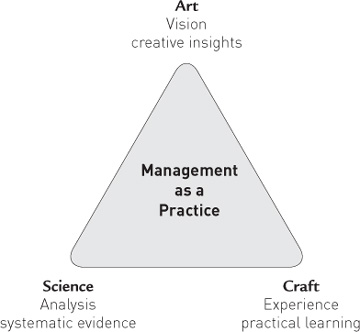
Figure 1.1 MANAGING AS ART, CRAFT, SCIENCE
Many medical skills of diagnosis, inference and treatment . . . assume that illness can be decomposed into separate problems that do not differ much between patients and can be treated by fairly standard remedies. . . . In contrast, much managerial work involves dealing with problems that are quite interdependent with other parts of the organization, are specific to this particular firm, market and industry and not readily reduced to a general, standard syndrome that can be treated by a specific technique. (Whitley 1995:92; see also 1989)
Little of management practice has been reliably codified, let alone certified as to its effectiveness. That is why Hill found that people “had to act as managers before they understood what the role was” (2003:45).
Ever since Frederick Taylor (1916) dubbed his work study method the “one best way,” we have been searching for the Holy Grail of management in science and professionalism. Today that lives on in the easy formulas of so much of the popular literature, whether “strategic planning,” “shareholder value,” and so forth. Yet time and time again, the easy answers have failed, giving the illusion of progress while the real problems have continued to fester.
Because of their codified knowledge, engineering and medicine must be learned formally. And so the trained expert can almost always outperform the layperson. Not so in management. Few of us would trust the intuitive engineer or physician, with no formal training, yet we trust all kinds of managers who have never spent a day in a management classroom (and we have suspicions about many of those who spent two years). 9
What does exist about managing is a good deal of tacit knowledge. But tacit means not easily accessible, which is why the practice has to be learned on the job, through apprenticeship, mentorship, and direct experience. Moreover, much of that kind of knowledge develops in context—the situation at hand—meaning that the learning cannot easily be carried from one managerial job to another, often not even from one function in a particular organization to another, let alone across organizations and industries. (Could Bramwell have run the bank or Fabienne conduct the orchestra?) Sure, there are managers who succeed at doing so, because they have the ability to learn what they need to know in a new context. But for every one of these, I’ll show you many who failed trying.
The true professional knows better, as does the true scientist. The patient does not argue with the surgeon or, for that matter, the surgeon with the molecular biologist. In their own domain, each knows better. But managers who believe they know better get in the way of their practice, because it has to be largely one of facilitation. The manager, by the definition used here, is someone responsible for a whole organization or some identifiable part of it (which, for want of a better term, I shall call a unit). To use that old saying, attributed to Mary Parker Follett in the 1920s, managers get things done largely through other people—those in the unit who formally report to them as well as others around it who do not. Managers have to know a lot, especially about their specific contexts, and they have to make decisions based on that knowledge. But especially in large organizations and those concerned with “knowledge work,” the manager has to help bring out the best in other people, so that they can know better, decide better, and act better.
Recently, while criticizing professional management, I was asked, Is there not something professional about the manager who treats his or her practice nobly, responsibly? Something important, yes, but let’s not mix up acting responsibly with practicing a profession. Instead, let’s recognize management as a calling, and so appreciate that efforts to professionalize it, and turn it into a science, undermine that calling.
Managing in Times of Less Change Than You Think
This book draws on research from the 1940s through to the 2000s. My own twenty-nine days of observation took place in the 1990s. Books these days are not supposed to do such things—they are expected to be terribly up-to-date.
Let’s try the reverse: terribly up-to-date can get in the way. We risk being mesmerized by the present, and biased by the stories we “know” all too well. A little time between us and the events can be a good thing. Moreover, does date really make a difference? Ask yourself if the examples used earlier struck you as out of date. Does that day in the working life of a sales manager, even in high technology, or a head nurse, not apply now because it happened in the 1990s? 10
Attend some speech on management. It is likely to begin with the claim that “we live in times of great change.” As you hear this, look down at the clothes you are wearing. Notice the buttons, and ask yourself if we really live in times of great change, how come we are still buttoning buttons? Indeed, how come we are still driving automobiles powered by internal combustion four-cycle engines? Weren’t these used in the Model T?
Why didn’t you notice those buttons when you dressed this morning, or that old technology when you drove to hear about living in times of great change? After all, when you arrived at work later, you did notice that Windows made another change in its operating system. The fact is that we only notice what is changing. And most things are not. Information technology has been changing; we all notice that, same with the economy of late. How about managing?
Managing Today and Yesterday “For all the fashionable hype about leadership, it is unfashionable management that is being practiced and its fundamental characteristics have not changed” (Hales 2001:54). Managers deal with different issues as time moves forward, but not with different managing. The job does not change. We buy new gasoline all the time and new shirts from time to time; that does not mean that car engines and buttons have been changing. Despite the great fuss we make about change, the fact is that basic aspects of human behavior—and what could be more basic than managing and leading?—remain rather stable. (If you doubt this, rent a good old movie about leadership.)
I was struck during my own earlier study (published in 1973) that the behaviors I observed were probably indistinguishable from that of similar managers of earlier times. Much of the information they needed was different, but they sought it in much the same way—by word of mouth. Their decisions may have concerned the latest technology, but their procedures to make those decisions used little of that technology.
Has any of that changed now? We might like to think so, but the evidence suggests otherwise. 11 Were management a science, even a profession, it would change. (Medical practice changes constantly.) But management is neither. So aside from the fads that come and go, many of them dysfunctional, managing carries merrily along. Even the new information technologies, especially e-mail—the one thing that does seem to be rendering significant change—may actually be reinforcing long-standing characteristics of managerial work (as we shall discuss in Chapter 2).
A Variety of Vintages
Accordingly, I have not hesitated to draw material for this book—examples, evidence, concepts, quotations—from the sources that seem to be most helpful, regardless of their age. Indeed, I hope you agree that the old quotations used in this chapter are some of the best. They have survived for good reason; indeed, like fine wine, they have improved with age.
My book of 1973 described managerial work in two basic ways: the characteristics of the job—namely, its unrelenting pace, many interruptions, oral and action nature, and so forth; and the content of the job, in the form of various roles managers perform (such as figurehead, crises handler). I was more satisfied with the former than the latter, and so Chapter 2, on the “The Dynamics of Managing,” draws extensively from that book. I have seen little subsequent evidence to change those conclusions—in fact, I cite a fair amount that supports them.
In contrast, Chapter 3—which is about the content of managing, what managers actually do in their jobs—breaks away from that book. Subsequent to it, I came to realize that it, like most other such books on the subject, offered a list of roles rather than an integrated description of managing. So in the 1990s, I undertook to develop “A Model of Managing” (the title of Chapter 3 here, first published in Mintzberg 1994b), which describes managing on three planes: information, people, and action. I used this model to help me interpret what I saw on those twenty-nine days, and this helps me to illustrate the material of Chapter 3.
The last three chapters, building on the first three, are new, fully up-to-date—but about my thinking, not about managing. (They could have been included in my 1973 book had I thought about them then. I’m the one who changed.)
Chapter 4 considers “The Untold Varieties of Managing.” As I went through the conventional evidence, about how various factors, such as national culture, level in the hierarchy, and personal style, affect the practice of managing, I became increasingly dissatisfied. Something felt wrong: this was not capturing the fascinating variety I observed in the twenty-nine days. So I went back over those days and found that few factors—even personal style—explained much across all of the days. It was the combination of factors that proved revealing. Hence, I conclude this chapter by describing various “postures” that managers assume—such as maintaining the work flow, managing out of the middle, connecting to the external environment—as well as various postures of managing without managers.
Chapter 5 faces head-on “The Inescapable Conundrums of Managing”—basic concerns that managers have to face because they cannot be resolved, such as the Syndrome of Superficiality, the Quandary of Connecting, and the Dilemma of Delegating. I thoroughly enjoyed writing this chapter and hope you can say the same about reading it.
Finally, I am the one who had to face “Managing Effectively” in the last chapter. Many authors have ridden boldly into this subject, particularly on that white leadership horse, only to have ended up on the rear ends of misguided banalities. With trepidation I proceeded, and to my surprise I had a grand time. This chapter muses quite seriously about why every manager, like every other human being, is flawed, yet many succeed. It draws on some published material about happy and unhappy families to consider happily and unhappily managed units. And it concludes that to be an effective manager—even, dare I say, a great leader—maybe you don’t have to be wonderful so much as normal, and clearheaded.
As I hope has become evident in this opening chapter, I have written this book not to reinforce conventional wisdom—add to all that stuffy managerial correctness—but to open up perspectives, to get us all probing, pondering, wondering about managing. I don’t want you to leave this book knowing. I want you to leave it, as I do, imagining, reflecting, questioning. Managers are only as good as their ability to work things out thoughtfully in their own way. To repeat, this is a job of paradoxes, dilemmas, and mysteries that cannot be resolved. The only guaranteed result of any formula for managing is failure (including, of course, this one).
So ahead we go, to the delights, duties, and distresses of the ancient and contemporary practice of managing.