



Download PDF Excerpt
Rights Information
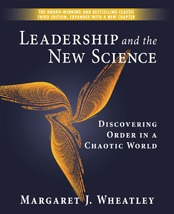
Leadership and the New Science 3rd Edition
Discovering Order in a Chaotic World
Margaret Wheatley (Author)
Publication date: 09/01/2006
Bestseller over 390,000+ copies sold
We live in a time of chaos, rich in potential for new possibilities. A new world is being born. We need new ideas, new ways of seeing, and new relationships to help us now. New science—the new discoveries in biology, chaos theory, and quantum physics that are changing our understanding of how the world works—offers this guidance. It describes a world where chaos is natural, where order exists "for free." It displays the intricate webs of cooperation that connect us. It assures us that life seeks order, but uses messes to get there.
This book will teach you how to move with greater certainty and easier grace into the new forms of organizations and communities that are taking shape. You'll learn that:
• Relationships are what matters—even at the subatomic level
• Life is a vast web of interconnections where cooperation and participation are required
• Chaos and change are the only route to transformation
In this expanded edition, Wheatley provides examples of how non-linear networks and self-organizing systems are flourishing in the modern world. In the midst of turbulence, Wheatley shows, we create work and lives rich in meaning.
Find out more about our Bulk Buyer Program
- 10-49: 20% discount
- 50-99: 35% discount
- 100-999: 38% discount
- 1000-1999: 40% discount
- 2000+ Contact ( bookorders@bkpub.com )
We live in a time of chaos, rich in potential for new possibilities. A new world is being born. We need new ideas, new ways of seeing, and new relationships to help us now. New science—the new discoveries in biology, chaos theory, and quantum physics that are changing our understanding of how the world works—offers this guidance. It describes a world where chaos is natural, where order exists "for free." It displays the intricate webs of cooperation that connect us. It assures us that life seeks order, but uses messes to get there.
This book will teach you how to move with greater certainty and easier grace into the new forms of organizations and communities that are taking shape. You'll learn that:
• Relationships are what matters—even at the subatomic level
• Life is a vast web of interconnections where cooperation and participation are required
• Chaos and change are the only route to transformation
In this expanded edition, Wheatley provides examples of how non-linear networks and self-organizing systems are flourishing in the modern world. In the midst of turbulence, Wheatley shows, we create work and lives rich in meaning.
—Xerox Business Services Magazine
“Meg Wheatley gave the world a new way of thinking about organizations with her revolutionary application of the natural sciences to business management. . . . Her ideas have found welcome homes in the military, not-for-profit organizations, public schools, health care and churches as well as in corporations. . . .”
—American Society For Training And Development
“A book like Leadership and the New Science only comes along once in a decade. Margaret Wheatley pushes our thinking about people and organizations to a new dimension. You will never think about organizational life in the same way again.”
—Ken Blanchard, Coauthor Of The One Minute Manager
“If there's a single book that sets the stage for the future of organizations, this is it . . . Wheatley makes complex ideas simple, and then shows how those simple ideas can be used as powerful tools.”
—Stephen E. Ewing, President And Ceo, Michigan Consolidated Gas Company
“Leadership and the New Science surpasses all books to date in management science. It is truly in a class by itself, introducing a standard of excellence in thought and perception against which all other management books and thought will surely be measured.”
—Gerene Schmidt, Founder And Ceo, Science, Business, And Education, Inc.
“If you want to think about change and organizations in an entirely new way . . . Read this book now.”
—John R. Berry, Vice President, Corporate Communications, Herman Miller, Inc.
“Hold onto the top of your head when you read this book. . . . Using exciting breakthroughs in biology, chemistry, and especially quantum physics, Wheatley paints a brand-new picture of business management. This new relationship between business and science is nothing less than an entirely new set of lenses through which to view our organizations.”
—Library Journal
“An extraordinary book. The new physics is opening frontiers of knowledge that are among the most significant of this century. Applying these discoveries to management and leadership is extraordinarily eye-opening.”
—Marjorie Kelly, Founder And Publisher, Business Ethics Magazine And Author Of The Divine Right Of Capital
“Years ahead of its time, this daring book will convince you that leaders must substitute their Newtonian mental model for a biological model in organizations of every size. . . . Your employees are already getting hip to this stuff. You'd be wise to catch up.”
—The Wall Street Journal
“. . . A thought-provoking work for practitioners and students who are serious about wanting to understand the forces impacting organizations and them- selves, and who desire to move forward to achieve goals and objectives.”
—Choice
“A breakthrough. Wheatley has taken leadership to the cutting edge.”
—Marilyn Ferguson, Author Of The Aquarian Conspiracy And Editor Of Brain/Mind
And Common Sense
“A work of immense importance in management and science. . . . [Wheatley] writes about scientific theory with clarity and precision—yet her observations are unfailingly poetic and human.”
—The Salt Lake Tribune
“Wheatley's message is brilliant and it encourages a provocative paradigm shift. Her explanations of quantum theory reduce what could be a mind-boggling complexity into an unpretentious beauty that even a science-challenged person can understand.”
—Andrea Markowitz, Adjunct Professor, University Of Baltimore
“Leadership and the New Science is a wonderful book, at once clear and profound, practical yet poetic. It is a lot like the new sciences it describes.”
—Timeline
“This beautifully written and compelling book is a gift to many of us who wrestle without the relationship between scientific thinking and organizational life.”
—Judy Sorum Brown, Educator, Writer, And Senior Fellow, Aspen Institute
“A warning to anyone who picks this book up . . . Be prepared to throw out almost everything you think you know about organizations, management, and leadership while reading this book. . . . It is quite literally one of the most interesting books I have ever read.”
—Journal For Quality And Participation
“A pioneering voyage of discovery into the essential elegance and simplicity of organizations. This is a book that must be read by any thinking manager, consultant, or professor who wishes to shake loose the shackles of limiting, old-world views and be free to explore the bountiful possibilities of what is in front of us.”
—Jim Kouzes, Coauthor Of The Leadership Challenge And Credibility
“One of the ten books of the decade that are must-reads for information systems professionals.”
—Cio Magazine
“Meg Wheatley has a way of helping us to discover that which was there but remained unseen and that which we knew but did not recognize. A great teacher, she makes discovery a joyous and sought-after experience.”
—Edgar Mitchell, Apollo 14 Astronaut And Author Of The Way Of The Explorer
“Any individual involved with organizational leadership needs to read this book.”
—Carlson Learning Company Journal
“If you are committed to humane, democratic, and highly productive corporations and communities, you have to pay attention to Leadership and the New Science. Wheatley's integration of the new science and its implications for leading organizations are, I believe, at the cutting edge of a whole new theory and practice of organizations badly needing to be born.”
—Marvin Weisbord, author of productive workplaces and discovering common ground, and coauthor of future search
“Wheatley's new and deep insights are must reading for any management consultant who is serious about making a difference in the world.”
—Journal Of Management Consulting
“Beautifully written and produced. A wonderful road map into the new science. . . . It should be on all of our bookshelves, and we should have extra copies available to send to our clients and friends.”
—The Chaos Network Newsletter
“Wheatley's book should be on every manager's, hrd specialist's, and OD practioner's bookshelf, and the concepts therein incorporated into our own understanding of organizations. . . . Even if you reject some of her notions, the book will make you think about what you do, why you do it, and the assumptions, filters, and biases you carry around with you.”
—OD Practitioner Journal
“When I was a corporate CEO, I was astonished by Leadership and the New Science. It affirmed for me that everything in organizational life—indeed I could say in life itself—is about relationships. It was so wise, so insightful, and so abundantly graceful. . . . I frequently call on Meg's work. She became both teacher and prophet in my mind. And yes, she became and still is, one of my heroes. Her open, wise, and generous spirit is an example for all of us.”
—James Autry, Bestselling Author And Former CEO, Meredith Corporation
“This is one of those seminal books that, once read, can continue to live on in the psyche, reshaping one's world-view permanently. To borrow an image from one of the new sciences contemplated in the book, it may well be like the butterfly in Tokyo whose flapping wings generate a tornado in Texas; it may fan subtle winds of change that eventually amass enough energy to transform corporate organizations into systems barely recognizable to us today.”
—The Advocate Newsletter
“I read Leadership and the New Science with fascination and awe. . . . It is one of the most provocative and exciting books I have read in years.”
—H. Thomas Johnson, Retzlaff professor of quality management, Portland State University
“This is one of the most wonderful books I have ever read. It is a work of art. Wheatley's writing style and communication of ideas have such underlying elegance that they demonstrate what she is writing about—again and again in myriad ways.”
—Barbara Shipka, author of leadership in a challenging world
“I would never have guessed that any book could have held me in such fascination as has leadership and the new science. . . . It will enrich the lives of everyone who reads it.”
—Rosemarie Liebmann, Adjunct Professor, Seton Hall University
“Having just finished Leadership and the New Science, I am compelled to write to tell you what a great impact it has had on my thinking . . . Once I got started reading it, I could not put it down. I also started highlighting the ‘re-ally good' stuff, and your entire book is now green neon. The metaphors you have used are so powerful and created such vivid images in my head that they are now indelibly imprinted there.”
—Michael F. Werneke, Manager, Human Resource Development, Cytec Industries
“Leadership and the New Science is the best book on organizational leadership that i have read in ten years. It reminds me of the life magazine issue devoted to Picasso. That excited me like few other things. I could not put it down. It captured my imagination and led me to a new plane for living and working. . . . That is what happened with Wheatley's book. It has the same kind of vision and uniqueness. It predicts the future and explains the present like only artists can. This book has helped me impart to others a totally unique kind of trust and courage that works, but seems to go completely contrary to the grain. Simply, it is exquisite.”
—Lee M. Hogan, President, Lee Hogan & Associates, And Member Of The Board Of Directors Of Associated Consultants International
“Wheatley's interpretation of the ‘new science'—quantum physics, biology, and chaos theory—into the organizing concepts of work and productivity is pure genius.”
—The New Leaders
“The work you do in the world is a wonder, Meg—so upstream to the way things appear on the surface, but so in harmony with deep-down dynamics of reality. It is a source of great joy to me to think that I have had a small part in the great work you do.”
—Parker Palmer, Educator And Author
“Meg Wheatley's pioneering insights into the self-organizing nature of our world have been remarkably well supported by recent advances in the new sciences. But what really makes leadership and the new science so enduring is that it offers us a solid place to stand amidst the chaos and complexity. We need this book more than ever.”
—Allan Cohen, Former Senior Vice President, Zefer, Former Coo, Waite & Company
“I admire the clarity, beauty, and passion with which you travel your chosen path. Without question, you are having considerable impact both here and abroad.”
—Robert Tannenbaum, A Founder Of The Field Of Od
“I believe that if this book was translated into Russian, it would make an invaluable contribution to our modern culture. It has made a huge impression on me not only for its simple, natural words, but the sense of novelty, and singularity of approach. This book for me was certainly a revelation, one of those books that make it worthwhile to study English.”
—Mikhail Kutyrev, Russia, Former Fishing Fleet Captain
“I've spent the last few days devouring Leadership and the New Science, eulogizing about it to my wife, commenting to the friend who lent me the book. ‘I'm not sure if it is true, but I really want it to be.' the truth of the matter is that much of what you have written I instinctively know to be true but I have never had quite the words to express it.”
—Steve Clifford, Leadership Development Consultant, England
“I was inspired and provoked by your writings to adapt your concepts to the situation of incarcerated individuals. . . . My work is with alcoholics and chemically abusing or addicted individuals. I believe your concepts are a perfect vehicle to reach people who are stuck in denial . . . And your concepts help provide information in a non-threatening and easily understood manner.”
—Diana Arostegui, Washington
“Your book speaks to me and I speak to it. I am a practicing lawyer, now almost 75. . . . I always feel the interconnections of everything and the joy of uncertainty and unknowing and am always excited about ideas that I had never thought of and couldn't have by myself.”
—Dorothy Stulberg, Tennessee
“When we can get people to perceive our organizations differently, they are better able to relate to one another in them. Here is where I find that the ‘secular' insights of your book and the ‘spiritual' notion of communion are powerful complements to one another. Your simplicity, your directness, and your imagination combine to provide insights that are accessible and compelling.”
—M.B. (Jerry) Handspicker, Professor Of Pastoral Theology (Emeritus), Andover Newton Theological School
“Leadership and the New Science . . . Is one of those books that held me spellbound with every turn of the page. I felt a keen sense of disappointment when I realized I had come to the last page. You have a gift, Margaret Wheatley, and I am grateful beyond my ability to express that I have been a recipient of it.”
—Maura Jones, North Dakota
“. . . I am very encouraged that there is still reason to believe ardently in the great resilience of the human spirit to re-invent itself over and over again, whether we view it fractally or as the first signs of a dawning and long awaited millennium of harmony and happiness for everyone. Perhaps what you are de-scribing is the forerunner not only of new leadership skills and deeper understanding one of another, but also the advent of greater openness of mind and genuine honesty between us all at all levels of communication.”
—Reverend Mary Fourchalk, B.C., Canada
Introduction: Searching for a Simpler Way to Lead Organizations
1. Discovering an Orderly World
2. Newtonian Organizations in a Quantum Age
3. Space Is Not Empty: Invisible Fields That Shape Behavior
4. The Participative Nature of the Universe
5. Change,Stability,and Renewal: The Paradoxes of Self-Organizing Systems
6. The Creative Energy of the Universe—Information
7. Chaos and the Strange Attractor of Meaning
8. Change—The Capacity of Life
9. The New Scientific Management
10. The Real World
Epilogue: Journeying to a New World
To Further Explore the Ideas and Work of Margaret Wheatley
The Berkana Institute
Bibliography
Index
About the Author
To my mind there must be, at the bottom of it all, not an equation, but an utterly simple idea. And to me that idea, when we finally discover it, will be so compelling, so inevitable, that we will say to one another, “Oh, how beautiful. How could it have been otherwise?”
—John Archibald Wheeler
Introduction
Searching for a Simpler Way to Lead Organizations
I am not alone in wondering why organizations aren’t working well. Many of us are troubled by questions that haunt our work. Why do so many organizations feel lifeless? Why do projects take so long, develop evergreater complexity, yet too often fail to achieve any truly significant results? Why does progress, when it appears, so often come from unexpected places, or as a result of surprises or synchronistic events that our planning had not considered? Why does change itself, that event we’re all supposed to be “managing,” keep drowning us, relentlessly making us feel less capable and more confused? And why have our expectations for success diminished to the point that often the best we hope for is endurance and patience to survive the frequent disruptive forces in our organizations and lives?
These questions had been growing within me for several years, gnawing away at my work and diminishing my sense of competency. The busier I became with work and the more projects I took on, the greater my questions grew. Until I began a journey.
Like most important journeys, mine began in a mundane place—a Boeing 757, flying soundlessly above America. High in the air as a weekly commuter between Boston and Salt Lake City, with long stretches of reading time broken only by occasional offers of soda and peanuts, I opened my first book on the new science—Fritjof Capra’s The Turning Point, which describes the new world view emerging from quantum physics. This provided my first glimpse of a new way of perceiving the world, one that comprehended its processes of change, its deeply patterned nature, and its dense webs of connections.
I don’t think it accidental that I was introduced to a new way of seeing at 37,000 feet. The altitude only reinforced the message that what was needed was a larger perspective, one that took in more of the whole of things. From that first book, I took off, reading as many new science books as I could find in biology, evolution, chaos theory, and quantum physics. Discoveries and theories of new science called me away from the details of my own field of management and raised me up to a vision of the inherent orderliness of the universe, of creative processes and dynamic, continuous change that still maintained order. This was a world where order and change, autonomy and control were not the great opposites that we had thought them to be. It was a world where change and constant creation were ways of sustaining order and capacity.
I don’t believe I could have grasped these ideas if I had stayed on the ground.
During the past several decades, books that relate new science findings for lay readers have proliferated, some more reputable and scientific than others. Of the many I read, some were too challenging, some were too bizarre, but others contained images and information that were breathtaking. I became aware that I was wandering in a realm that created new visions of freedom and possibility, giving me new ways to think about my work. I couldn’t always draw immediate connections between science and my dilemmas, but I noticed myself developing a new serenity in response to the questions that surrounded me. I was reading of chaos that contained order; of information as an essential, nourishing element; of systems that fell apart so they could reorganize themselves; and of invisible influences that permeate space and affect change at a distance. These were compelling, evocative ideas, and they gave me hope, even if they did not reveal immediate solutions.
Somewhere—I knew then and believe even more firmly now—there is a simpler way to lead organizations, one that requires less effort and produces less stress than our current practices. For me, this new knowledge is now crystallizing into applications even as I realize that this exploration will take many years. But I no longer believe that organizations are inherently unmanageable in this world of constant flux and unpredictability. Rather, I believe that our present ways of organizing are outmoded, and that the longer we remain entrenched in our old ways, the further we move from those wonderful breakthroughs in understanding that the world of science calls “elegant.” The layers of complexity, the sense of things being beyond our control and out of control, are but signals of our failure to understand a deeper reality of organizational life, and of life in general.
We are all searching for this simpler way. In every academic discipline and institution, we live today with questions for which our expertise provides no answers. At the turn of the century, physicists faced the same unnerving confusion. There is a frequently told story about Niels Bohr and Werner Heisenberg, two founders of quantum theory. This version is from The Turning Point:
In the twentieth century, physicists faced, for the first time, a serious challenge to their ability to understand the universe. Every time they asked nature a question in an atomic experiment, nature answered with a paradox, and the more they tried to clarify the situation, the sharper the paradoxes became. In their struggle to grasp this new reality, scientists became painfully aware that their basic concepts, their language, and their whole way of thinking were inadequate to describe atomic phenomena. Their problem was not only intellectual but involved an intense emotional and existential experience, as vividly described by Werner Heisenberg: “I remember discussions with Bohr which went through many hours till very late at night and ended almost in despair; and when at the end of the discussion I went alone for a walk in the neighboring park I repeated to myself again and again the question: Can nature possibly be so absurd as it seemed to us in these atomic experiments?”
It took these physicists a long time to accept the fact that the paradoxes they encountered are an essential aspect of atomic physics. … Once this was perceived, the physicists began to learn to ask the right questions and to avoid contradictions … and finally they found the precise and consistent mathematical formulation of [quantum] theory.
. . . Even after the mathematical formulation of quantum theory was completed, its conceptual framework was by no means easy to accept. Its effect on the physicists’ view of reality was truly shattering. The new physics necessitated profound changes in concepts of space, time, matter, object, and cause and effect; and because these concepts are so fundamental to our way of experiencing the world, their transformation came as a great shock. To quote Heisenberg again: “The violent reaction to the recent development of modern physics can only be understood when one realizes that here the foundations of physics have started moving; and that this motion has caused the feeling that the ground would be cut from science.” (Capra 1983, 76–77)
For the past several years, I have found myself often relating this story to groups of people in organizations everywhere. The story speaks with a chilling familiarity. Each of us recognizes the feelings this tale describes, of being mired in the habit of solutions that once worked yet that are now totally inappropriate, of having rug after rug pulled from beneath us, whether by a corporate merger, reorganization, downsizing, or personal disorientation. But the story also gives great hope as a parable teaching us to embrace our despair as a step on the road to wisdom, encouraging us to sit in the unfamiliar seat of not knowing and open ourselves to radically new ideas. If we bear the confusion, then one day, the story promises, we will begin to see a whole new land, one of bright illumination that will dispel the oppressive shadows of our current ignorance. I still tell Heisenberg’s story. It never fails to speak to me from this deep place of reassurance.
I believe that we have only just begun the process of discovering and inventing the new organizational forms that will inhabit the twenty-first century. To be responsible inventors and discoverers, we need the courage to let go of the old world, to relinquish most of what we have cherished, to abandon our interpretations about what does and doesn’t work. We must learn to see the world anew. As Einstein is often quoted as saying: No problem can be solved from the same consciousness that created it.
There are many places to search for new answers in a time of paradigm shifts. For me, it was appropriate that my inquiry led back to the natural sciences, reconnecting me to an earlier vision of myself. At fourteen, I aspired to be a space biologist and carried heavy astronomy texts on the New York subway to weekly classes at the Hayden Planetarium. These texts were far too dense for me to understand, but I carried them anyway because they looked so impressive. My abilities in biology were better founded, and I began college majoring in biology, but my encounters with advanced chemistry ended that career, and I turned to the greater ambiguity of the social sciences. Like many social scientists, I am at heart a lapsed scientist, still hoping the world will yield up its secrets to me.
But my focus on science is more than a personal interest. Each of us lives and works in organizations designed from Newtonian images of the universe. We manage by separating things into parts, we believe that influence occurs as a direct result of force exerted from one person to another, we engage in complex planning for a world that we keep expecting to be predictable, and we search continually for better methods of objectively measuring and perceiving the world. These assumptions, as I explain in Chapter Two, come to us from seventeenth-century physics, from Newtonian mechanics. They are the basis from which we design and manage organizations, and from which we do research in all of the social sciences. Intentionally or not, we work from a world view that is strongly anchored in the natural sciences.
But the science has changed. If we are to continue to draw from science to create and manage organizations, to design research, and to formulate ideas about organizational design, planning, economics, human motivation, and change processes (the list can be much longer), then we need to at least ground our work in the science of our times. We need to stop seeking after the universe of the seventeenth century and begin to explore what has become known to us during the twentieth century. We need to expand our search for the principles of organization to include what is presently known about how the universe organizes.
The search for the lessons of new science is still in progress, really in its infancy; but what I hope to convey in these pages is the pleasure of sensing those first glimmers of a new way of thinking about the world and its organizations. The light may be dim, but its potency grows as the door cracks wider and wider. Here there are scientists who write about natural phenomena with a poetry and a clarity that speak to dilemmas we find in organizations. Here there are new images and metaphors for thinking about our own organizational experiences. This is a world of wonder and not knowing, where many scientists are as awestruck by what they see as were the early explorers who marveled at new continents. In this realm, there is a new kind of freedom, where it is more rewarding to explore than to reach conclusions, more satisfying to wonder than to know, and more exciting to search than to stay put. Curiosity, not certainty, becomes the saving grace.
This is not a book filled with conclusions, cases, or exemplary practices. It is deliberately not that kind of book, for two reasons. First, I don’t believe that organizations are ever changed by imposing a model developed elsewhere. So little transfers to, or inspires, those trying to work at change in their own organizations. In every organization, we need to look internally, to see one another as the critical resources on this voyage of discovery. We need to learn how to engage the creativity that exists everywhere in our organizations. Second, the new physics cogently explains that there is no objective reality out there waiting to reveal its secrets. There are no recipes or formulas, no checklists or expert advice that describe “reality.” If context is as crucial as the science explains, then nothing really transfers; everything is always new and different and unique to each of us. We must engage with each other, experiment to find what works for us, and support one another as the true inventors that we are.
This book attempts to be true to that new vision of reality, where ideas and information are but half of what is required to evoke reality. The creative possibilities of the ideas represented here depend on your engagement with them. I assigned myself the task of presenting material to provoke and engage you, knowing that your experience with these pages will produce different ideas, different hopes, and different experiments than mine. It is not important that we agree on one expert interpretation or one best practice. That is not the nature of the universe in which we live. We inhabit a world that co-evolves as we interact with it. This world is impossible to pin down, constantly changing, and infinitely more interesting than anything we ever imagined.
Though the outcomes to be gained from reading this book are unique to each of you, the ideas I have chosen to think about focus on the meta-issues that concern those of us who work in organizations: Where is order to be found? How do complex systems change? How do we create structures that are flexible and adaptive, that enable rather than constrain? How do we simplify things without losing what we value about complexity? How do we resolve personal needs for autonomy and growth with organizational needs for prediction and accountability?
The new science research referred to in this book comes from the disciplines of physics, biology, and chemistry, and from theories of evolution and chaos that span several disciplines. Each chapter inquires into metaphorical links between certain scientific perspectives and organizational phenomena, but it may be useful first to say something about the direction of new science.
Scientists in many different disciplines are questioning whether we can adequately explain how the world works by using the machine imagery emphasized in the seventeenth century by such great geniuses as Sir Isaac Newton and René Descartes. This machine imagery leads to the belief that studying the parts is the key to understanding the whole. Things are taken apart, dissected literally or figuratively (as we have done with business functions, academic disciplines, areas of specialization, human body parts), and then put back together without any significant loss. The assumption is that the more we know about the workings of each piece, the more we will learn about the whole.
Newtonian science is also materialistic—it seeks to comprehend the world by focusing on what can be known through our physical senses. Anything real has visible and tangible physical form. In the history of physics and even to this day, many scientists keep searching for the basic “building blocks” of matter, the physical forms from which everything originates.
One of the first differences between new science and Newtonianism is a focus on holism rather than parts. Systems are understood as whole systems, and attention is given to relationships within those networks. Donella Meadows, an ecologist and author, quotes an ancient Sufi teaching that captures this shift in focus: “You think because you understand one you must understand two, because one and one makes two. But you must also understand and” (1982, 23). When we view systems from this perspective, we enter an entirely new landscape of connections, of phenomena that cannot be reduced to simple cause and effect, or explained by studying the parts as isolated contributors. We move into a land where it becomes critical to sense the constant workings of dynamic processes, and then to notice how these processes materialize as visible behaviors and forms.
Explorations into the subatomic world began early in this century, creating the dissonance described in Heisenberg’s story. In physics, therefore, the search for radically new models now has a long and somewhat strange tradition. The strangeness lies in the pattern of discovery that characterized many of the major discoveries in quantum mechanics: “A lucky guess based on shaky arguments and absurd ad hoc assumptions gives a formula that turns out to be right, though at first no one can see why on earth it should be” (March 1978, 3). I delight in that statement of scientific process. It gives me hope that we might all approach discovery differently, hope that we can move away from the plodding, deadening character of so many research and planning activities.
The quantum mechanical view of reality startles us out of common notions of what is real. Even to scientists, it is admittedly bizarre. In the quantum world, relationship is the key determiner of everything. Subatomic particles come into form and are observed only as they are in relationship to something else. They do not exist as independent “things.” There are no basic “building blocks.” Quantum physics paints a strange yet enticing view of a world that, as Heisenberg characterized it, “appears as a complicated tissue of events, in which connections of different kinds alternate or overlap or combine and thereby determine the texture of the whole” (1958, 107). These unseen connections between what were previously thought to be separate entities are the fundamental ingredient of all creation.
In other disciplines, especially biology, nonmechanistic models are only beginning to be replaced by more holistic, dynamic ones. Traditional mechanistic thinking still prevails in the field of molecular biology and most work in genetics. But many scientists now seek to understand life as life, moving away from machine imagery. For example, in The Web of Life (1996), Fritjof Capra presents a new synthesis of the science of living systems, drawing together scientific discoveries and theories from many branches of science. Capra’s synthesis reveals processes that are startlingly different from the mechanistic ones that had been used to explain life.
Similar shifts in understanding have appeared in the field of human health. In holistic treatments, the body is viewed as an integrated system rather than as a collection of discrete parts. Some biologists offer the perspective that what we thought of as discrete systems (such as the immune, endocrine, and neurological systems) are better understood as one system, totally interdependent in their functioning (see Pert and Chopra 1997).
And at the grandest level of scale, looking at the earth as a whole, is the Gaia theory, first proposed by James Lovelock. There is increasing support for his hypothesis that the earth is a self-regulating system, a planetary community of interdependent systems that together create the conditions which make life possible (see Lovelock 1988, Margulis 1998).
In biology, so many fundamental reformulations of prevailing theories are occurring—in evolution, animal behavior, ecology, physiology—that Ernst Mahr, a noted chronicler of biological thought, stated that a new philosophy of biology is needed (1988). What is being sought, comments biologist Steven Rose, is a biology that is more holistic and integrative, a “science that is adult enough to rejoice in complexity” (1997, 133).
In chemistry, Ilya Prigogine won the Noble Prize in 1977 for work that demonstrates how certain chemical systems reorganize themselves into greater order when confronted with changes in their environment. In the older, mechanistic models of systems, change and disturbances signaled trouble. These disruptions would only speed up the inevitable decline that was the fate of all systems. But Prigogine’s work offered a new and more promising future. He demonstrated that any open system has the capacity to respond to change and disorder by reorganizing itself at a higher level of organization. Disorder becomes a critical player, an ally that can provoke a system to self-organize into new forms of being. As we leave behind the machine model of life and look more deeply into the dynamics of living systems, we begin to glimpse an entirely new way of understanding fluctuations, disorder, and change.
New understandings of change and disorder have also emerged from chaos theory. Work in this field has led to a new appreciation of the relationship between order and chaos. These two forces are now understood as mirror images, two states that contain the other. A system can descend into chaos and unpredictability, yet within that state of chaos the system is held within boundaries that are well-ordered and predictable. Without the partnering of these two great forces, no change or progress is possible. Chaos is necessary to new creative ordering. This revelation has been known throughout time to most human cultures; we just needed the science to help us remember it.
New science is also making us more aware that our yearning for freedom and simplicity is one we share with all life. In many examples, scientists now describe how order and form are created not by complex controls, but by the presence of a few guiding formulas or principles repeating back on themselves through the exercise of individual freedom. The survival and growth of systems that range in size from large ecosystems down to the smallest microbial colonies are sustained by a few key principles that express the system’s overall identity combined with high levels of autonomy for individuals within that system.
The world described by new science is changing our beliefs and perceptions in many areas, not just those of science. New science ideas have crept into almost every discipline, including my own field of organizational theory. I can see the influence of science if I look at those problems that plague us most in organizations and how we are reformulating them. Leadership, an amorphous phenomenon that has intrigued us since people began organizing, is being examined now for its relational aspects. Few if any theorists ignore the complexity of relationships that contribute to a leader’s effectiveness. Instead, there are more and more studies on partnership, followership, empowerment, teams, networks, and the role of context.
Relational issues appear everywhere I look. Ethical and moral questions are no longer fuzzy religious concepts but key elements in the relationship any organization has with colleagues, stakeholders, and communities. At the personal level, many authors write now on our interior relationship with our spirit, soul, and life’s purpose. Ecological writers stress the relationship that exists not only between us and all beings in our environment, but between us and future generations. If the physics of our time is revealing the primacy of relationships, is it any wonder that we are beginning to rethink our major issues in more relational terms?
In motivation theory, attention is shifting from the use of external rewards to an appreciation for the intrinsic motivators that give us great energy. We are refocusing on the deep longings we have for community, meaning, dignity, purpose, and love in our organizational lives. We are beginning to look at the strong emotions of being human, rather than segmenting ourselves by believing that love doesn’t belong at work, or that feelings are irrelevant in the organization. There are many attempts to leave behind the view that predominated in the twentieth century, when we believed that organizations could succeed by confining workers to narrow roles and asking only for very partial contributions. As we let go of the machine model of organizations, and workers as replaceable cogs in the machinery of production, we begin to see ourselves in much richer dimensions, to appreciate our wholeness, and, hopefully, to design organizations that honor and make use of the great gift of who we humans are.
The impact of vision, values, and culture occupies a great deal of organizational attention. We see their effects on organizational vitality, even if we can’t define why they are such potent forces. We now sense that some of the best ways to create continuity and congruence in the midst of turbulent times are through the use not of controls, but of forces that are invisible yet palpable. Many scientists now work with the concept of fields—invisible forces that occupy space and influence behavior. I have played with the notion that organizational vision and values act like fields, unseen but real forces that influence people’s behavior. This is quite different from more traditional notions that vision is an evocative message about some desired future state delivered by a charismatic leader.
Our concept of organizations is moving away from the mechanistic creations that flourished in the age of bureaucracy. We now speak in earnest of more fluid, organic structures, of boundaryless and seamless organizations. We are beginning to recognize organizations as whole systems, construing them as “learning organizations” or as “organic” and noticing that people exhibit self-organizing capacity. These are our first journeys that signal a growing appreciation for the changes required in today’s organizations. My own experience suggests that we can forego the despair created by such common organizational events as change, chaos, information overload, and entrenched behaviors if we recognize that organizations are living systems, possessing the same capacity to adapt and grow that is common to all life.
Some believe that there is a danger in playing with science and abstracting its metaphors because, after a certain amount of stretch, the metaphors lose their relationship to the tight scientific theories that gave rise to them. But others would argue that all science is metaphor, a hypothetical description of how to think of a reality we can never fully know. In seeking to play with the rich images coming out of new science, I share the sentiments of physicist Frank Oppenheimer: “If one has a new way of thinking, why not apply it wherever one’s thought leads to? It is certainly entertaining to let oneself do so, but it is also often very illuminating and capable of leading to new and deep insights” (Cole 1985, 2).