The commons — those creations of nature and society we inherit together and must preserve for our children — is under siege. Our current version of capitalism — the corporate, globalized version 2.0 — is rapidly squandering this heritage. Now, Peter Barnes offers a solution: protect the commons by giving it property rights and strong institutional managers.
Barnes shows how capitalism — like a computer — is run by an operating system. Our current operating system gives too much power to profit-maximizing corporations that devour the commons and distribute most of their profits to a sliver of the population. And government — which in theory should defend the commons — is all too often a tool of those very corporations.
Barnes proposes a revised operating system — Capitalism 3.0 — that protects the commons while preserving the many strengths of capitalism as we know it. His major innovation is the commons trust, a market based legal entity with the power to limit the use of scare commons, charge rent, and pay dividends — in both cash and services — to everyone.
In Barnes' vision, an array of commons trusts would institutionalize our obligations to future generations, fellow citizens, and nature. Once established, they'd use markets and property rights to create a better world for us all.
Capitalism 3.0 offers a practical alternative to our current flawed economic system. It points the way to a future in which we can retain capitalism's virtues while mitigating its vices.
By a cofounder and former president of Working Assets
Offers a startlingly original way to adapt capitalism to the 21st century
Shows that protecting "the commons"--humanity's shared natural and cultural heritage--is the key to revitalizing capitalism and safeguarding the planet
Orders of 10+ copies shipping to one address receive free ground shipping
within the U.S. Shipping to separate individual addresses via USPS media mail will be applied a handling fee:
Book Details
Overview
The commons — those creations of nature and society we inherit together and must preserve for our children — is under siege. Our current version of capitalism — the corporate, globalized version 2.0 — is rapidly squandering this heritage. Now, Peter Barnes offers a solution: protect the commons by giving it property rights and strong institutional managers.
Barnes shows how capitalism — like a computer — is run by an operating system. Our current operating system gives too much power to profit-maximizing corporations that devour the commons and distribute most of their profits to a sliver of the population. And government — which in theory should defend the commons — is all too often a tool of those very corporations.
Barnes proposes a revised operating system — Capitalism 3.0 — that protects the commons while preserving the many strengths of capitalism as we know it. His major innovation is the commons trust, a market based legal entity with the power to limit the use of scare commons, charge rent, and pay dividends — in both cash and services — to everyone.
In Barnes' vision, an array of commons trusts would institutionalize our obligations to future generations, fellow citizens, and nature. Once established, they'd use markets and property rights to create a better world for us all.
Capitalism 3.0 offers a practical alternative to our current flawed economic system. It points the way to a future in which we can retain capitalism's virtues while mitigating its vices.
By a cofounder and former president of Working Assets
Offers a startlingly original way to adapt capitalism to the 21st century
Shows that protecting "the commons"--humanity's shared natural and cultural heritage--is the key to revitalizing capitalism and safeguarding the planet
About the Author
Peter Barnes (Author)
Peter Barnes (editor) is a cofounder of Working Assets/Credo and the author of Capitalism 3.0.
Endorsements
“This is a dangerous book—it could revolutionize capitalism. It's also a conservative book— it could save capitalism from its own tragic flaws. Every thoughtful citizen should read it.” — Frances Moore Lappé, author of Diet for a Small Planet and Democracy's Edge “Peter Barnes, a co-founder of Working Assets, has another important idea: Capitalism 3.0. This version of capitalism can save the planet, redress many inequities of wealth, and reclaim the commons—our air, our water, our airwaves, and more. Here is capitalism as you've never seen it before. Take a look!” — George Lakoff, author of Don't Think of an Elephant and Whose Freedom? “Reading Capitalism 3.0 is like putting on a new pair of glasses. It is clearly written, provocative, and fresh. And it offers a sharp new tool for solving the problem of capitalism's threat to the commons.” — Michael Pollan, author of The Omnivore's Dilemma “Using his years of experience as a successful entrepreneur, Barnes shows how capitalism can be upgraded so that it protects rather than devours our planet. Required reading for everyone who looks further than the next quarter's results.” — Robert F. Kennedy, Jr., Senior Attorney, Natural Resources Defense Council “Barnes' concept of commons trusts is nothing short of brilliant. If applied on a large scale, it would fundamentally change capitalism. This idea has legs.” — Marjorie Kelly, author of The Divine Right of Capital “Barnes shows us how to build a new economic sector that is held in trust for future generations. Ecosystems and their services would be managed for long-term benefit rather than short-term profit, and all Americans would get cash dividends.” — Ben Cohen, Co-Founder, Ben & Jerry's “Barnes has opened the dialogue of the 21st century. He takes the traditional concept of the commons and marries it to the institutions of modern capitalism. In so doing he exposes those who take from the commons without paying, then make the rest of us buy back what we already own.” — Carl Pope, Executive Director, Sierra Club
Table of Contents
Preface Acknowledgments
PART 1: THE PROBLEM Time to Upgrade A Short History of Capitalism The Limits of Government The Limits of Privatization
PART 2: A SOLUTION Reinventing the Commons Trusteeship of Creation Universal Birthrights Sharing Culture
PART 3: MAKING IT HAPPEN Building the Commons Sector What You Can Do Appendix Notes Web Resource Guide Bibliography Index About the Author
Excerpt
Capitalism 3.0
Chapter 1
Time to Upgrade
Society is indeed a contract … between those who are living,
those who are dead, and those who are to be born.
— Edmund Burke (1792)
For the first time in history, the natural world we leave our children will be frightfully worse than the one we inherited from our parents. This isn’t just because we’re using the planet as if there were no tomorrow—that’s been going on for centuries. It’s because the cumulative weight of our past and present malfeasance has brought us to several tipping points. Nature has her tolerance limits, and we’ve reached many of them. In some cases, very possibly, we’ve passed them.
The State of the World
Consider, for example, our atmosphere. It’s not just today’s pollution that hurts, it’s the accumulation of fumes we’ve been pouring into the air for centuries. This has already caused ice caps to melt, hurricanes to gain ferocity, and the Gulf Stream to weaken. Almost universally, the world’s scientists warn that far worse lies ahead. The question our generation faces is: will we change our economic system voluntarily, or let the atmosphere change it for us?
Consider also what scientists call biodiversity. The earth is a tiny island of life in a cold, dark universe. We humans share this magical island with millions of other species, most of whom we haven’t met. Each of these species fills a niche and contributes to the web of life. Yet little by little, we’re pushing the others out of their living spaces. The result is a wave of extinctions comparable to that which wiped out the dinosaurs sixty-five million years ago. The difference is that, while the dinosaurs’ extinction was triggered by a freak event, the current extinctions are being caused by our everyday activities.
And it’s not just other species we’re endangering. As anthropologists Jared Diamond and Ronald Wright recently reminded us, past human civilizations (Sumer, Rome, the Maya, Easter Island) did on a smaller scale what our own economic system seems bent on doing planet-wide: they destroyed their resource bases and crashed. The pattern is hauntingly familiar. First, the civilization finds a formula—agriculture, irrigation, fishing, capitalism—for extracting value from ecosystems. Because the formula works so well, the civilization’s leaders become blindly attached to it. Eventually, the key resources on which the formula depends become depleted and the inflexible civilization collapses like a house of cards.
I’m not suggesting we’re doomed to repeat this pattern. Because we can revise our economic operating system, we have a chance to avert it. But let’s not belittle the risks we face today—they’re real and imminent. And the time we have left to upgrade our operating system is limited.
What I Mean By the Commons
When most people think of the commons, they imagine a pasture where animals graze. That’s an antiquated notion, and not what I have in mind. In this book I use the commons as a generic term, like the market or the state. It refers to all the gifts we inherit or create together.
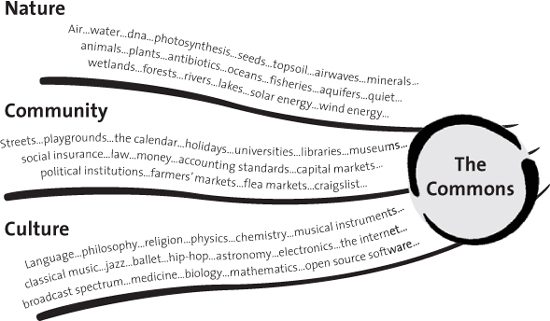
This notion of the commons designates a set of assets that have two characteristics: they’re all gifts, and they’re all shared. A gift is something we receive, as opposed to something we earn. A shared gift is one we receive as members of a community, as opposed to individually. Examples of such gifts include air, water, ecosystems, languages, music, holidays, money, law, mathematics, parks, the Internet, and much more.
These diverse gifts are like a river with three tributaries: nature, community, and culture (see figure 1.1). This broad river precedes and surrounds capitalism, and adds immense value to it (and to us). Indeed, we literally can’t live without it, and we certainly can’t live well.
There’s another quality to assets in the commons: we have a joint obligation to preserve them. That’s because future generations will need them to live, and live well, just as we do. And our generation has no right to say, “These gifts end here.” This shared responsibility introduces a moral factor that doesn’t apply to other economic assets: it requires us to manage these gifts with future generations in mind. Markets don’t naturally do this. If an asset yields a competitive return to capital, markets keep it alive; otherwise, they let it die. No other factors matter.
Figure 1.1
THE THREE FORKS OF THE COMMONS RIVER
Assets in the commons are meant to be preserved regardless of their return to capital. Just as we receive them as shared gifts, so we have a duty to pass them on in at least the same condition as we received them. If we can add to their value, so much the better, but at a minimum we must not degrade them, and we certainly have no right to destroy them.
Besides the commons, I use a few similar-sounding terms that should be clarified here as well.
• By common wealth I mean the monetary and nonmonetary value of all the assets in the commons. Like stockholders’ equity in a corporation, it may increase or decrease from year to year depending on how well the commons is managed.
• By common property I mean a class of human-made rights that lies somewhere between private property and state property. Like private property, common property arises when the state recognizes it. Unlike private property, it’s inclusive rather than exclusive—it strives to share ownership as widely, rather than as narrowly, as possible.
• By the commons sector I mean an organized sector of our economy. It embraces some of the gifts we inherit together, but not all. In effect, it’s a subset of the given commons that we consciously organize according to commons principles. It’s small at the moment, but the point of this book is that we should enlarge it.
The Tragedy of the Commons Isn’t What You Think
If you heard about the commons before you picked up this book, your impressions were probably shaped by a 1968 article called “The Tragedy of the Commons.” In that article, biologist Garrett Hardin used the metaphor of an unmanaged pasture to suggest a root cause of many planetary problems.
The rational herdsman concludes that the only sensible course for him to pursue is to add another animal to his herd. And another…. But this is the conclusion reached by each and every rational herdsman sharing a commons. Therein is the tragedy. Each man is locked into a system that compels him to increase his herd without limit—in a world that is limited. Ruin is the destination toward which all men rush, each pursuing his own best interest…. Freedom in a commons brings ruin to all.
Hardin’s notion of tragedy was taken from philosopher Alfred North Whitehead, who in turn drew upon Aristotle. According to Whitehead, the essence of tragedy is “the remorseless working of things.” In Hardin’s view, commons are fated to self-destruct. There’s nothing humans can do in the context of the commons to halt this inexorable outcome.
Hardin was right about humanity’s unrelenting destruction of nature, but wrong about its cause and inexorability. He blamed the commons itself, when the true destroyer was, and remains, forces outside the commons. In Hardin’s hypothetical, the commons does nothing to protect itself against those forces. It’s completely unmanaged. But there’s no inherent reason why commons can’t be managed as commons.
Contrary to the picture painted by Hardin, medieval European commons (which included not only pastures but forests and streams) were far from unmanaged. They had rules barring access to outsiders and limiting use by villagers. For example, a rule that persists today in many Swiss villages is that villagers can’t graze in common pasture more animals than they can feed over winter on their own land. A managed commons, in other words, isn’t inherently self-destructive. The real danger to the commons is enclosure and trespass by outsiders.
Our Economic Operating System
An operating system is a set of instructions that orchestrates the moving parts of a larger system. The most familiar example is a computer operating system that coordinates the keyboard, screen, processor, and so on. Operating system instructions are written in code that can reside in electrons (as in a computer), chemicals (as in genes), or social norms and laws. Frequently, parts of the code can be expressed mathematically.
Just as our Constitution sets the rules for our democracy, so our economic operating system sets the rules for capitalism. Our economic operating system isn’t as widely understood as our Constitution, nor is it spelled out in one concise document. It’s visible if you look for it, but it’s hidden in a shroud of statutes and court decisions. Still, like the Constitution, it’s there—and it runs the mercantile life of our nation.
I like to think of our economic operating system as analogous to the rules of the board game Monopoly. It defines such things as starting conditions, rules of play, and the distribution of rewards and risk. It defines them partly through law, and partly by assigning fictional things called property and money.
All operating systems contain feedback loops—if certain conditions are detected, do this; if others are detected, do that. These feedback loops can be virtuous (the reaction fixes the problem) or vicious (the reaction makes the problem worse). A stable system has lots of virtuous loops and is good at weeding out vicious loops.
Sometimes, in human-made systems, virtuous loops have to be consciously added. Consider the steam engine of eighteenth-century inventor James Watt. Watt’s design included two critical mechanisms: the steam-driven engine itself, and a centrifugal governor to keep the engine from getting out of control. When the latter detects a potentially dangerous behavior—speeding—it automatically corrects that behavior.
Illth and Thneeds
More than a century ago, English economist John Ruskin observed that the same economic system that creates glittering wealth also spawns what he called illth—poverty, pollution, despair, illness. It makes life comfortable for some, but does so at considerable discomfort to others.
Modern economists’ term for illth is negative externalities. By this they mean the costs of economic transactions that are “external” to the parties involved. The classic example is a factory that dumps effluent into a river. Unlike homeowners who pay for garbage pickup, the factory’s owners pay nothing for disposing their waste into the river. But humans and other creatures living downstream do pay a cost. Plants and animals suffer and die, while cities have to build expensive treatment plants. From the standpoint of the factory owner, none of this matters. But from the standpoints of nature and society, these are negative externalities. (There can, sometimes, be positive externalities—for example, if your neighbor repaints her house, that may increase the value of yours.)
For a long time, economists assured us that the wealth spewed out by our economic machine was so great, and the illth so trivial, that we didn’t need to worry about negative externalities. If this was ever true, it’s assuredly true no longer. Contemporary climate change is, quintessentially, a problem of negative externalities. We pay owners of land beneath which fossil fuels lie. We pay drillers, refiners, transporters, and retailers. But we don’t pay nature, or anyone else, for dumping heat-trapping gases into the atmosphere. We shift this cost to our children, and take a free ride. We party, they pay.
What’s more, many negative externalities aren’t even the result of meeting genuine human needs. The word thneed doesn’t appear in any economics text, but it’s symbolic of our modern predicament. The word was coined by Theodor Geisel—better known as Dr. Seuss—in his children’s fable The Lorax. A thneed is a thing we want but don’t really need. As many parents will recall, The Lorax pits a dynamic entrepreneur (the Once-ler) against a pesky Lorax who “speaks for the trees.” The Once-ler makes thneeds by cutting down truffula trees. When the Lorax protests, the Once-ler replies:
I’m being quite useful. This thing is a Thneed. A Thneed’s a Fine-Something-That-All-People-Need!
Economists have no technical term for thneed; they assume that all “demand” in the economy is equivalent, as long as it’s backed with money. Yet surely it would be helpful to differentiate. One can imagine an axis running from needs to thneeds. On one end are such things as food, shelter, basic transportation, and health care. On the other end are Coca-Cola, iPods, and Hummers. (Significantly, needs are generic, while thneeds are typically branded.) Filling needs contributes more to human well-being than does selling thneeds, yet our economic system increasingly devotes scarce resources to thneeds.
Why do we have so much illth and so many thneeds? Because our economic operating system is far out of balance. On one side, representing owners of capital, are powerful profit-maximizing corporations. On the other side, representing future generations, nonhuman species, and millions of humans with unmet needs, are—almost nothing. The system lacks institutions that preserve shared inheritances, charge corporations for degrading nature, or boost the “demanding” power of people whose basic needs are ignored. Hence the system generates ever more illth, waste, and ever-widening disparities between rich and poor.
Upgrading Our System
Can we imagine, design, and install an upgraded operating system that fixes these flaws? This may seem a far-fetched dream. But consider that something comparable happened before, in 1935, with the enactment of Social Security.
Like the changes I’m suggesting here, Social Security is an intergenerational compact, engraved into our economic operating system. It was imagined, designed, and installed early in the twentieth century in response to what was then a looming crisis: the impoverishment of millions too old to work. The basic contract was, and remains, simple: active workers collectively support retired workers, and in return are supported in old age by the next generation of workers. For seventy years, this contract has been administered without scandal or waste by a trust fund that has never missed a payment. Thanks to this operating system upgrade, extreme old-age poverty, once rampant, is largely a thing of the past.
What we need now is a comparable system upgrade, this time to fix capitalism’s disregard for nature, future generations, and the nonelderly poor.
Premises of This Book
All thought processes start with premises and flow to conclusions. Here are the main premises of this book.
1. WE HAVE A CONTRACT
Each generation has a contract with the next to pass on the gifts it has jointly inherited. These gifts fall into three broad categories: nature, community, and culture. The first category includes air, water, and ecosystems. The second includes laws, infrastructure, and many systems by which we connect with one another. The third includes language, art, and science. All of these gifts are immensely valuable, and need to be preserved if not enhanced.
2. WE ARE NOT ALONE
We living humans could benefit from a bit more humility. Not only do our children and grandchildren matter, so do other beings and their offspring. They have a right to be here, even if they aren’t useful to us. An economic system should represent their interests as well as ours. A practical way to do this is needed.
3. ILLTH HAPPENS
Poverty, pollution, despair, and ill-health—what John Ruskin called illth—is the dark side of capitalism. This dark side needs to be addressed.
4. FIX THE CODE, NOT THE SYMPTOMS
If we want to reduce illth on an economy-wide scale, we need to change the code that produces it. Ameliorating symptoms after the fact is a losing strategy. Unless the code itself is changed, our economic machine will always create more illth than it cleans up. Moreover, illth prevention is a lot cheaper than illth cleanup.
5. REVISE WISELY
Most of what’s in our current code is fine as is, and shouldn’t be tinkered with. “If it ain’t broke, don’t fix it,” is a valid maxim. What does need fixing should be fixed gradually whenever possible, as fairly as possible, and at the lowest cost possible. Efficiency and grace matter.
6. MONEY ISN’T EVERYTHING
Money is the blood of our economic system; it shouldn’t be the soul. Humans have needs and desires that can’t be met by exchanging dollars. These needs include connection to family and community, closeness to nature, and meaning in life. A twenty-first-century economic system must address these needs, too. This doesn’t mean it must fill them directly; often, the best it can do is leave space for them to be filled in nonmonetary ways. What it shouldn’t do is get in the way of their being met.
7. GET THE INCENTIVES RIGHT
Notwithstanding the above, an economic system works best when it rewards desired behavior. As Mary Poppins put it, “A spoonful of sugar helps the medicine go down” (and as I’ve never forgotten, offering a free pint of Ben & Jerry’s was the best way Working Assets ever found to get customers). While we’re looking for methods to protect nature and future generations, we need to make the incentives work for living humans as well.
If you disagree with any of these premises, you’re unlikely to fancy my conclusions. If, on the other hand, these premises make sense to you, then welcome to these pages. I won’t bore you with statistics, or tell you, yet again, that our planet is going to hell; I’m tired, as I suspect you are, of numbers and gloom. Nor will I tell you we can save the planet by doing ten easy things; you know it’s not that simple. What I will tell you is how we can retool our economic system, one step at a time, so that after a decent interval, it respects nature and the human psyche, and still provides abundantly for our material needs.
Perhaps capitalism will always involve a Faustian deal of some sort: if we want the goods, we must accept the bads. But if we must make a deal with the devil, I believe we can make a much better one than we presently have. We’ll have to be shrewd, tough, and bold. But I’m confident that, if we understand how to get a better deal, we will get one. After all, our children and lots of other creatures are counting on us.
Thank you for ordering a digital copy of this title. This will be delivered via email after checkout. Please refer to our Information About E-Books page for any further questions on formats, rights and compatible devices.
Thank you for requesting an exam copy. If you would like to request additional exam copies, please click on ‘Continue Shopping.’ Please limit your requests to not more than three books at a time. If not, please go to ‘Checkout’ and fill in your information and complete your request.