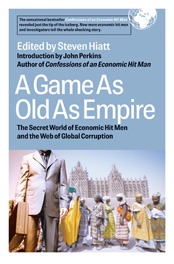
John Perkins' controversial and bestselling exposé, Confessions of an Economic Hit Man, revealed for the first time the secret world of economic hit men (EHMs). But Perkins' Confessions contained only a small piece of this sinister puzzle. The full story is far bigger, deeper, and darker than Perkins' personal account revealed. Here other EHMs, journalists, and investigators join Perkins to tell their own stories, providing the first probing and expansive look into this pervasive web of systematic corruption.
With chapters spotlighting how specific countries around the globe have been subverted, A Game As Old As Empire uncovers the inner workings of the institutions behind these economic manipulations. The contributors detail concrete examples of how the “economic hit man game” is still being played: an officer of an offshore bank hiding hundreds of millions of dollars in stolen money, IMF advisers slashing Ghana's education and health programs, a mercenary defending a European oil company in Nigeria, a consultant rewriting Iraqi oil law, and executives financing warlords to secure supplies of coltan ore in Congo. Together they show how this system of corruption and plunder operates in real life, and reveal the price that the rest of the world must pay as a result.
Most important, A Game As Old As Empire connects the dots, showing how the various pieces of this system come together to create the world's first truly global empire.
• Builds on the shocking picture of worldwide economic corruption first presented in John Perkins' Confessions of an Economic Hit Man
• Features a dozen chapters detailing contemporary examples of how the economic hit man game is played around the globe
John Perkins’ controversial and bestselling exposé, Confessions of an Economic Hit Man, revealed for the first time the secret world of economic hit men (EHMs). But Perkins’ Confessions contained only a small piece of this sinister puzzle. The full story is far bigger, deeper, and darker than Perkins’ personal account revealed. Here other EHMs, journalists, and investigators join Perkins to tell their own stories, providing the first probing and expansive look into this pervasive web of systematic corruption.
With chapters spotlighting how specific countries around the globe have been subverted, A Game As Old As Empire uncovers the inner workings of the institutions behind these economic manipulations. The contributors detail concrete examples of how the “economic hit man game” is still being played: an officer of an offshore bank hiding hundreds of millions of dollars in stolen money, IMF advisers slashing Ghana’s education and health programs, a mercenary defending a European oil company in Nigeria, a consultant rewriting Iraqi oil law, and executives financing warlords to secure supplies of coltan ore in Congo. Together they show how this system of corruption and plunder operates in real life, and reveal the price that the rest of the world must pay as a result.
Most important, A Game As Old As Empire connects the dots, showing how the various pieces of this system come together to create the world’s first truly global empire.
Orders of 10+ copies shipping to one address receive free ground shipping
within the U.S. Shipping to separate individual addresses via USPS media mail will be applied a handling fee:
Book Details
Overview
John Perkins' controversial and bestselling exposé, Confessions of an Economic Hit Man, revealed for the first time the secret world of economic hit men (EHMs). But Perkins' Confessions contained only a small piece of this sinister puzzle. The full story is far bigger, deeper, and darker than Perkins' personal account revealed. Here other EHMs, journalists, and investigators join Perkins to tell their own stories, providing the first probing and expansive look into this pervasive web of systematic corruption.
With chapters spotlighting how specific countries around the globe have been subverted, A Game As Old As Empire uncovers the inner workings of the institutions behind these economic manipulations. The contributors detail concrete examples of how the “economic hit man game” is still being played: an officer of an offshore bank hiding hundreds of millions of dollars in stolen money, IMF advisers slashing Ghana's education and health programs, a mercenary defending a European oil company in Nigeria, a consultant rewriting Iraqi oil law, and executives financing warlords to secure supplies of coltan ore in Congo. Together they show how this system of corruption and plunder operates in real life, and reveal the price that the rest of the world must pay as a result.
Most important, A Game As Old As Empire connects the dots, showing how the various pieces of this system come together to create the world's first truly global empire.
• Builds on the shocking picture of worldwide economic corruption first presented in John Perkins' Confessions of an Economic Hit Man
• Features a dozen chapters detailing contemporary examples of how the economic hit man game is played around the globe
John Perkins’ controversial and bestselling exposé, Confessions of an Economic Hit Man, revealed for the first time the secret world of economic hit men (EHMs). But Perkins’ Confessions contained only a small piece of this sinister puzzle. The full story is far bigger, deeper, and darker than Perkins’ personal account revealed. Here other EHMs, journalists, and investigators join Perkins to tell their own stories, providing the first probing and expansive look into this pervasive web of systematic corruption.
With chapters spotlighting how specific countries around the globe have been subverted, A Game As Old As Empire uncovers the inner workings of the institutions behind these economic manipulations. The contributors detail concrete examples of how the “economic hit man game” is still being played: an officer of an offshore bank hiding hundreds of millions of dollars in stolen money, IMF advisers slashing Ghana’s education and health programs, a mercenary defending a European oil company in Nigeria, a consultant rewriting Iraqi oil law, and executives financing warlords to secure supplies of coltan ore in Congo. Together they show how this system of corruption and plunder operates in real life, and reveal the price that the rest of the world must pay as a result.
Most important, A Game As Old As Empire connects the dots, showing how the various pieces of this system come together to create the world’s first truly global empire.
About the Authors
Steven Hiatt (Author)
Steven Hiatt is a professional editor and writer—but also has a long history as an activist. He went on his first demonstration, for a city equal housing ordinance, in Des Moines in 1965. He went on to edit an underground newspaper, was active in the movement against the Vietnam War, and then became a community college teacher and teachers union organizer. After moving to California he worked for a number of years at Stanford Research Institute, a think tank and consultancy organization serving multinational corporations and government agencies and closely linked to Bechtel, Chevron, Bank of America, and other players in the EHM world. There he edited a series of research reports circulated to Global Fortune 1000 companies advocating standard neoliberal nostrums such as public-private partnerships and offshoring. He left SRI in 1987 and has since produced and edited books for Verso, The New Press, and other publishers, working with authors such as Alexander Cockburn, Mike Davis, Lewis H. Lapham, Christian Parenti, and Rebecca Solnit. He is co-editor, with Mike Davis, of Fire in the Hearth: The Radical Politics of Place in America. Hiatt lives in San Francisco and is president of Editcetera, a nonprofit cooperative of publishing professionals.
John Perkins (Introduction by)
John Perkins is an activist and author of ten books on global intrigue, shamanism, and transformation, including the classic Confessions of an Economic Hit Man. As a former chief economist at a major consulting firm, he advised the World Bank, United Nations, Fortune 500 corporations, and governments. He regularly speaks at universities, economic forums, and shamanic gatherings around the world and is a founder and board member of the Pachamama Alliance and Dream Change.
Table of Contents
Introduction: New Confessions and Revelations from the World of Economic Hit Men 1 Global Empire: The Web of Control, Steven Hiatt 2 Selling Money—and Dependency: Setting the Debt Trap, S. C. Gwynne 3 Dirty Money: Inside the Secret World of Offshore Banking, John Christensen 4 BCCI's Double Game: Banking on America, Banking on Jihad, Lucy Komisar 5 The Human Cost of Cheap Cell Phones, Kathleen Kern 6 Mercenaries on the Front Lines in the New Scramble for Africa, Andrew Rowell and James Marriott 7 Hijacking Iraq's Oil Reserves: Economic Hit Men at Work, Greg Muttitt 8 The World Bank and the $100 Billion Question, Steve Berkman 9 The Philippines, the World Bank, and the Race to the Bottom, Ellen Augustine 10 Exporting Destruction, Bruce Rich 11 The Mirage of Debt Relief, James S. Henry 12 Global Uprising: The Web of Resistance, Antonia Juhasz About the Authors Acknowledgments Appendix: Resources of Hope Index
Excerpt
A Game As Old As Empire
John Perkins links his experiences to new revelations that expose the drive for empire that lies behind the rhetoric of globalization.
Introduction: New Confessions and Revelations from the World of Economic Hit Men
John Perkins
Economic hit men (EHMs) are highly paid professionals who cheat countries around the globe out of trillions of dollars. They funnel money from the World Bank, the U.S. Agency for International Development (USAID), and other foreign “aid” organizations into the coffers of huge corporations and the pockets of a few wealthy families who control the planet's natural resources. Their tools include fraudulent financial reports, rigged elections, payoffs, extortion, sex, and murder. They play a game as old as empire, but one that has taken on new and terrifying dimensions during this time of globalization.
I should know; I was an EHM.
I wrote that opening paragraph to Confessions of an Economic Hit Man as a description of my own profession. Since the book’s first publication in early November 2004, I have heard TV, radio, and event hosts read those words many times as they introduced me to their audiences. The reality of EHMs shocked people in the United States and other countries. Many have told me that it convinced them to commit themselves to taking actions that will make this a better world.
The public interest aroused by Confessions was not a foregone conclusion. I spent a great deal of time working up the courage to try to publish it. Once I made the decision to do so, my attempts got off to a rocky start.
By late 2003, the manuscript had been circulated to many publishers—and I had almost given up on ever seeing the book in print. Despite praising it as “riveting,” “eloquently written,” “an important exposé,” and “a story that must be told,” publisher after publisher—twenty-five, in fact—rejected it. My literary agent and I concluded that it was just too anti-corporatocracy. (A word introduced to most readers in those pages, corporatocracy refers to the powerful group of people who run the world’s biggest corporations, the most powerful governments, and history’s first truly global empire.) The major publishing houses, we concluded, were too intimidated by, or perhaps too beholden to, the corporate elite.
Eventually a courageous independent publisher, Berrett-Koehler, took the book on. Confessions’ success among the public astounded me. During its first week in bookstores it went to number 4 on Amazon.com. Then it spent many weeks on every major bestseller list. In less than fourteen months, it had been translated into and published in twenty languages. A major Hollywood company purchased the option to film it. Penguin/Plume bought the paperback rights.
Despite all these successes, an important element was still missing. The major U.S. media refused to discuss Confessions or the fact that, because of it, terms such as EHM, corporatocracy, and jackal were now appearing on college syllabuses. The New York Times and other newspapers had to include it on their bestseller lists—after all, numbers don’t lie (unless an EHM produces them, as you will see in the following pages)—but during its first fifteen months in print most of them obstinately declined to review it. Why?
My agent, my publicist, the best minds at Berrett-Koehler and Penguin/Plume, my family, my friends, and I may never know the real answer to that question. What we do know is that several nationally recognized journalists appeared poised on the verge of writing or speaking about the book. They conducted “pre-interviews” with me by phone and dispatched producers to wine and dine my wife and me. But, in the end, they declined. A major TV network convinced me to interrupt a West Coast speaking tour, fly across the country to New York, and dress up in a television-blue sports coat. Then—as I waited at the door for the network’s limo—an employee called to cancel. Whenever media apologists offered explanations for such actions, they took the form of questions: “Can you prove the existence of other EHMs?” “Has anyone else written about these things?” “Have others in high places made similar disclosures?”
The answer to these questions is, of course, yes. Every major incident described in the book has been discussed in detail by other authors—usually lots of other authors. The CIA’s coup against Iran’s Mossadegh; the atrocities committed by his replacement, Big Oil’s puppet, the Shah; the Saudi Arabian money-laundering affair; the jackal-orchestrated assassinations of Ecuador’s President Jaime Roldós and Panama’s President Omar Torrijos; allegations of collusion between oil companies and missionary groups in the Amazon; the international activities of Bechtel, Halliburton, and other pillars of American capitalism; the unilateral and unprovoked U.S. invasion of Panama and capture of Manuel Noriega; the coup against Venezuelan President Hugo Chávez—these and the other events in the book are a matter of public record.
Several pundits criticized what some referred to as my “radical accusation"—that economic forecasts are manipulated and distorted in order to achieve political objectives (as opposed to economic objectivity) and that foreign “aid” is a tool for big business rather than an altruistic means to alleviate poverty. However, both of these transgressions against the true purposes of sound economics and altruism have been well documented by a multitude of people, including a former World Bank chief economist and winner of the Nobel Prize in economics, Joseph Stiglitz. In his book Globalization and Its Discontents, Stiglitz writes:
To make its [the IMF’s] programs seem to work, to make the numbers “add up,” economic forecasts have to be adjusted. Many users of these numbers do not realize that they are not like ordinary forecasts; in these instances GDP forecasts are not based on a sophisticated statistical model, or even on the best estimates of those who know the economy well, but are merely the numbers that have been negotiated as part of an IMF program. …1
Globalization, as it has been advocated, often seems to replace the old dictatorships of national elites with new dictatorships of international finance…. For millions of people globalization has not worked…. They have seen their jobs destroyed and their lives become more insecure.2
I found it interesting that during my first book tour—for the hardcover edition, in late 2004 and early 2005—I sometimes heard questions from my audiences that reflected the mainstream press. However, they were significantly diminished during the paperback edition tour in early 2006. The level of sophistication among readers had risen over the course of that year. A growing suspicion that the mainstream press was collaborating with the corporatoc-racy—which, of course, owned much of it or at least supported it through advertising—had become manifest. While I would love to credit Confessions for this transformation in public attitude, my book has to share that honor with a number of others, such as Stiglitz’s Globalization and Its Discontents, David Korten’s When Corporations Rule the World, Noam Chomsky’s Hegemony or Survival, Chalmers Johnson’s Sorrows of Empire, Jeff Faux’s Global Class War, and Antonia Juhasz’s Bush Agenda, as well as films such as The Constant Gardener, Syriana, Hotel Rwanda, Good Night, and Good Luck, and Munich. The American public recently has been treated to a feast of exposés. Mine is definitely not a voice in the wilderness.
Despite the overwhelming evidence that the corporatocracy has created the world’s first truly global empire, inflicted increased misery and poverty on millions of people around the planet, managed to sabotage the principles of self-determination, justice, and freedom that form the foundations upon which the United States stands, and turned a country that was lauded at the end of World War II as democracy’s savior into one that is feared, resented, and hated, the mainstream press ignores the obvious. In pleasing the money-men and the executives upstairs, many journalists have turned their backs on the truth. When approached by my publicists, they continue to ask: “Where are the trenches?” “Can you produce the trowels that dug them?” “Have any ‘objective’ researchers confirmed your story?”
Although the evidence was already available, Berrett-Koehler and I decided that the proper response was to answer such questions in terms that no one could ignore and that only those who insisted on remaining in denial could dispute. We would publish a book with many contributors, an anthology, further revealing the world of economic hit men and how it works.
In Confessions, I talked about a world rooted in the cold war, in the dynamics and proxy conflicts of the U.S.-Soviet conflict. My sojourn in that war ended in 1981, a quarter of a century ago. Since then, and especially since the collapse of the USSR, the dynamics of empire have changed. The world is now more multipolar and mercantile, with China and Europe emerging to compete with the U.S. Empire is heavily driven by multinational corporations, whose interests transcend those of any particular nation-state.3 There are new multinational institutions and trade agreements, such as the World Trade Organization (WTO) and North American Free Trade Agreement (NAFTA), and newly articulated ideologies and programs, such as neoliberalism and the structural adjustments and conditionalities imposed by the IMF. But one thing remains unchanged: the peoples of the Third World continue to suffer; their future, if anything, looks even bleaker than it did in the early 1980s.
A quarter-century ago, I saw myself as a hit man for the interests of U.S. capitalism in the struggle for control of the developing world during the cold war. Today, the EHM game is more complex, its corruption more pervasive, and its operations more fundamental to the world economy and politics. There are many more types of economic hit men, and the roles they play are far more diverse. The veneer of respectability remains a key factor; subterfuges range from money laundering and tax evasion carried out in well-appointed office suites to activities that amount to economic war crimes and result in the deaths of millions of people. The chapters that follow reveal this dark side of globalization, showing a system that depends on deception, extortion, and often violence: an officer of an offshore bank hiding hundreds of millions in stolen money, IMF advisors slashing Ghana’s education and health programs, a Chinese bureaucrat seeking oil concessions in Africa, a mercenary defending a European oil company in Nigeria, a consultant rewriting Iraqi oil law, and executives financing warlords to secure supplies of coltan ore in Congo.
The main obstacle to compiling such stories should be obvious. Most EHMs do not think it is in their best interests to talk about their jobs. Many are still actively employed in the business. Those who have stepped away often receive pensions, consultant fees, and other perks from their former employers. They understand that whistle-blowers usually sacrifice such benefits—and sometimes much more. Most of us who have done that type of work pride ourselves on loyalty to old comrades. Once one of us decides to take the big leap—“into the cold,” to use CIA vernacular—we know we will have to face the harsh reality of powerful forces arrayed to protect the institutional power of multinational corporations, global banks, government defense and security agencies, international agencies—and the small elite that runs them.
In recent years, the people charged with deceiving ordinary citizens have grown more cunning. The Pentagon Papers and the White House Watergate tapes taught them the dangers of writing and recording incriminating details. The Enron, Arthur Andersen, and WorldCom scandals, and recent allegations about CIA “extraordinary renditions,” weapons of mass destruction deceits, and National Security Agency eavesdropping serve to reinforce policies that favor shredding. Government officials who expose a CIA agent to retaliate against her whistle-blowing spouse go unpunished. All these events lead to the ultimate deterrent to speaking the truth: those who expose the corporatocracy can expect to be assassinated—financially and by reputation, if not with a bullet.
Less obvious deterrents also keep people from telling the truth. Opening one’s soul for public scrutiny, confessing, is not fun. I had written many books before Confessions (five of them published). Yet none prepared me for the angst I would encounter while exposing my transgressions as an EHM. Although most of us humans do not want to think of ourselves as corrupt, weak, or immoral, it is difficult—if not impossible—to ignore those aspects of ourselves when describing our lives as economic hit men. Personally, it was one of the most difficult tasks I have ever undertaken. In approaching prospective contributors to a book such as this I might tell them that confessing is, in the end, worth the anguish. However, for someone setting out on this path, that end seems very distant.
I discussed these obstacles and the potential benefits of overcoming them with Steve Piersanti, the intrepid founder and CEO of Berrett-Koehler, who made the decision to publish Confessions. It did not take us long to decide that the benefits were well worth the struggle. If my Confessions could send such a strong message to the public, it made sense that multiple confessions—or stories about people who need to confess—might reach even more people and motivate them to take actions that will turn this empire back into the democratic republic it was intended to be. Our goal was nothing less than convincing the American public that we can and must create a future that will make our children and grandchildren—and their brothers and sisters on every continent—proud of us.
Of course we had to start by showing journalists the trowels and the trenches. We decided that we should also include well-researched analyses by observers who came from a more objective perspective, rather than a personal one. A balance between firsthand and third-party accounts seemed like the prudent approach.
Steve took it upon himself to find someone who could be an editor and also serve as a sleuth: he’d have to ferret out prospective writers and convince them that loyalty to country, family, and future generations on every continent demanded that they participate in this book. After an extensive selection process, he, his staff, and I settled on Steven Hiatt. Steve is a professional editor—but he also has a long history as an activist, first against the Vietnam War and then as a teachers’ union organizer. In addition, he worked for a number of years at Stanford Research Institute, a think tank and consultancy organization serving multinationals and government agencies around the world and closely linked to Bechtel, Bank of America, and other players in the EHM world. There he worked on research reports that he describes as essentially “the corporatocracy talking to itself.”
Once the process of assembling this anthology began, I started speaking about it. When people asked those questions—“Can you prove the existence of other EHMs?” “Has anyone else written about these things?” “Have others made similar disclosures?"—I told them about the upcoming book. The wisdom of making that decision to publish an anthology was supported on February 19, 2006, when the New York Times ran a major article that featured Confessions on the front page of its Sunday Business Section. The editors, I am sure, were comforted by the results of a background check confirming my account of my life and the episodes described in Confessions; however, the fact that other EHMs and researchers had committed to writing this book was, I suspect, the most important factor in their decision to publish that article.
The contributors to this book uncover events that have taken place across a wide range of countries, all EHM game plans under a variety of guises. Each sheds more light on the building of an empire that is contrary to American principles of democracy and equality. The chapters are presented in an order that follows the flow of money and power in the Global Empire. The chart on page 10 shows that progression: the selling of loans to Third World countries, the flow of dirty money back to First World control via secret offshore accounts, the failure of debt-led development models to reduce poverty, the accumulation of mountains of unpayable debt, the gutting of local economies by the IMF, and military intervention and domination to secure access to resources. Steve Hiatt, in “Global Empire,” gives an overview of the web of control that First World companies and institutions use to rule the global economy; each subsequent chapter exposes another facet. In brief summary:
• S.C. Gwynne joined Cleveland Trust and quickly moved into the heady atmosphere of international banking, where he learned that ability to pay had little to do with placing loans. In “Selling Money—and Dependency: Setting the Debt Trap” he describes a culture of business corruption in which local elites and international banks build mutually supportive relationships based on debts that will have to be repaid by ordinary citizens.
• John Christensen worked for a trust company on the offshore banking haven of Jersey, one of Britain’s Channel Islands. There he found himself at the center of the EHM world, part of a global offshore banking industry that facilitates tax evasion, money laundering, and capital flight. In “Dirty Money” he reveals the workings of a system that enables the theft of billions from Third World (and First World) citizens; the lures of an opulent lifestyle; and why he decided to get out.
• The Bank of Credit and Commerce International was for two decades a key player in offshore/underground banking. It provided off-the-books/ illegal transactions for a startling range of customers—from the CIA to the Medellín cartel to Osama bin Laden and al-Qaeda. In “BCCI’s Double Game,” Lucy Komisar recounts the bank’s rapid rise and fall—and its $13 billion bankruptcy.
• Congo remains one of the world’s poorest countries and is caught in a civil war that has cost at least 4 million lives over the last ten years, with western multinationals financing militias and warlords to ensure access to gold, diamonds, and coltan. In “The Human Cost of Cheap Cell Phones,” Kathleen Kern provides an eyewitness account of the high price the Congolese have paid to bring cheap electronics to First World consumers.
• Some 30 percent of America’s supply of oil is expected to come from Africa in the next ten years, but U.S. and UK oil companies will be competing with China for access to these reserves. Local communities have been campaigning to gain a share of this new wealth and to prevent environmental destruction of their region. In “Mercenaries on the Front Lines in the New Scramble for Africa,” Andrew Rowell and James Marriott tell how a British expat security officer found himself in the middle of this struggle for oil and power.
• According to most estimates Iraq has the world’s second largest oil reserves—and access to Iraq’s oil has been one of the essential elements of U.S. foreign policy. The occupation regime is planning to sign oil production sharing agreements with U.S. and UK companies that will cost the Iraqi people $200 billion that they need to rebuild their country. In “Hijacking Iraq’s Oil Reserves,” Greg Muttitt reveals the EHM behind this high-level hit.
• “Have you brought the money?” a Liberian official asked World Bank staffer Steve Berkman, clearly expecting him to hand over a satchel full of cash. In “The World Bank and the $100 Billion Question,” Berkman provides an insider’s account of how and why the Bank looks the other way as corrupt elites steal funds intended for development aid.
• In the 1970s, the Philippines were a showcase for the World Bank’s debt-based model of development and modernization. In “The Philippines, the World Bank, and the Race to the Bottom,” Ellen Augustine tells how billions in loans were central to U.S. efforts to prop up the Marcos dictatorship, with the World Bank serving as a conduit.
• Export credit agencies have a single job: to enrich their countries’ corporations by making it easier for poor countries to buy their products and services. In “Exporting Destruction,” Bruce Rich turns a spotlight on the secretive world of ECAs and the damage they have caused in selling nuclear plants to countries that cannot manage them and pushing arms in war-torn regions.
• The G8 finance ministers announced before their Gleneagles meeting that they had agreed on $40 billion of debt relief for eighteen Third World countries. In “The Mirage of Debt Relief,” James S. Henry, an investigative journalist, economist, and lawyer, shows how little debt relief has actually been granted—and why dozens of countries remain caught in the West’s debt trap.
Feel free to read the chapters according to your interests. Skip around, focus on one geographic area at a time or on one particular discipline, if you wish. Then turn to Antonia Juhasz’s “Global Uprising” to learn what you can do to resist global domination by the corporatocracy.
As you read, please allow yourself to think about and feel the implications of the actions described for the world and for our children and grandchildren. Permit your passions to rise to the surface. Feel compelled to take action. It is essential that we—you and I—do something. We must transform our country back into one that reflects the values of our Declaration of Independence and the other principles we were raised to honor and defend. We must begin today to re-create the world the corporatocracy has inflicted on us.
This book presents a series of snapshots of the tools used by EHMs to create the world’s first truly global empire. They are, however, a mere introduction to the many nefarious deeds that have been committed by the corporate elite—often in the name of altruism and progress. During the post-World War II period, we EHMs managed to turn the “last, best hope for democracy,” in Lincoln’s words, into an empire that does not flinch at inflicting brutal and often totalitarian measures on people who have resources we covet.
After reading the chapters you will have a better understanding of why people around the world fear, resent, and even hate us. As a result of the cor-poratocracy’s policies, an average of 24,000 people die every day from hunger; tens of thousands more—mostly children—die from curable diseases because they cannot afford available medicines. More than half the world’s population lives on less than $2 a day, not nearly enough to cover basic necessities in most places. In essence our economic system depends on modern versions of human exploitation that conjure images of serfdom and slavery.
Global Empire North and South FLOWS OF MONEY AND POWER
The Global North has for decades sold a model of development based on debt. Loans pushed by First World lenders and eagerly grabbed by corrupt Third World elites have left Global South countries in a debt trap $3.2 trillion deep—often with little real development to show for it. Much of the money simply round-trips back to First World suppliers or offshore banking havens. Meanwhile, a new era of imperial domination has begun with interventions to secure control of scarce resources like oil and coltan.
GLOBAL NORTH G8 NATIONS • MULTINATIONALS • WORLD BANK • IMF
1. FOLLOW THE MONEY
S.C. GWYNNE
Selling Money—
and Dependency
JOHN CHRISTENSEN
Dirty Money: Offshore Banking
LUCY KOMISAR
BCCI: Banking on America,
Banking on Jihad
2. DEBT-LED DEVELOPMENT
STEVE BERKMAN
The $100 Billion Question
ELLEN AUGUSTINE
The World Bank and the Philippines
BRUCE RICH
Exporting Destruction
3. INTERVENTION AND DOMINATION: ACCESS TO RESOURCES
KATHLEEN KERN
The Human Cost of Cheap Cell Phones
ANDREW ROWELL/JAMES MARRIOTT
Oil, Mercenaries, and the New Scramble for Africa
GREG MUTTITT
Hijacking Iraq’s Oil: EHMs at Work
4. THE DEBT TRAP
JAMES S. HENRY
The Mirage of Debt Relief
GLOBAL SOUTH THE UNDERDEVELOPED WORLD
We must put an end to this. You and I must do the right thing. We must understand that our children will not inherit a stable, safe, and sustainable world unless we change the terrible conditions that have been created by EHMs. All of us must look deep into our hearts and souls and decide what it is we can best do. Where are our strengths? What are our passions?
As an author and lecturer, I know that I have certain skills and opportunities. Yours may be different from mine, but they are just as powerful. I urge you to set as a primary goal in your life making this a better world not only for you but also for all those who follow. Please commit to taking at least one action every single day to realize this goal. Think about those 24,000 who die each day from hunger, and dedicate yourself to changing this in your lifetime. Write letters and e-mails—to newspapers, magazines, your local and national representatives, your friends, businesses that are doing the right thing and those that are not; call in to radio shows; shop consciously; do not “buy cheap” if doing so contributes to modern forms of slavery; support nonprofit organizations that help spread the word, protect the environment, defend civil liberties, fight hunger and disease, and make this a sane world; volunteer; go to schools and teach our children; form discussion groups in your neighbor-hood—the list of possible actions is endless, limited only by imagination. We all have many talents and passions to contribute. The most important thing is to get out there and do it!
One thing we all can—and must—do is to educate ourselves and those who interact with us. Democracy is based on an informed electorate. If we in the United States are not aware that our business and political leaders are using EHMs to subvert the most sacred principles upon which our country is founded, then we cannot in truth claim to be a democracy.
There is no excuse for lack of awareness, now that you have this book, plus many others and a multitude of films, CDs, and DVDs to help educate everyone you connect with. Beyond that, it is essential that every time you read, hear, or see a news report about some international event, do so with a skeptical mind. Remember that most media are owned by—or dependent on the financial support of—the corporatocracy. Dig beneath the surface. The appendix, “Resources of Hope,” provides a list of alternative media where you can access different viewpoints.
This may well be the most pivotal and exciting time in the history of a nation that is built on pivotal and exciting events. How you and I choose to react to this global empire in the coming years is likely to determine the future of our planet. Will we continue along a road marked by violence, exploitation of others, and ultimately the likelihood of our self-destruction as a species? Or will we create a world our children will be proud to inherit?
The choice is ours—yours and mine.
Notes
1. Joseph E. Stiglitz, Globalization and Its Discontents (New York: Norton, 2003), p. 232.
Thank you for ordering a digital copy of this title. This will be delivered via email after checkout. Please refer to our Information About E-Books page for any further questions on formats, rights and compatible devices.
Thank you for requesting an exam copy. If you would like to request additional exam copies, please click on ‘Continue Shopping.’ Please limit your requests to not more than three books at a time. If not, please go to ‘Checkout’ and fill in your information and complete your request.