



Download PDF Excerpt
Rights Information
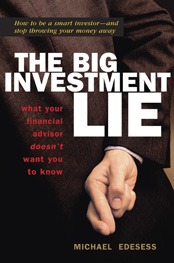
The Big Investment Lie
What Your Financial Advisor Doesn't Want You to Know
Michael Edesess (Author)
Publication date: 01/01/2007
Once you know the truth, you'll want to adopt Edesess's Ten New Commandments for Smart Investing, simple rules you can follow to invest, get a profitable return, and avoid squandering any more of your hard-earned dollars on bogus expertise.
Find out more about our Bulk Buyer Program
- 10-49: 20% discount
- 50-99: 35% discount
- 100-999: 38% discount
- 1000-1999: 40% discount
- 2000+ Contact ( [email protected] )
Once you know the truth, you'll want to adopt Edesess's Ten New Commandments for Smart Investing, simple rules you can follow to invest, get a profitable return, and avoid squandering any more of your hard-earned dollars on bogus expertise.
Michael Edesess is an accomplished mathematician and economist with experience in the investment, energy, and sustainable development fields. He is a senior research fellow in the Centre for Systems Informatics Engineering at City University of Hong Kong, principal and chief strategist of DC-based Compendium Finance, research associate of the EDHEC–Risk Institute, and senior fellow and project consultant at two Hong Kong–based think tanks.
He writes regularly for the online journal Advisor Perspectives, coauthored "The 3 Simple Rules of Investing" (Berrett-Koehler 2014) and authored The Big Investment Lie (Berrett-Koehler, 2007). He was a founding partner and chief economist of the Lockwood Financial Group until its 2002 sale to The Bank of New York. Previously a consultant and provider of mathematical computer systems to institutional investors, Dr. Edesess worked with several of the largest banking and consulting firms. He has taught courses in finance, energy and environmental economics, mathematics, and statistics at six universities. He has been interviewed on radio and TV and published in the Wall Street Journal, the Journal of Portfolio Management, and Technology Review, among other publications.
In addition to his work in investments, Dr. Edesess has been active in nonprofit organizations. He chaired the board of International Development Enterprises USA, which focuses on rural smallholders in developing countries, and also chaired the board of Rocky Mountain Institute, a prominent energy efficiency think tank, and the Rocky Mountain Advisory Board of the Environmental Defense Fund. Dr. Edesess holds a bachelor’s degree from MIT and a Ph.D. in pure mathematics from Northwestern University.
—David Booth, Chairman, Chief Executive Officer, President, and Chief Investment Officer, Dimensional Fund
“With wit and accuracy, and based on years of personal experience, Edesess provides clear and easy advice that will help you add substantial value to your portfolio.”
—George Case, consultant and analytical software pioneer
Introduction: Excuse Me, Is This the “Real” World?
Part I: How Much You Pay
1. The Beardstown Ladies versus the Professionals
2. The Extraordinarily High Cost of Investment Advice
3. The Outer Limits: Hedge Fund Fees
4. Taxes Down the Drain
5. Why Do We Give Golden Crumbs to Rich People?
Part II: How Little You Get
6. Why Investment Professionals Can't Predict Markets
7. The Abject Failure of Professional Advisors and Managers
8. The Market Can Turn on a Dime
9. The Claims of Money Managers: “Smoking Our Brand Prevents Cancer”
10. Idle, Greedy Hands and Too Much Data Do the Devil's Work
11. The Simple Rules of Nobel Prize Winners
12. There's No Such Thing as a Free Lunch
13. Investment Genius or the Thousandth Coin?
Part III: How You Are Sold
14. Effective Pitches to Sell the Big Lie
15. How Investors Delude Themselves
16. How Hedge Funds Operate and Are Sold
17. How Consultants and Money Managers Sell to Institutional Investors
18. Derivatives: The Good, the Bad, and the Ugly
19. The Modern Slippery Slope of Business Ethics
Conclusion: The Ten New Commandments for Smart Investing
Notes
Glossary
Bibliography
Index
About the Author
1
The Beardstown Ladies versus the Professionals

The Beardstown Ladies would have had it made for good if they hadn’t been so naive and honest.9
In the early 1980s, Mrs. Betty Sinnock, a grandmotherly woman of homespun wisdom, formed an investment club with fifteen other women—also senior citizens—in the town of Beardstown, Illinois, population 6,200. They called their club the Beardstown Business and Professional Women’s Investment Club.
They got together regularly to study public companies and to select some to invest in. They joined the National Association of Investors Corporation (NAIC), an organization of investment clubs. They researched stocks, looking for companies with a solid history of growth. They saved and invested diligently, contributing $4,800 a year to their joint portfolio.
They stuck to companies they knew. When one of them came to a club meeting and announced she had seen a lot of cars parked at Wal-Mart, they bought Wal-Mart. One member brought some Hershey Hugs to a meeting. The members decided they tasted good. They wound up buying Hershey stock.
By 1992, they had accumulated a substantial portfolio, making them one of the larger investment clubs in the NAIC. The Beardstown Ladies’ discipline and hard work had paid off. They were proud of their achievement, accomplished through their own efforts without professional advisors.
They were so unlike the conventional image of astute investors, and so appealing as a human interest story, that they attracted media attention. They appeared on the nationally televised program CBS This Morning, performing so well that CBS asked them back.10
What happened next will go down in history. As one observer’s account puts it, “For the Beardstown Ladies, it was the deviation from their comfort zone—in an attempt to quell the fast-paced, number-hungry media—that got them into trouble.”
In senior partner Betty Sinnock’s own words: “In 1991, a producer of CBS This Morning called and asked to feature our club for the second time. They wanted us to be on the show January 2, 1992 and they wanted to know what our annual return had been and how we had fared against the Dow.”1
To respond to this request, the club bought the NAIC Accounting Software and received permission to use it at their bank, since Mrs. Sinnock didn’t own a computer.
When Mrs. Sinnock finally got the data entered and read the results, the club had earned an average 23.4 percent per year for a ten-year period. The Standard and Poor’s 500 (S&P 500) stock market index, a broader index than the Dow, had achieved only 14.9 percent per year.
The Beardstown Ladies had outperformed the stock market by a full 8.5 percent per year!
The mere human interest story of the Beardstown Ladies got a shot of adrenaline from that 23.4 percent ten-year return that Betty Sinnock had calculated with the NAIC accounting program. This was the stuff of big print on book jackets, a publisher’s dream.
A book packager in New York asked to do a book based on the club. The book, The Beardstown Ladies Common Sense Investment Guide, became an instant best seller and soon was being published in seven different languages. Four more books followed, plus several audio and big-print editions and a video. The books touted in big bold letters the Beardstown Ladies’ “23.4% per year return.” The ladies were doing more traveling than they had ever dreamed possible. They were happy to share their knowledge to motivate others to save and learn about investing. They were constantly in the news, always in stories glowing with warmth and admiration.
In Betty Sinnock’s words:
Television stations would fly us to New York or California for a four-minute segment. For us, coming from a small town, it was all the more exciting. Maybe a little frustrating and amazing, too.11
In December 1994, Phil Donahue flew 13 ladies and our broker to New York to appear on his show to promote the first book. Six of the ladies had never been to New York City, and two of the ladies, in their 70s, had never flown before. It was a fantastic experience.
As we were being chauffeured around in limousines, I remember thinking, “we don’t spend money like this.”…
As part of the book’s promotion, we were scheduled to be in a different city every day for 14 days. We were doing several interviews a day, for the print, radio and television media. It got pretty exhausting.… I was traveling nearly four days a week.…
It wasn’t until the groups of people coming to hear us talk began to grow that we finally began to take in what was happening. At one point we were asked to do a program for the Smithsonian. Every time I talked to the people from the Smithsonian, the venue had changed because they needed more space to accommodate all of the people. Finally, we ended up in the auditorium of Washington University, where 1,500 people had made reservations to hear us speak.
For the first time, I felt that this must be how a celebrity feels.2
And it was all because of their 23.4 percent annual return.
When I heard about this on the news I assumed the number was wrong—but not because the Beardstown Ladies were inexperienced and untrained investment professionals. No, I assumed it was wrong because I knew how easily accidental or trumped-up statistics acquire lives of their own in the investment field. The gullible public and the mass media that cater to it, wishing fervently to believe in investment Holy Grails, regularly swallow these unlikely but facile figures whole, without checking.
On March 2, 1995, the New York Times, usually known for careful reporting and fact checking, nevertheless published a long and thoroughly uncritical piece on the Beardstown Ladies, in which their 23-plus percent performance was cited not just once but several times. The piece included a recipe for “Shirley’s Stock Market Muffins (Guaranteed to Rise).”12
A Times editor would reread this piece now with deep embarrassment. But from 1992 to 1998, the Beardstown Ladies had a spectacular run. Their books, audios, and videos sold in the millions. Their success spawned investment clubs around the country. They became investment advisors to the world.
In 1998, a journalist for Chicago magazine, Shane Tritsch, expecting to write the usual puff piece on the Beardstown Ladies, suddenly became suspicious. What aroused his suspicion was a fine-print disclaimer on the copyright page of the paperback version of the Beard-stown Ladies’ Common Sense Investment Guide. The disclaimer read, “This ‘return’ may be different from the return that might be calculated for a mutual fund or bank.”
At the instigation of the Beardstown Ladies themselves, an independent audit of their investment returns was performed by the accounting firm Price Waterhouse. The study concluded that their investment return over the ten years had been not 23.4 percent but only 9.1 percent—underperforming the S&P 500 index by almost 6 percent instead of outperforming it.
The news should have come as no surprise to knowledgeable stock market and financial media observers. But it was of course devastating to the Beardstown Ladies’ reputations as investment gurus. The error was apparently totally innocent. As Betty Sinnock described it:
In 1992, the club offered to buy the NAIC Accounting Software if I could get permission to use it on a computer at the bank since I didn’t own a computer. I entered the data as of 12/31/91 and I thought I was inputting the data so the first eight years would be included in our returns. Because of this, when the computer showed an annual return for our members in 1993 of 23.4 percent, I thought it was for the first 10 years and shared the information with the rest of the ladies and with the producer of our video, which had recently been completed.…
We have since learned that the 23.4 percent was for a two-year period and not for the first 10 years as we had always thought.3
In giving this account of the error in a press release, Mrs. Sinnock added, “The Beardstown Ladies are just really, really sorry.”13
The error was duly reported in the media. Time magazine published an article under the tongue-in-cheek headline “Jail the Beard-stown Ladies.” The Beardstown Ladies’ publisher dropped them. But the Ladies had clearly not connived, knowingly and maliciously, to propagate an erroneous number purely to enhance their own reputations and sell books. Their phenomenal success—though based largely on a falsehood—was not based on a deliberate, premeditated, and knowing falsehood but on an inadvertent one, a falsehood that the credulous public and the media lapped right up.
There was the expected, though muted, tut-tutting, implying that things had been set right again. Of course, mere amateurs like the Beardstown Ladies couldn’t really beat the pants off the market and compete with professional investors on Wall Street. But this theme was surprisingly downplayed, not played very often, and not played much at all—in particular—by professional investment counselors themselves. It might seem like a case of professional courtesy, or just kindness and deference to some white-haired old ladies.
In fact, the muted quality and even nonexistence of “I told you so’s” in the investment profession was also motivated by the perennial need of the investment advisory industry—the community of investment advisors, investment managers, investment consultants, investment commentators, and other investment “experts” of all stripes—to deflect attention from their own nakedness.
In March 1998, after the Beardstown unmasking, Tom Gardner, a founder of the offbeat Web-based investment commentary called “The Motley Fool,” posted the appropriate comment on the Fool’s Web site, fool.com. Noting that the Associated Press had run an article entitled “Beardstown Investors Called Frauds,” Gardner wrote:
Over the past five- and ten-year periods, between 85–95% of all mutual funds have done worse than market average, and we haven’t yet come across a single article entitled “Mutual Fund Managers Called Frauds.” This even as their advertisements cloud over the real underlying value of their managed funds (after the deduction of all costs and taxes) relative to that of an index fund. Do mutual-fund families plan to hire outside auditors to scrutinize and then publicize the after-tax returns of their products over the past decade? (I’ve decided to start holding my breath now. Someone please tell me to stop.)414
Compared with the Beardstown Ladies (their inadvertent fraud having been exposed at their own behest, to the ruin of their enterprise)—whose fraudulent practice was naive, unintended, and strictly from Hicksville—the fraud of the investment advice and management industry is studied, refined, Wall Street minted and Madison Avenue packaged, and extraordinarily effective.
Unfortunately, the real message of the Beardstown Ladies—the example they represented of the virtues of self-reliance, disciplined saving, and thrift—was lost in the shuffle. For the prurient taste of the public and the media, these virtues had to be mixed with a hint of avarice. The Beardstown Ladies fell short, in the end, on the avarice quota. But they needn’t have.
If they had been more artful, more worldly, more knowing, more cunning in the ways of the investment advice industry, they could have come out smelling like a crafty rose. They could have admitted and quickly apologized for their error, then swiftly moved on to emphasize the years in which they did beat the stock market. They could have explained away the years in which they lagged the stock market by saying their investment approach was “out of style” in those years or some such thing. Their publisher would not have dumped them, they would continue to be regarded as investment gurus, and they would have joined the ranks of the true investment professionals.5
The Big Investment Lie
The saga of the Beardstown Ladies may seem like an aberration and a curiosity in the annals of investment gurus. But it is not an aberration and a curiosity. On the contrary, it is typical. Behind the success of nearly every wealthy investment professional lie a winning way, an air of confidence, and an erroneous or highly selectively quoted statistic.
The success of nearly all prosperous investment professionals consists not in procuring higher rates of return on investment for their clients but in procuring astoundingly high fees from their clients—without the clients taking much notice.
In other fields, too, professional advice can be of doubtful value. An abundance of savage lawyer jokes makes it clear that many people think lawyers often do more harm than good—and overcharge their clients. Even in the medical field, doctors themselves will admit that their medical expertise can make a real difference only in a minority of cases.15
But in no service field in which customers pay for professional advice and assistance is the failure to help so clearly measurable, and so clearly demonstrated, as in the investment field. Furthermore, for this total and demonstrable failure, customers pay far, far more than they will ever pay for medical advice and treatment, or for the services of a lawyer, or for any other professional advice and assistance they will ever get.
The investment advice and management industry encompasses a vast and complex array of advisors, managers, financial analysts, custodians, brokers, traders, performance evaluators, auditors, accountants, actuaries, conference managers, journalists and publishers, writers, ghostwriters, newsletter publishers, computer systems developers, and an endless array of consultants and consultants to consultants.
The investment advice and management industry is enormous, with total revenues well over $200 billion per year in the United States alone.6 A percentage of investors’ assets provides the entire financial support for this industry.
When an investor engages the services of an investment advisor or of a money manager, or both (usually both), the investor typically winds up with a combination of two investment strategies, one on top of the other.
The first is a sound, simple, low-cost strategy of investing in a diversified portfolio of stocks and bonds, a strategy that is almost certain to provide a strong positive return on investment in the long run.
The second strategy, which is skillfully and seamlessly overlaid on the first, is a gambling strategy, having expected zero return, and a cost paid to the croupiers rivaling the house take at any gambling casino in Las Vegas.
The vast majority of advisors and managers recommend not just the first strategy but also the second strategy packaged with it. Recommending both strategies as a package and collecting the large resulting fees is, quite frankly, like taking candy from a baby. Most investors—even those, surprisingly, who are very wealthy—seem totally unaware of what they are paying and equally unaware of the fact that they get nothing for it. On the contrary, they assume, against all the plainly available evidence, that they are getting something of great value.16
In maintaining this situation, the community of investment professionals is helped greatly by what I will call “the Big Investment Lie.” A Big Lie is a lie so bold, so often and so firmly stated that even in the face of contradictory evidence, people cannot believe anyone would be so assertive if it were not true. Once a Big Lie gains currency, it is repeated by many people, adding to its force.
The investing public has been fooled (and has fooled itself) for a long time by the Big Lie, a lie strongly supported by the investment advice and management professions. As the infamous former leader of Nazi Germany said,
The size of the lie is a definite factor in causing it to be believed, for the vast masses of a nation are in the depths of their hearts more easily deceived than they are consciously and intentionally bad. The primitive simplicity of their minds renders them more easily prey to a big lie than a small one, for they themselves often tell little lies but would be ashamed to tell a big one.7
Indeed, the vast masses of a nation are not as primitively simple as the leader thought. Yet his insight into the nature of a Big Lie is still valid. It is harder to debunk a Big Lie than a little one, because the vast majority of people do not tell big lies themselves. Therefore, given the choice, on the one hand, of believing what a phalanx of ostensible authorities (at least as respectable in appearance as they are themselves) says to be true and, on the other hand, believing it is an outlandish whopper, most people will believe it to be true.
Therefore, it takes a major information campaign to debunk a Big Lie. It is a campaign that must be waged again and again—because the Big Lie keeps hopping verbal airships bound for bigger and more unearthly lies, while the Truth lags far behind, still putting on its boots.
If an investor interviews several investment advisors, she will find that they all say much the same thing. They will speak of a process of “asset allocation” and “selecting the best money managers or mutual funds.” They may speak of “dollar-cost averaging” and, perhaps, “regression toward the mean,” “efficient frontier,” “mean-variance analysis,” and “Nobel Prize–winning technology”—all with the predictable effect of snowing the client and helping to spread the Big Investment Lie.17
Once you hear the same things from several different members of the same profession, all wearing nice clothes and occupying plush offices, you will assume a verifiable body of fact, theory, and evidence lies behind it—much as you would assume the same if you interviewed several doctors about a medical condition. And indeed there is a body of theory and evidence. But virtually all of that theory and evidence implies you should use the simple strategy, Strategy 1—never Strategy 2.
Strategy 2 is what advisors and managers add so that they can get paid handsomely. It is like the cable that a computer store sells you at a high price, to go along with the printer you thought you were buying for such a low price. It is like the maintenance insurance contract they try to sell you, too, because they can make a good profit on that, while they can’t make much profit on the printer itself because price competition has driven the price of that commodity to rock bottom.
Similarly, in the field of investment advice and management, the advisors and managers add on features to the basic investment commodity that they can charge you for. But what a charge! When you buy a printer and then find you have to buy a cable too, it might cost you $15 extra. But the add-on for worthless investment advice and management will cost you tens of thousands, hundreds of thousands, even millions of dollars. The investment advice and management industry is trying to sell you a $10 million mainframe—almost all of it of no value to you—when all you need is a $499 laptop.
The Big Lie is perpetuated by a constant barrage of advertising. The typical ad is a two-page spread in a glossy magazine for a big brokerage firm or a big bank. The ad shows a distinguished-looking man in a conventional suit, graying at the temples (sometimes now it is a woman), who looks like he came from central casting (and he is, in fact, not an employee of the company but a professional model). The look implies “we know our business.”
But that knowing look is a look of knowing… absolutely nothing, except how to sell a high-fee service.
This tactic is not that surprising or even shameful in a capitalist economy. The company is only doing what it is supposed to do: sell whatever its product is and try to maximize profits.
But the customer is not doing what the customer is supposed to do: try to minimize costs. Instead, the customers in the investment advice and management industry are so befuddled and so taken in by the Big Investment Lie, that they seem almost totally inattentive to costs. They will search for hours online to find the cheapest airfare to save $50, but they will not realize they are losing $50,000 on costly but worthless investment advice and management. In recent years, as the evidence has piled up and piled up that money management by professional investment managers adds nothing at all,8 the exorbitant fees charged by money managers have not decreased but increased. And investors pay these fees, apparently unaware of the cost.918
Investors pay these fees because of what an investment professional I know, the chairman of a major investment firm, calls “optics.” If you are an investment advisor or manager or any one of a veritable explosion of middlemen in the investment field, you state fees in such a way that they look small. This usually takes the form of stating fees as a “small” percentage of assets. Investors accept these “small” fees without quibble because they assume that the value of the advice, as a percentage of assets, will surely exceed the cost.
But this is exactly what the evidence, unequivocally, shows to be untrue. This is no secret. It has been published widely. It has been pointed out by the best writers of investment self-help books, people like Jane Bryant Quinn, Andrew Tobias, and many others. Public awareness of the fact accounts for the success of a mutual fund subindustry based on low-cost investing. Yet, still, far too many people pay exorbitant fees for investment advice and management. The message has gotten through, but it hasn’t spread as widely as it should. The Big Investment Lie has seen to that.
Sauntering through the expensive, glossy outputs of the professional investment field, you may glimpse arcane, sophisticated-sounding articles, suggesting the discourses of an elite corps of exquisitely knowledgeable experts. Recent issues of Institutional Investor magazine, for example, and others like it carry stories about “portable alpha,” “separating your alpha from your beta,” and other impenetrable themes.
Yet in spite of the self-serving message trumpeted to both insiders and outsiders by these arcana—“we insiders are smart and extraordinarily capable”—the actual fact is that professional investors do not do better than the random investment picks of a gaggle of monkeys.
The Big Investment Lie is rather like the Big Lie perpetrated by tobacco companies in their advertising in the 1950s. As evidence that cigarette smoking was detrimental to health began to mount, cigarette companies’ TV commercials featured men wearing white laboratory coats touting their brand of cigarettes. This “doctor” strategy finally fell apart under a barrage of negative medical evidence, after decades of resistance by tobacco companies and a torrent of advertising.19
But the strategy of the Big Investment Lie is still working wonders. No equivalent of the federal Food and Drug Administration (FDA) rigorously checks the validity of the implied claims of investment advisory firms. If the tacitly implied claims of investment advice and management firms were subjected to a statistical test similar to the tests new pharmaceutical drugs have to pass, few or no investment advisory firms would ever be registered.
But because poor advice and investment management is not detrimental to your health, only to your finances, it is—perhaps properly—deemed a matter in which the buyer, not the government, must beware. The government will guard you against certain openly fraudulent practices in the investment advice and management industry; but it will not—as it does in the approval process for pharmaceutical drugs—protect you or even warn you against a remedy that costs far too much and doesn’t work at all.
The investor is not an entirely innocent victim of the Big Investment Lie. The lure of getting rich quick, of finding the Holy Grail, can make the client a willing partner in assisted self-delusion. Perhaps, like Blanche DuBois in A Streetcar Named Desire, clients for investment advice and management would honestly say, “I don’t want reality—I want magic!”
The investment industry by and large caters to this wish instead of discouraging it. Industry “professionals” are like physicians who invent medical-sounding reasons why their addicted patients should keep on smoking. Their advertising suggests that the investor is smart to hire professional assistance, but it is smarter by far to “just say no” to expensive and misleading help—and, as I shall show in later chapters, how much smarter, you cannot begin to imagine!
The typical investor—the buyer of hot mutual funds or the client of expensive advisors who imply they offer superior investments—is looking to get rich without working. He is looking for a vicarious road to riches, a road that enables him to suddenly wake up one day rich.
The odd thing is that this road exists. But its advantages are squandered away by investors who want their road to be better and richer than other people’s. Diversified, low-cost, low-tax investment in stocks and bonds will make most thrifty people, who save their money and invest it, well off over time. But instead—because investors want not just a pot of gold but the rainbow, too—they make investment advisors and managers rich, while they themselves do only modestly well. In some cases, they do not do well at all.20
Investors have a central role to play in breaking the back of the Big Investment Lie. They must give up the temptation of high-cost gambling and realize that it is much more likely to keep them poor than to make them rich. They must be supremely suspicious of investment advisors who imply they will beat the market or who do not fully reveal, in every minute and cumulative detail, what their services cost.
The job of genuinely professional investment advisors should be to disabuse investors of the get-rich-quick, beat-the-market mentality and tell them how simple it is, if they would only stop searching for the Holy Grail. And they should not charge them too much for this unadorned truth.
There are a few fine, upstanding people and companies in the investment advice and management field, who charge only reasonable fees and who honestly and learnedly advise you what will and will not add investment value. If you feel the need for a personal advisor, this book will help you find one. But it will also show you that you don’t need one. The smartest investment strategy is so simple and so direct that you can easily do it yourself. This book will show you how.
It is not the purpose of this book to indict an entire industry and put it to shame. The investment industry is doing what businesses are, for better or worse, supposed to do in a capitalist economy: figure out what earns a profit and pursue it. It is inevitable that they will find ways to present their sales materials so that customers buy into it. As long as their activities do not clearly violate broad legal principles, they are entitled to persist. If the customers buy the sales pitch and the product, sellers can only presume they have given the customers what they want at the price they want to pay.
It is emphatically not the purpose of this book to call for new legislation or regulation, though requirements for the money management industry to publicize more balanced and accurate statistical information may be beneficial.
No, the proper check on a rogue industry is an informed consumer. The purpose of this book is to expose the Big Investment Lie and thus to enlighten consumers of investment services. The information in this book is already widely available, but it continues to be drowned in a sea of the Big Investment Lie. The steady drumbeat of the message, “You need professional investment advice and management,” drowns out the relatively far weaker voices purveying the truth. Why? Because, of course, there’s much more money to be made in selling expensive advice and management than there is in exposing the fact that it is far too high priced and adds nothing of value.21
As I shall show, two types of professionals that could, if bent to the purpose, expose the truth in a louder voice have in large part been subtly co-opted by the reality, or even the whiff, of the money that can be made in the investment industry: financial journalists and financial academicians.
This book’s aim is to start a communication snowball rolling that will enlist these voices as well as others, becoming big enough to combat the Big Investment Lie. Thus, perhaps, this book will reduce the investment advice and management industry to the compensation and size that are properly due it, and it may release a number of smart people from golden bondage to pursue more productive work.