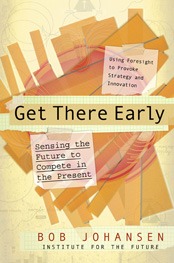
GET THERE EARLY explains how leaders can anticipate future challenges and opportunities in order to optimally compete in the present. Using numerous examples and applying a revolutionary Foresight to Insight to Action model, Bob Johansen, former president and CEO of the Institute for the future, explains how to get a head start on your competition.
These days, every leader struggles with a paradox: you can’t predict the future, but you have to be able to make sense of it to thrive. In the age of the Internet, everyone knows what’s new, but to succeed you have to be able to sort out what’s important, devise strategies based on your own point of view, and get there ahead of the crowd.
Bob Johansen shares techniques the Institute for the Future has been refining for nearly forty years to help leaders navigate what, borrowing a term from the Army War College, he calls the VUCA world: a world characterized by volatility, uncertainty, complexity, and ambiguity. As the institute’s ten-year forecast makes clear, leaders now face fewer problems with neat solutions and more dilemmas: recurring, complex, messy, and puzzling situations. Get There Early lays out the institute’s three-step Foresight to Insight to Action Cycle that will allow readers to sense, make sense of, and win with dilemmas. Johansen offers specific techniques, ranging from storytelling to simulation gaming, as well as real-world examples to help readers turn the VUCA world on its head through creative use of vision, understanding, clarity, and agility. This book offers hope for leaders facing the constant tension—a dilemma in itself—between judging too soon and deciding too late.
GET THERE EARLY explains how leaders can anticipate future challenges and opportunities in order to optimally compete in the present. Using numerous examples and applying a revolutionary Foresight to Insight to Action model, Bob Johansen, former president and CEO of the Institute for the future, explains how to get a head start on your competition.These days, every leader struggles with a paradox: you can’t predict the future, but you have to be able to make sense of it to thrive. In the age of the Internet, everyone knows what’s new, but to succeed you have to be able to sort out what’s important, devise strategies based on your own point of view, and get there ahead of the crowd.
Bob Johansen shares techniques the Institute for the Future has been refining for nearly forty years to help leaders navigate what, borrowing a term from the Army War College, he calls the VUCA world: a world characterized by volatility, uncertainty, complexity, and ambiguity. As the institute’s ten-year forecast makes clear, leaders now face fewer problems with neat solutions and more dilemmas: recurring, complex, messy, and puzzling situations. Get There Early lays out the institute’s three-step Foresight to Insight to Action Cycle that will allow readers to sense, make sense of, and win with dilemmas. Johansen offers specific techniques, ranging from storytelling to simulation gaming, as well as real-world examples to help readers turn the VUCA world on its head through creative use of vision, understanding, clarity, and agility. This book offers hope for leaders facing the constant tension—a dilemma in itself—between judging too soon and deciding too late.
1
Introduction
Foresight to Insight to Action
As the son of a milkman in the small midwestern town of Geneva, Illinois, I was taught to get there early from the start. In the days before refrigeration, my dad got up at midnight to deliver his milk. My first job was getting up with him to help on the milk route, but by that time we had a refrigerated truck and were able to sleep in until 4 a.m. My dad started early, but he got to finish early as well, and he saw things that others did not see. I still remember the freshness of the predawn summer mornings in Illinois when we were up and active before anyone else. Once I was up and out of bed—as long as I was not out late the night before—getting there early had lots of dividends. Getting there early helps you see beyond the problems of the present.
Most organizational cultures today, and most leaders, want to get there just in time, not get there early. Many are willing to settle for getting there “fashionably” late. They focus on quick-fix problems, and they love people who solve those problems rapidly. They hate dealing with the long-term kinds of dilemmas that will characterize the future.
THE VUCA WORLD OF DANGER AND OPPORTUNITY
VUCA is an unpleasant acronym, but I have found it surprisingly useful as a way to open conversations about the future. It stands for Volatility, Uncertainty, Complexity, and Ambiguity. It originates from the U.S. Army War College in Carlisle, Pennsylvania—the U.S. Army's graduate school for generals-to-be—which is now informally calling itself “VUCA University.”
2
Sometimes perceived as the most conservative, the most hierarchical, and the slowest moving of the military branches, the army is transforming itself. Assumptions about logical human behavior are being challenged in the face of extremes—like indiscriminate killing of civilians and children, or suicide bombings. In this kind of world, an increasing number of leadership challenges will be embedded in dilemmas—some of which look like problems.
Many people are so fearful and uncomfortable with uncertainty that they have a desperate need for answers. Some will accept only a simple moral equation as an answer, even if there is no simple moral equation. Many people feel an urgent longing for a sense of control.
As an example, consider how often words like absolutely are used in your daily conversations. The word absolutely gives the speaker a sense of momentary control and comfort in a world where absolutes are hard to find. It is a satisfying word to say, with two opportunities for emphasis: AB-so-LUTE-ly! Listen for this word in your conversations and consider how it is being used and for what purpose. In my experience, the popularity of the word absolutely and other strong declarations (words like exactly, precisely, of course, no doubt, undoubtedly, clearly, utterly) has increased significantly in recent years. Absolute language is comforting, and demand for certainty will grow in the future.
We all need some comfort and security in life. In order to thrive, beyond just surviving, people must take on dangers and turn around the uncomfortable VUCA acronym by developing the skills and state of mind that I describe as having Vision, Understanding, Clarity, and Agility, all of which will be explored in this book. We need to call attention to the challenges, but we also need provocative ways to generate believable hope.
How can leaders develop their own abilities to get there early, to understand what's going on, and to succeed in a world of dilemmas—without resorting to a false sense of certainty?
3
GET THERE EARLY
Get there early has a very specific meaning for me, and it is not just about speed. Get is an action word, and there implies direction and intent: an outcome, a vision, or a goal. Get there suggests strategy to me, a direction and a place where you are going, with at least some idea how to proceed and what you might do when you get there. Early means at the right time or at least with good timing. Usually, getting there early means getting there before the masses, in time to gain some advantage. If you get there late, you stand in line, and you might not get in at all. If you get there early, you don't have to rush, and you have time to make a good decision.
For corporations, get there early means finding new markets, new customers, and new products ahead of your competitors. Toyota got to the hybrid car market with the Prius at a very good time, with a conscious focus on consumers who wanted to change the world with a purchase decision that evolved into a public statement. The iPod was not the first digital music player, but Apple was the first maker to do it right, with great design, ease of use, and functionality. The iPod demonstrates that it is important to get there early but not necessarily to get there first. Success is more about timing than it is about time. Sony got there early with the Walkman for cassette tapes and CDs, but it got there late for digital music players. Success is transient.
For nonprofits, get there early means anticipating the needs of your stakeholders and sensing emerging issues before they become overwhelming or before others who don't agree with your issues have taken a commanding position. In the United States, people with great foresight saw that—by getting there early—they could create massive public national parks that never could have been established once commercial land development took over. California's Coastal Commission, established in the early 1970s, was created much later than most national parks, but it still got there early enough to establish public-oriented coastal guidelines that have resisted commercial real estate forces.
Get there early means seeing a possible future before others see it. Crest toothpaste, for example, was the first toothpaste to be approved by the American Dental Association. Before the ADA endorsement was granted, Procter & Gamble supported large public research efforts on the effects of fluoride, a key ingredient in Crest. Get there early also means being able to act before others have figured out what to do. Based on the positive results from the fluoride research, P&G came up with a novel plan for ADA endorsement of Crest. It doesn't do any good to get there early if you don't do anything.
4
Within UPS, there is an informal cultural understanding that if you get to a meeting fifteen minutes early, you are on time, so that you show respect for others by not having them wait and also increase the productivity of the meeting. UPS is still a get-there-early company, with a culture that requires on-time behavior. Not surprisingly, UPS is one of the most sophisticated corporations in using foresight to draw out insight as input to strategy. Management uses ten-year scenarios to test their strategies on a regular basis, and they have a corporate strategy group that keeps the get-there-early discipline alive. At UPS, getting there early is not an option; it is built into the company's strategy.
I get to airports two hours before flight time, and I bring my work with me. I find that takes a lot of the stress out of travel, and if something does go wrong, I've got time to recover. Some years ago, my wife and I were going to Australia, where I was to give a talk for an Australian government celebration. I dragged my wife to the airport three hours early, only to discover as we checked in that we did not have proper visas for the trip. In those three hours before flight time, we were able to contact the embassy, get special visa photos, rush in a cab to the nearby home of a local Australian official, get an emergency visa, and still make our flight (just barely). My wife has never complained about getting there early since that trip.
When airports are on alert, the time it takes to go through security is unpredictable. Arriving at the airport two hours early has reduced my travel stress—and I get a lot of work done as well. Time at airports and on planes has become a very important opportunity for uninterrupted work for me. In fact, much of this book was drafted in airports and on planes. At least some of the current discomfort of travel is of our own making, when we play a fragile system too closely and stress out when it doesn't work as fast as we want it to work.
5
When I go to baseball games, I like to arrive right when the ballpark opens, about two hours before the first pitch. That way, we get to see batting practice, and we can relax and watch the scene unfold as the crowd arrives. We become part of a relaxed and expectant gathering that is gradually coming to life. We rarely encounter traffic or lines. Our experience at a ballgame is reflective and pastoral, in spite of the fact that—eventually—we are part of a large crowd at our San Francisco ballpark. Getting there early creates a special experience for us. We get a more personal experience of the game. When we get there early, the staff and even the players pay more attention to us. We wander into places where crowds are not allowed. Almost any experience is changed, usually for the better, by getting there early.
In professional baseball, Billy Beane and the Oakland A's got there early with the “moneyball” approach to talent selection, an innovative approach that uses quantitative measures to forecast player performance—and thereby build winning teams.1 For years, the A's achieved much better performance results with a small budget than did most other teams that spent much more money on players. Now, however, other teams are applying similar measures, meaning the A's must continue to innovate.
Bill Walsh of the San Francisco 49ers got there early with his West Coast Offense in professional football. The 49ers achieved great success during the Bill Walsh era, but the West Coast Offense is now used by many teams as Walsh's former assistant coaches have moved on to lead other teams. The get-there-early advantage is usually only temporary.
What happens when you have a scheduled meeting but some of the participants don't show up on time? (In a cross-cultural world, with different habits, practices, and preferences with regard to time, coordinating our work—especially our global work—will become increasingly complex.) Those who are on time are left to make awkward conversation, while tardy members essentially waste the time of their increasingly anxious colleagues. What about conference calls in which some participants straggle in late to the call? Remember those awkward exchanges? “Who has just joined?” “When should we start?”
How about starting on time, with an agreed-upon-in-advance protocol for appropriate and inappropriate behavior? How much time is wasted each day by waiting for those who arrive late? I have a friend who joined a get-there-early company, and his first boss was an industrial engineer who was particularly punctual. Using the salary levels of all the people in a given meeting of his staff, this leader always had his algorithm ready so that he could he could greet any latecomer with a calculation of the cost of any delay expressed in dollars. This approach is probably too extreme for most of us, but his staff did learn not to be late for meetings.
Organizations that have a get-there-early culture begin meetings on time, even if everyone is not there. Getting there late is just not acceptable. Once a get-there-early or on-time culture is established, most people show up on time—unless truly extenuating circumstances arise. Getting there early respects the time of others, as long as you don't get there too early.
Getting there early is not about rushing to do as many things as possible, running from one action to another. Doing things in a rush is more of a modern American value than getting there early. To me, get there early means getting there ahead of the rush so that you have time to reflect, time to consider alternative paths of action, time to think. I get there early so I don't have to rush.
When I was president of Institute for the Future, I set all of the clocks seven minutes fast. Of course, that works only if you run according to the new time, and some of my colleagues didn't get the concept. Setting your clock ahead doesn't make any difference if you still believe only the original setting. At one point, in friendly rebellion, one of my colleagues brought in an additional clock and hung it in our conference room. Under the matching clock that ran seven minutes fast were the words His Time, while the sign under the other clock read Our Time. Seven minutes ahead of actual time came to be referred to as Bob Time, just as it used to be called Daddy Time by my kids when they were little.
Get there early can play out in different ways for different people. You need to decide what get there early might mean for you and how this stance could alter your own leadership. This book will give you lots of options and lots of rationales for why it is good to beat the crowd.
7
The key is to get out in front—or at least toward the front—of whatever process you are engaged in. In some cases, you'll want to be there ahead of your competition in order to get some kind of edge or advantage. Kleenex, for example, got there early with a good tissue and became the name for an entire category, not just a brand. Most consumers don't say “Do you have a tissue?” Instead, they say “Do you have a Kleenex?”
Getting there early is particularly valuable if you have no idea what's going to happen after you arrive. It allows you to get settled, establish a position, and prepare. If you get there early, you can be centered and ready, while your competitors who arrive late are likely to be disheveled. It helps you think through what might happen, once you are there, and consider alternative strategies with time to think them through. You've got a chance to be ready when others are just rushing in. You can hold the possibilities in your mind while still figuring out what to do and gain a deeper understanding of what was going on before you got there. Getting there early is especially important in times of volatility, uncertainty, complexity, and ambiguity—where figuring out what's going on is not at all easy.
SENSING AND FLEXING
It takes understanding to engage with complexity without becoming mired in it. Leaders must determine when decisions need to be made (sensing) while still allowing for agile course corrections as decisions play out (what I call “flexing”). This determination takes great sensing skills, combined with an ability to make sense out of what is happening and flex your way to success. While judging too soon can be dangerous, deciding too late could be worse.
Part 1 of the book (Chapters 1 through 4) prepares you with a birds-eye view of big-picture driving forces and discontinuities; the map inside the book jacket illustrates a mesh of dilemmas requiring new forms of leadership beyond problem solving. Part 2 (Chapters 5 through 7) helicopters down to make sense out of the present, to draw out strategic insight. Part 3 (Chapters 8 through 11) takes you to the ground level of action, teaching you how to use our approach to win and help others win. The Conclusion offers personal suggestions for applying the ideas in this book to your own leadership challenges.
8
Get There Early lays out the Institute for the Future's three-step process—foresight to insight to action—that will enable readers to sense, make sense out of, and win when faced with dilemmas. Get There Early offers practical methods for sensemaking and flexing, a collection of skills, intuition, content, and style that allow you to:
Develop foresight, to sense and understand the context around the dilemmas that challenge you. The goal is not to predict what's going to happen but to provoke your creativity and prepare you for your biggest challenges, many of which are likely to come in the form of dilemmas. Foresight is the first step in any good strategy process: the search for external forces and environmental factors creates the context for both strategy and innovation. Leaders are always sensing, as well as coaching others, about what's important and what's not. Foresight is, essentially, the ability to sense what could happen before it happens, the ability to identify innovation opportunities. The result is a strategic vision of where you are and where you want to go, and a pretty good idea how you are going to get there early.
Develop your own insight, and stimulate insight for others. Leaders are sense makers, and they help others make sense—often by asking penetrating questions. It turns out that foresight is a particularly good way to stimulate insight, to help make sense out of dilemmas and imagine what you might do next. What innovations are possible, given the dilemmas you are facing? Sensemaking is, essentially, a search for an “Aha!” that contributes to your strategy and seeds innovation. Insight is the core element of any good strategy, but insight is scarce, and it doesn't just happen. Insight is most likely to happen as a result of hard work, open-mindedness toward future possibilities, intuition, and a touch of serendipity. Insight must be communicated clearly so that not only you understand it but so also do those whom you need to engage.
9
Learn when to act and how to learn from your actions. Decisions still need to be made in the world of dilemmas, but leaders must be tuned to the emergent realities around them in order to decide what to do and when to act. Connection is key, and leaders are always connecting: people to people, ideas to ideas. Many innovations are simply connections that are made for the first time. Leaders need a flexible learn-as-you-go style—since most dilemmas keep changing faces. Strategy leads to decisions and action—in order to make a difference. Even when the action begins, it must be carried out with agility—in order to respond to the inevitable corrections that will be required. Firm action is needed, with an ability to flex.
The Foresight to Insight to Action Cycle was designed to stimulate winning decisions in a world where leaders must concentrate on dilemmas— while others continue to focus on problem solving.2 A shift in emphasis is necessary: leaders must be both problem solvers and dilemma managers, but the emphasis must be on the latter.
Even though you can't accurately predict in the world of dilemmas, you can tune yourself in to what is going on around you. You can improve your abilities to sense and make sense. You can learn to be flexibly firm. You can prepare for success in the uncertainty zone created by dilemmas. You can learn how to get there early, at least some of the time.
The Foresight to Insight to Action Cycle provides a simple discipline of readiness.
I have seen the Foresight to Insight to Action Cycle come together many times with great impact. One example sticks out in my mind as particularly inspirational. In 1999, our forecasts suggested that biotech was becoming increasingly important and that it was mixing in very creative ways with information technologies, as we can see much more clearly today. We presented this forecast to the Global Leadership Council of Procter & Gamble. Our foresight for P&G was that biotech would become increasingly important for many P&G products. The top twelve people at P&G looked around the table and realized that none of them had the expertise needed to make good business decisions with regard to biotech. This was an insight, an “Aha!” moment, for P&G.
10
1.1 Foresight to Insight to Action Cycle
The action was to create a Biotech Reverse Mentoring Program for the top twelve people at P&G. We located young PhD biotech scientists, all of them at P&G, who were willing to become reverse mentors for their senior executive colleagues—meeting about once a month for one year. The result was a considerable increase in the biotech expertise of the top executives: they did not become scientists, but they certainly knew a lot more about the business implications of this new area of science. At the end of the year, P&G had a biotech strategy, and you can now see the results of this strategy reflected in many P&G products, especially in detergents and hair care. One of the top executives, A. G. Lafley, continued to use his reverse mentor, Len Sauers, as an informal science adviser even after he became CEO of Procter & Gamble.
This example shows the full cycle: the foresight was that biotech would have major impacts on P&G products; the insight was that the leaders did not have enough background to make good business decisions in this important emerging area of science; and the action was a reverse mentoring program that paired young scientists with the top managers in the company. The follow-up action was a biotech strategy that has now become part of many P&G product strategies.
The Foresight to Insight to Action Cycle can help you get there early, and the greatest value comes from experiencing the whole cycle. Foresight provokes insight, insights spark action, and action reveals lessons that can only be learned in the field, to avoid repeating old mistakes and to suggest new futures to explore. The art of getting there early is achieved through using the cycle again and again.
The dangers of the VUCA world yield to vision, understanding, clarity, and agility, to help leaders resolve the tension between judging too soon and deciding too late.