



Download PDF Excerpt
Videos by Coauthors
Follow us on YouTube
Rights Information
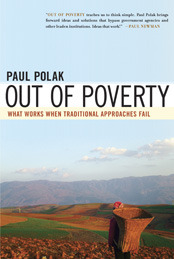
Out of Poverty
What Works When Traditional Approaches Fail
Paul Polak (Author)
Publication date: 09/14/2009
Bestseller over 30,000+ copies sold
Drawing on his more than twenty-five years of experience, Polak explodes what he calls the “Three Great Poverty Eradication Myths” and lays out an alternative: providing the dollar-a-day poor with innovative, low-cost tools that allow them to use the market to improve their lives. Polak tells fascinating and moving stories about the people he and IDE have helped, especially Krishna Bahadur Thapa, a Nepali farmer who went from barely surviving to becoming solidly upper middle class. Out of Poverty offers a new and promising way to end world poverty, one that honors the entrepreneurial spirit of the poor themselves.
OUT OF POVERTY: What Works When Traditional Approaches Fail
- Offers a new, innovative and proven-in-the-field approach to alleviating world poverty
- Exposes the flaws in traditional approaches
- Includes moving personal stories of the people Paul Polak and his organization IDE have helped
Find out more about our Bulk Buyer Program
- 10-49: 20% discount
- 50-99: 35% discount
- 100-999: 38% discount
- 1000-1999: 40% discount
- 2000+ Contact ( bookorders@bkpub.com )
Drawing on his more than twenty-five years of experience, Polak explodes what he calls the “Three Great Poverty Eradication Myths” and lays out an alternative: providing the dollar-a-day poor with innovative, low-cost tools that allow them to use the market to improve their lives. Polak tells fascinating and moving stories about the people he and IDE have helped, especially Krishna Bahadur Thapa, a Nepali farmer who went from barely surviving to becoming solidly upper middle class. Out of Poverty offers a new and promising way to end world poverty, one that honors the entrepreneurial spirit of the poor themselves.
OUT OF POVERTY: What Works When Traditional Approaches Fail
- Offers a new, innovative and proven-in-the-field approach to alleviating world poverty
- Exposes the flaws in traditional approaches
- Includes moving personal stories of the people Paul Polak and his organization IDE have helped
—David M. Kelley, Founder and Chairman, IDEO, and Donald W. Whittier Professor in Mechanical Engineering, Stanford University
“Paul Polak listens to people few of us ever hear from—the world's poor ‘one-acre farmers'—and comes up with simple, practical solutions for helping them better their lives. His work is profoundly inspiring. Even if you don't normally read books about development and poverty, read this one!”
—Lori Pottinger, Director of Africa Programs, International Rivers
“With personal anecdotes and field experiences, Paul Polak shares the philosophies that have made IDE one of the most successful organiza- tions in providing life-changing technologies to people in the develop- ing world. Paul's joie de vivre, his commitment to eliminating poverty, and his pragmatic irreverence are all captured in his book.”
—Amy Smith, Senior Lecturer, Department of Mechanical Engineering, MIT
“Viewing the poor as passive recipients of assistance has wasted billions of dollars. Top-down, bailout subsidy programs don't work. As Paul ex- plains, we need to partner with the developing world and provide tools and technologies to give them an opportunity to help themselves.”
—Shrikrishna Upadhyay, Founder, SAPPROS, Nepal
“Paul Polak delivers a refreshing dose of common sense to the question of how best to help the world's poorest citizens, the common sense borne of a lifetime of hands-on experience. It serves as a how-to manual for Stanford's course on Design for Extreme Affordability.”
—James M. Patell, Herbert Hoover Professor of Public and Private Management, Graduate School of Business, Stanford University
“Paul Polak is passionate about the alleviation of poverty. This book presents numerous case studies demonstrating that effective programs to raise the incomes of poor people must start with an effort to under- stand and involve poor people in the environments in which they find themselves.”
—Vernon W. Ruttan, Regents Professor Emeritus, Departments of Economics and Applied Economics, University of Minnesota
“Paul Polak's provocative and compelling story of how smart techno- logical tools can empower poor entrepreneurs to create their own wealth will disgruntle some devotees of old development. Let them get ‘regruntled' and notice what works.”
—Amory B. Lovins, Chairman and Chief Scientist, Rocky Mountain Institute
“Out of Poverty is an ‘unputdownable' record of Polak's success with tiny-scale farmers, embedded with workable rules for designing, scaling up, and distributing affordable innovations to the poor. It makes a clear declaration: Poverty can be ended if business, government, and development agencies learn these lessons.”
—Michael Lipton, Research Professor, Poverty Research Unit, University of Sussex
“Paul's ideas have helped bring millions of people out of poverty, and, along the way, he has ignited a design revolution that offers us all a bright new way to look at the world.”
—Michael Cronan, Cronan Design
“Paul Polak's insights open new vistas in design discovery. Out of Poverty is one of the clearest descriptions of how design has a profound impact on the cycle of poverty and really changes the world.”
—Yves Behar, President and Creative Director, fuseproject, and Chair of Industrial Design, California College of the Arts
“Paul Polak's method works because it harnesses the power of design thinking, low-cost technology, and human enterprise to create sustain- able communities of trade. Paul's remarkable work has eliminated poverty and restored dignity to millions of families.”
—Ann Willoughby, President and Creative Director, Willoughby Design Group
Introduction: Learning to Do the Simple and Obvious
Chapter 1. Twelve Steps to Practical Problem Solving
Chapter 2. The Three Great Poverty Eradication Myths
Chapter 3. It All Starts With Making More Money
Chapter 4. Design for the Other Ninety Percent
Chapter 5. From Subsistence to New Income
Chapter 6. Affordable Small Plot Irrigation
Chapter 7. A New Agriculture for One Acre Farms
Chapter 8. Creating Vibrant New Markets That Serve Poor
Customers
Chapter 9. Slums -- The Incubator for New Income Opportunities
Chapter 10. Poverty and the Planet
Chapter 11. Taking Action to End Poverty
Chapter 12: Bahadur and His Family Move Out of Poverty
Notes
Resources
Acknowledgments
Index
About the Author
About IDE
CHAPTER ONE
Twelve Steps to Practical Problem Solving
ONE OF THE THINGS THAT ALWAYS PIQUED MY CURIOSITY ABOUT poverty is that most people see it as more permanent than the Rock of Gibraltar. But I know that people are capable of moving out of poverty in a few months, because there are simple and obvious solutions to it. The central theme of this book is that you can come up with obvious practical solutions to just about any complicated social problem by following a few simple basic steps. Here are the twelve steps I used to arrive at the solutions to extreme poverty I describe in this book. Although each of them is simple and obvious, many people find them difficult to apply. For example, most poverty experts spend little or no time talking with and listening to extremely poor people in the places where they live and work, although that is exactly where I have been guided to most of the practical solutions to poverty that I describe in this book.
1. Go to where the action is.
2. Talk to the people who have the problem and listen to what they say.
3. Learn everything you can about the problem’s specific context.
4. Think big and act big.
5. Think like a child.
6. See and do the obvious.
7. If somebody has already invented it, you don’t need to do so again.
8. Make sure your approach has positive measurable impacts that can be brought to scale. Make sure it can reach at least a million people and make their lives measurably better.
9. Design to specific cost and price targets.
10. Follow practical three-year plans.
11. Continue to learn from your customers.
12. Stay positive: don’t be distracted by what other people think.
1. GO TO WHERE THE ACTION IS
You can’t sit in your office at the World Bank or in your research lab at Stanford and figure out what to do about poverty in Myanmar.
Hurricane Katrina struck New Orleans at 6:10 a.m. on August 29, 2005. Here’s what Michael Brown, director of the Federal Emergency Management Agency (FEMA) said when Paula Zahn, a CNN interviewer, asked him four days later about the desperate conditions where crowds of people had sought refuge at the Ernest N. Morial Convention Center.
Michael Brown:“We just learned about that today.”
Paula Zahn:“Sir, you’re not telling me... that you just learned that the folks at the convention center didn’t have food and water until today, are you?”
Brown:“Paula, the federal government did not even know about the convention center people until today.”1
What kept Michael Brown from going to the convention center to see for himself? The practical solutions for the rapidly deteriorating conditions experienced by so many Katrina survivors who had taken shelter there would have been immediately obvious.
Michael Brown resigned under pressure a few weeks later.
In 1981, when I was working on a project to build and sell five hundred donkey carts to refugees in Somalia, I met a pleasant middle-aged man who managed five health clinics in refugee camps for a major international relief organization.
“How often do you get out to the refugee camps to visit your clinics?”I asked.
“I haven’t been there yet and I don’t plan to go soon,” he said with considerable pride.“If you go to the field, it’s mass confusion. Managers have to be able to think clearly, without distractions, to make good decisions, and you simply can’t do it in the middle of the noise and chaos of field conditions.”
I was so astonished that for once in my life I was speechless.
Two months ago, I had lunch with a man who managed a large US-based demonstration farm for an organization that makes livestock available to poor rural families in developing countries. He was responsible for public education and fund-raising with the thousands of people who visited the farm each year. During the seven years he had managed this important demonstration farm, he had never visited any of his organization’s programs in developing countries.
I simply can’t imagine how anybody can make realistic plans to eradicate poverty or to address any important problem without visiting the places where the problem is occurring and talking with the people who have the problem.
2. TALK TO THE PEOPLE WHO HAVE THE PROBLEM, AND LISTEN TO WHAT THEY HAVE TO SAY
In the 1990s, agriculture experts in Bangladesh were dismayed that small-acreage farmers were applying only a tiny fraction of the fertilizer that their monsoon-season rice crops needed, even though they could triple their investment in fertilizer from the increased rice yields the recommended amount would stimulate. The experts complained about the irrational and superstitious behavior of small-acreage farmers, and set up extension programs and farmer-training programs, but nothing worked. The farmers continued to apply a tiny fraction of the fertilizer that their rice needed to thrive. Finally, somebody asked some farmers why they were using so little fertilizer.
“Oh, that’s easy,” they said.“Every ten years or so around here, there is a major flood during the monsoon season that carries away all the fertilizer we apply. So we only apply the amount of fertilizer we can afford to lose in a ten-year flood.”
Suddenly it became clear that the farmers were excellent, rational decision makers and that it was the agriculture experts who had a lot to learn. In order to survive, subsistence farmers have to be at the cutting edge of avoiding risk. With very good reason, they care much more about avoiding losing their farm than they do about tripling their income. When they have the opportunity (and the money) to invest in fertilizer during the dry season when the risk of floods is close to zero, they are glad to do so.
There is another problem with this action step. Far too many people can talk to the people who have the problem and not learn anything, because those who would help don’t always know how to listen. As a young psychiatrist in 1962, I got interested in finding out if the patients admitted to the psychiatric wards of Colorado Mental Health Institute at Fort Logan and the psychiatrists, social workers, and nurses treating them were working on the same treatment goals. To my amazement, the mental health professionals not only had different treatment goals from their patients, but they also were unable to predict which goals the patients saw as most important. When I asked more questions, I learned that mental health professionals were trained to define the problem bringing a patient to a psychiatric hospital as a mental illness inside the head of the patient, while patients saw the problem as residing in the group of people with whom they lived and worked outside the hospital. Often the patient’s symptoms of mental illness would get better when he or she was given medication and removed from the upheavals going on in his or her real-life setting, only to be readmitted to hospital after being released again into the unchanged social setting that had precipitated the symptoms in the first place. When mental health professionals learned to listen for and intervene in the problems in the real-life setting at the same time they diagnosed the symptoms of mental illness, treatment outcome improved dramatically. The same kind of thing happens with people trying to address the problems of poverty. If these professionals are trained to assume that modern farming depends on Western mechanization, in the end they are likely to leave behind rusting hulks of big tractors and harvesters as monuments to the inability to listen and learn.
3. LEARN EVERYTHING YOU CAN ABOUT THE PROBLEM’S SPECIFIC CONTEXT
We achieved a great deal of success with treadle pumps in Bangladesh. Now I quickly run out of fingers and toes when I try to count how many people have asked me if they could use treadle pumps to help farmers in villages in other countries.
“How deep is the water table in your village?”I ask, because a treadle pump is a suction pump that simply won’t lift water more than about twenty-seven feet.
“I don’t know” is the most common answer.
“Tie a rock on the end of a piece of string, go to the nearest well, and measure how deep the water table is,”I say.“Or go to the government ministry of water resources —they likely have maps with that kind of information.”
“OK, we’ll do it the next time we visit,” they say.
The fact is, you can’t make practical plans unless you gather a lot of details about each specific village context. What kind of high-value crops you can grow in each depends on the type of soil and the climate. The price of fruits and vegetables is usually highest at the time of year when it’s most difficult to grow them, so it’s important to know why these crops are difficult to grow at that time of year and what can be done to overcome the difficulty. If there is a factory nearby with jobs that pay well, the labor required for intensive horticulture may be hard to come by.
Everything I have to say in this book depends almost totally on having interviewed three thousand poor farm families, listened carefully to what they had to say, and learned everything I could about the specific context in which they lived and worked.
4. THINK BIG AND ACT BIG
If you learn about a problem in its real-life context from the people who have the problem, ask basic questions, and open your eyes to see the obvious, you are likely to come up with big ideas with world-changing potential. This is not only exhilarating, it can be frightening — and some people react to this excitement by making puny action plans. Other people fail to think and act big because they have never done so and aren’t used to it, or because they don’t want to be seen as arrogant, or because they are afraid of failing if they think too big. I have learned to look at the total global market potential of any idea from the beginning, even if doing so makes me uncomfortable. I’ve gotten used to the grandiosity labels that come with thinking big.
In the chapter on creating new markets, I will consider the fact that there are a billion people in the world who need eyeglasses but don’t have them, and I will discuss the potential solution of providing access to display stands from which people could pick two-dollar spectacles that correct their vision problems. When most people think of implementing a solution like this, they think small. There are several organizations that have started to provide affordable reading glasses to poor people, but all of them together have delivered less than a half million eyeglasses, which serves less than one-tenth of 1 percent of the customers who need them. I start by thinking about how to reach half of the total potential market of 1 billion or so within fifteen years. A business plan to accomplish this would probably need to reach global sales of 50 million a year within five years, purchasing fifty-cent eyeglasses from mainland China a million or more at a time and selling them at a retail price of about two dollars. I would spend most of my time designing an effective global marketing-and-distribution plan for both rural and urban areas, and wrap it up with a clear statement of the start-up capital required to implement a three-year plan, how it would be spent, and what it would accomplish. This kind of planning is routine for large businesses or for any entrepreneur seeking start-up venture capital, but it is rare for development organizations.
Thinking big in this way always carries the risk that you will fail in a big way. But if you can’t stand to take the risk of failing and looking bad while doing so, you probably should be in a different line of work. If you want to make the world a better place, coming up with a breakthrough concept or technology is just the first step. The most challenging problem is coming up with a practical way that you can put the innovation into the hands of the hundreds of millions of people in the world who need it.
5. THINK LIKE A CHILD
Coming from a refugee family who barely escaped being murdered by Hitler in Czechoslovakia in 1939 when I was five-and-a-half, I don’t want to romanticize childhood. But there is a simple and direct curiosity in childhood and a love of play that we tend to miss badly in our approach to problem-solving as adults. If you think like a child, you can quickly strip a problem down to its basic elements.
In 1996 I was in Cachoeira, the Amazon rain forest home village of Chico Mendes, who founded the rubber tappers’ union and was martyred by the cattle interests. I was trying to figure out how rubber tappers could shell and dry Brazil nuts at the village gathering point so they could increase their income. We had to design a village drier to replace the large industrial driers of big-city plants. When we walked through rain forest villages, I saw that every second house had a forno de farinha, a two-foot-high baked-clay furnace with an eight-by-ten-foot stove top used to dry manioc flour. When I saw all these ovens used to dry manioc, I realized that each of them could also become a Brazil nut drier. If you think about how to dry something as if you’re a child instead of an engineer, you think about how you can warm it and blow air over it, like when you hang a wet towel on a clothesline in the breeze and the sunlight.
So we built a removable wooden house with a chimney that sat on top of the manioc-drying oven, and used the heat coming from the stove top to draw air over the surface of Brazil nuts that were drying on wire-mesh drawers inside the wooden house. We built the first one from scratch in two hours.
6. SEE AND DO THE OBVIOUS
If we can’t see our blind spots, how can we begin to see and do the obvious?
Here is an obvious fact that hasn’t been incorporated into the plans of most poverty alleviation experts. It took me several years and several hundred interviews with poor families to begin to see it. Three-quarters of the dollar-a-day poverty in the world has its roots in tiny farms. Ninety-eight percent of all the farms in China, 96 percent of the farms in Bangladesh, 87 percent of the farms in Ethiopia, and 80 percent of the farms in India are smaller than five acres. Eight hundred million of the people who earn less than a dollar a day scratch most of what they earn out of one-acre farms that are divided into four or five scattered quarter-acre plots. International Development Enterprises (IDE), the small organization I started, has been able to help 17 million people out of poverty because we realized that creating new wealth on one-acre farms depends on opening access to new forms of irrigation, agriculture, markets, and design.
7. IF SOMEBODY HAS ALREADY INVENTED IT, YOU DON’T NEED TO DO SO AGAIN
People are often hesitant to use ideas from elsewhere. I have run into countless instances of the not-invented-here syndrome. Doing a quick world search to see if somebody has already come up with a solution to the problem you’re working on is always faster and easier than coming up with something new.
Perhaps the most embarrassing example of learning that it had already been invented came when I was convinced that I had found a new way of delivering water cheaply, drop by drop, to plants by punching holes in plastic pipes and letting water slowly dribble out. Dan Spare, the first engineer I talked to about this great of idea of mine, politely informed me that the Israelis had invented it thirty-five years earlier and that it was called “drip irrigation.”I had never heard of it.
So I scanned the world literature on drip irrigation and learned that while the method had spread rapidly, it represented only 1 percent of irrigated acreage, because the setup was too big and too expensive for the majority of the world’s farmers. So we went to work to design drip-irrigation systems that cut existing costs by four-fifths, reducing their size to fit small plots.
8. MAKE SURE YOUR APPROACH HAS POSITIVE MEASURABLE IMPACTS THAT CAN BE BROUGHT TO SCALE
While we were working on the donkey cart project in Somalia, we ran across a team from International Labor Organization (ILO) that had organized a project to help refugee women make and sell soap. But when we asked how much it would cost to buy some of this soap, it was hard to get a clear answer. We eventually learned that ILO could have bought the finest, most perfumed soaps available in Paris, airfreighted them to Somalia, and sold them at a cheaper price than what it cost to produce the crude soap the refugees were making with ILO’s help. When I asked how she could justify this, the program’s manager hinted that I had no understanding of the tremendous importance of the self-esteem these women gained from the positive group interaction during the process of making the soap.
On the contrary, I believed that the only real self-esteem raised by this project was that of the ladies in the project team that designed and implemented it. If they were really interested in improving the self-esteem of the refugee women with whom they worked, they would help these women produce something they could continue selling at a profit long after ILO left Somalia. Producing soap at a cost greater than the existing market price for the finest soaps also meant that the project would be unlikely ever to be taken up by other groups of women, so it could never be expanded beyond its original scope.
How many people can benefit from a development project if it proves to be successful? This is one of the first questions to be asked about any idea for a practical solution, since it takes a lot of time and money to implement a project. But often this question is never asked. For example, a few refugees in Somalia who lived in camps beside rivers and caught catfish to sell could broaden their markets by preserving the fish through salting and smoking, since refrigeration was unavailable. But all refugees needed affordable transport services, so picking between fish smokers and donkey carts was a no-brainer.
The only projects worth doing have measurable costs, impacts that are an improvement over their antecedents, and the potential to be brought to scale.
9. DESIGN TO SPECIFIC COST AND PRICE TARGETS
The key issue that prevented the ILO staff from implementing a cost-effective project is that they had little interest in figuring out the cost and price targets refugee women had to reach to be competitive in the local marketplace. Like so many other development organizations, they scorned materialistic measurements such as costs and profits, and had no measurements of impact other than their own belief that the group activity was good for refugee morale.
10. FOLLOW PRACTICAL THREE-YEAR PLANS
You may have a world-changing plan with a stunning vision for the future, but if you can’t come up with a specific plan for the next three-year period, you’ll never get anywhere. If your three-year targets are too ambitious, you will likely fail long before you have any chance of reaching your long-range vision. If your three-year targets are too puny, you won’t lay a solid base for scaling up. As in “Goldilocks and the Three Bears,” your three-year objectives have to be not too big, not too small, but just right.
When I wrote a three-page concept note for the Bill and Melinda Gates Foundation, I said that my long-term vision was to increase the net yearly income of 30 million families by five hundred dollars a year, and the foundation was satisfied. But when we started negotiating a specific initiative they could support, they said “Forget the 30 million — we want to see clear evidence over the next four years that you can reach 100,000. Prove to us that you can achieve the specific impacts that you say you can, and then we can consider going on to phase two and maybe even phase three.”
11. CONTINUE TO LEARN FROM YOUR CUSTOMERS
About ten years ago, the low-cost drip-irrigation technology we designed and field-tested in Nepal was ready for marketing. By this time we had a good sales force, and several hundred hill farmers within thirty kilometers of Pokhara purchased low-cost drip systems. But sales didn’t go up at all in the second year. In fact, our field staff were dismayed to learn that many farmers who bought low-cost drip systems used only a quarter of the system they purchased. When they interviewed the farmers who had bought drip systems, our field staff learned these were maize and millet farmers who had no experience with the intensive horticulture required to grow off-season vegetables. In fact, there was a widely held belief that it was impossible to grow vegetables in winter in the Pokhara region, which became a self-fulfilling prophecy.
Our Pokhara field staff convinced the Kathmandu office staff, who convinced me, that we would never be able to sell low-cost drip systems until we trained farmers how to use these systems to grow off-season vegetables. We introduced field-based training programs in intensive horticulture, and sales took off quickly. It never would have happened if our field staff hadn’t kept talking to our customers.
Each of the last twenty-five years, I have interviewed at least a hundred of IDE’s small-acreage customers. All my ideas for projects that worked, and even some that didn’t work, came from what I learned from these small-acreage farmers, and now all the people who work for IDE talk to and learn from these farmers every day.
12. STAY POSITIVE: DON’T BE DISTRACTED BY WHAT OTHER PEOPLE THINK
Twelve years ago I was championing two affordable irrigation technologies. The first was an animal-powered treadle pump, which produced as much water as a small diesel pump. A lot of people told me that if an animal-driven treadle pump putting out five liters of water a second were needed, it would have been developed long ago. I ignored them. A five-horsepower diesel pump cost $500 then, and I knew we could produce a bullock pump for $125, a pump that “burned” fodder instead of diesel. So I kept pressing till we had a marketable reliable bullock pump ready to go.
At the same time, I was convinced that a small-plot drip-irrigation system that could be bought at about a fifth of the price of conventional drip would command huge global demand. People told me if there really were a need for such a system, the market would have introduced it long ago. But I was convinced that millions of small-acreage farmers could earn big money from drip-irrigated vegetables. It took seven years to bring the first low-cost drip systems to market.
By the time the bullock pump was ready to sell, Chinese diesel pumps were available for one hundred fifty dollars instead of the five-hundred-dollar price farmers paid two years earlier, and the bullock pump was no longer cost-competitive. I had no regrets. We had good reasons to develop the bullock pump, and we had good reasons at that point to put the product on a back burner. The global market for low-cost drip irrigation, however, looks to be huge. I think at least 10 million poor families will buy a system.
Most breakthrough solutions to important problems, such as Henry Ford’s five-hundred-dollar automobile and Jobs and Wozniak’s two-thousand-dollar computer, came about because one or two stubborn entrepreneurs saw new solutions to old problems and persisted until their dream became a reality. Why should solving the problem of poverty be any different?
I have set a target for IDE of ending the poverty of 30 million dollar-a-day families by the year 2020 by using these twelve principles, and I’m sure we’ll make it.
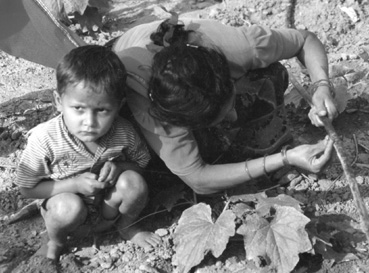
Unclogging a plugged emitter in a low-cost drip irrigation system in Nepal
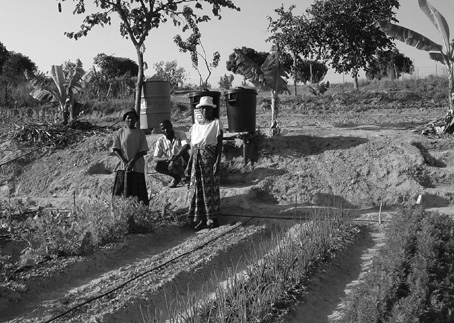
Low-cost drip irrigation in Zimbabwe