



Download PDF Excerpt
Rights Information
Seeing Systems 2nd Edition
Unlocking the Mysteries of Organizational Life
Barry Oshry (Author)
Publication date: 08/01/2007
Bestseller over 40,000+ copies sold
• New edition of a classic, revised and updated throughout, with a new section and a new epilogue
• Explains why so many efforts at creating satisfying and productive systems end in disappointment
• Offers an approach to improving organizational life that removes the personal biases that stymie so many change efforts
Find out more about our Bulk Buyer Program
- 10-49: 20% discount
- 50-99: 35% discount
- 100-999: 38% discount
- 1000-1999: 40% discount
- 2000+ Contact ( bookorders@bkpub.com )
• New edition of a classic, revised and updated throughout, with a new section and a new epilogue
• Explains why so many efforts at creating satisfying and productive systems end in disappointment
• Offers an approach to improving organizational life that removes the personal biases that stymie so many change efforts
Barry Oshry, a pioneer in systems thinking, is the creator of Power Lab, the When Cultures Meet Workshop, and the Organization Workshop on Creating Partnership, which he and his associates have conducted in hundreds of organizations in the U.S. and around the world. He and his wife and partner, Karen Ellis Oshry, are cofounders of Power + Systems, Inc. an educational institute dedicated to providing programs and publications that deepen people's understanding of social system phenomena. A former Chairman of the Department of Human Relations at Boston University, Oshry has presented keynote addresses and workshops for the Association of Quality and Participation, the American Management Association, the Organizational Development Network, and GOAL/QPC. He is the author of Leading Systems: Lessons from the Power Lab and Seeing Systems: Unlocking the Mysteries of Organizaitonal Life.
To visit Barry's website, please click HERE
—Scott Powers, Chief Executive Officer, Old Mutual U.S.
“It is all about relationships. Oshry recognizes this and the importance of organizational dynamics in his works. His insights offer great advice regardless of where you ‘sit' in the organization. In fact, you may find that you ‘sit' in a different place than you thought.”
—Al Grasso, President and Chief Executive Officer, Mitre Corporation
“I have read with enormous interest Seeing Systems and must say that through many years of being involved in entities dedicated to systemic under- standing, this has been the most exciting reading.”
—Dr. Enrique G. Herrscher, Honorary Professor, Universidad de Buenos Aires (UBA), former President, International Society for the Systems Sciences (ISSS)
“Precious few business books reveal know-how that fundamentally changes the way we operate and experience our world of work. Seeing Systems helps us grasp what really happens beneath the surface in organizations. Regardless of whether you are an executive, executive coach, middle manager or individual contributor, Seeing Systems provides powerful insights and applications for enhancing your effectiveness.”
—Julian D. Kaufmann, Vice President, Leadership & Organization Development, Tyco International
“Seeing Systems is a much needed antidote to the personal bias that dominates much of our thinking about organizations.”
—Timothy J. Giarrusso, Professor, E. Philip Saunders College of Business, Rochester Institute of Technology
“I have been a fan of Oshry's Seeing Systems for a number of years and use it extensively to engage staff in recognizing the bigger picture in their everyday activities.”
—David Morhart, Deputy Minister of Public Safety and Deputy Solicitor General, Province of British Columbia
“Oshry's work has the power to transform our lives by removing the blinders we usually wear. I regularly used his books and workshops as powerful tools for our senior leaders' development. With great regularity, people reported that they felt liberated and energized once they could see the dances he describes in their personal or professional lives.”
—Sabina Nawaz, former Senior Director of Leadership Development, Microsoft, and Principal, Nawaz Consulting LLC
“You never know how students will react to a book, so I wasn't prepared for the electric impact Seeing Systems had on the class. They loved it and were clearly affected by its insights and style.”
—Barton Kunstler, PhD, Director, Graduate Program in Organizational and Corporate Communications, Emerson College
“We, like fish, are unaware of the medium in which we swim. Oshry takes us to a higher level, allowing us to see the systemic ocean that engulfs us. From this viewpoint, we can change the very nature of how we swim. The perspective about systems, power, and relationships hits the reader clearly and with impact. This book can make a difference in our organizations, and in our lives.”
—Thomas Crum, author of The Magic of Conflict, Journey to the Center, and Three Deep Breaths
“Seeing Systems is exactly what happened for me the first time I read Oshry's work. This was the first organizational model that made sense of what I was experiencing as a manager. Not a simple laundry list of ideas or ‘paradigms' but practical theories based on how people behave in the workplace. I applied Oshry's principles daily as a manager of a county jail in Washington, and I continue to apply them, in my retirement, managing large volunteer organizations.”
—Lucia Meijer, former Administrator, King County North Rehabilitation Facility
“Oshry's framing of systems and the interaction between functions and levels is dead on. Seeing Systems is a close friend for everyone on our team.”
—Rob Kramer, Director, Training and Development, University of North Carolina
“Oshry weaves a remarkable explanation for the subtle, and largely unseen, ways in which our structures influence our behavior. Part poetry, part philosophy, part practical advice, this book offers a creative lens for examining our own behavior.”
—Marvin Weisbord, Co-Director, Future Search Network; coauthor of Future Search; and author of Productive Workplaces Revisited
“Anyone who is in the business of leading others or managing change will profit from the lenses Seeing Systems offers. They help us understand and avoid the all too common traps of disempowerment and failed partnerships. Instead of blaming others, ourselves, or the system, we learn how these organizational dynamics predictably shape our perceptions in ways that are self-defeating, and we see how we can rise above them and create relationships and organizations where collaboration can flourish.”
—Dr. Gervase R. Bushe, Segal Graduate School of Business, Simon Fraser University, author of Clear Leadership and coauthor of Parallel Learning Structures
“Oshry is a genius in designing simulations of complex social systems and in constructing frameworks that generate rare insights into the simplicity that lies beyond the complexity of such systems. For systems that have a large group of employees that consider themselves to be disempowered—whether factory line workers, government bureaucrats, or orchestra musicians—Seeing Systems offers the most powerful tools I know.”
—Grady McGonagil, EdD, Director of Learning, Generon Consulting
“Oshry explains in clear, convincing, and poetic language why people behave as they do in organizational life. His insights shine a bright light into the dark cave of organizational systems...and show us a way out.”
—Jeffrey and Merianne Liteman, coauthors of Retreats that Work
“Seeing Systems helped me better understand my many roles; it also yielded valuable insights into the worlds of those in other positions, enabling me to adjust my behavior in ways that make me a more effective leader and follower. The book has made a lasting impression.”
—Jeffrey B. Cooper, PhD, Director, Biomedical Engineering, Partners HealthCare System, Inc.
Prologue: Overcoming System Blindness
Act I: Seeing the Big Picture
Scene 1. When We Don't See Systems
1 Pinball
2 The Manager of the Heart
3 The Mystery of the Swim
4 Seeing the Local Picture
5 "Stuff" Happens
Scene 2. Transforming Spatial Blindness into Spatial Sight
6 Seeing Context
7 The "Truth" About Jack
8 Charlotte Is a Problem
9 Center Ring or Side Show ?
10 Times Out of Time: Seeing the Whole
11 The TOOT Dilemma
Scene 3. Transforming Temporal Blindness into Temporal Sight
12 The Invisible Histories of the Swims We Are In
13 History's Burst of Illumination
14 Bart and Barb: A System Evolves…Perfectly
15 "Anthropology" or Mick Gets Wiped Out
16 Applied Anthropology: Unraveling System History
Summary
Act II: Seeing Patterns of Relationship
Scene 1. Relational Blindness
17 What About All the Drama?
18 The Dance of Blind Reflex
Scene 2. Transforming Relational Blindness into Relational Sight
19 Three Patterns of Relationship
20 One Wakes, the Other Sleeps
21 The Top/Bottom Dance of Blind Reflex
22 It Takes Two to Tango . . . or Does It?
23 Let's Declare Bankruptcy: Transforming the Top/Bottom Dance
24 The Universal Civics Course
25 The End/Middle/End Dance of Blind Reflex
26 Daniel: Mutant in the Middle Space
27 Organizations in the Middle
28 The Provider/Customer Dance of Blind Reflex
29 Overcontrol or Transformation: The Mutant Customer
30 The Unfairly Judged Professor
31 Abused and Misused in the Space of Service
32 The Web of Relationships
33 How to Clean Sidewalks: It's a Matter of Being
34 Resistance or The Sound of the Old Dance Shaking
35 How We Can See the Dance
Summary
Act III: Seeing Patterns of Process
Scene 1. Process Blindness
36 Are You Sure You Have It All?
37 Turf Warfare, Alienation, and GroupThink: The DBR Continued
38 Relationship Breakdowns in a Nutshell
Scene 2. Transforming Process Blindness into Process Sight
39 Territorial Tops: Stuck on Differentiation
40 The Success of a Business, the Failure of Its Partners
41 Learning from Experience: A Good Second Marriage
42 Help! No Recovering Top Groups Sighted
43 Advice for the Top Team
44 Alienated Middles: Stuck on Individuation
45 Alienation Among the Middles
46 Can Alienated Middles Become a Powerful System?
47 Mutant Middle Groups
48 How to Create Powerful Middle Teams
49 Bottom GroupThink: Stuck on Integration
50 Immigrant Martha Has a Breakdown
51 Where Is Everyone? A Mutant Bottom Group
52 Power Is Managing Differentiation
53 Creating Powerful Bottom Groups
Scene 3: The Politics of System Processes
54 Huddlers and Humanists…Enough With Consensus!
55 Amebocytes and Slugs: The Politics of Individuation and Integration
56 The Politics of Gender
57 Or Would You Rather Be an Earthworm? Societal Implications of Differentiation and Homogenization
58 Differentiation, Inquiry, Warfare
59 An Ode to Homogenization
Scene 4: The Challenge of Robust Systems
60 The Dominants and the Others
61 Robust System Processes
62 The Dance of the Robust System: Ballet Notes
63 A Remarkable, If Somewhat Premature, Epiphany
Summary
Act IV: Seeing Uncertainty
64 The Emergence of Organizational Positions
Scene 1. Individuals in Uncertainty
65 Individuals Facing and Escaping from Organizational Uncertainty
66 A Mutant Moment in the Middle
67 Dancing In and Out of the Tunnel of Limited Options
68 His Magic Consultant Card #2
Scene 2. Groups in Uncertainty
69 Groups Facing and Escaping from Uncertainty
70 How to Transform Oppositional Struggles into Multi-Faceted Flexible Teams
Scene 3. Existential Uncertainty
71 Not all Possibilities Are Possible
72 Coping with Uncertainty: Mythos and Logos
Summary
The Next Act—Seeing More
Epilogue: A Continuing Revolution
Notes
About the Author
Scene 1
When We Don’t See the Big Picture
1 Pinball
Sometimes life in the organization feels like a game of pinball,
and we’re the little metal ball.
We start each day launched into a mysterious world of
bumpers
lights
bells
and whistles.
Lights flash on
and off.
Buzzers sound.
Gates open
and close,
sometimes propelling us at high speed to some other center of the action,
and sometimes letting us drop quietly
into a hole.
All of this is a mystery to us.
Is this just a set of random events?
Or is there some grand scheme
known to others, but not to us?
One day we hit a bumper.
Lights flash.
Bells ring.
Big numbers go up on the scoreboard.
The next day we keep an eye out for that bumper.
We hit it.
Nothing. A dull thud.
And we continue, puzzled, along our way.
Some days there’s lots of action
and big scores.
Other days there’s lots of action
but not much of a score to show for it.
And other days there’s very little of either.
At the end of the day—
lots of action
or little,
high scores
or low—
we drop through the final gate, heading home.
Sometimes we’re impressed with our accomplishments,
sometimes depressed by our failures,
sometimes we’re dreading the next launch,
sometimes we’re champing at the bit for the next game.
And most times,
as we slide past the gate heading home,
we pause momentarily to reflect:
NOW WHAT WAS THAT ALL ABOUT?
2 The Manager of the Heart
Suggestion: You might enjoy reading this piece to a group of supervisors or middle managers; see if they know what it is like to be “The Manager of the Heart.”
Life in the organization may feel like a game of pinball,
but the organization itself works more like the human body,
everything neatly connected to everything else.
However, when we don’t see the whole,
it can all feel like one chaotic mess.
Take the Manager of the Heart.
At times it’s a peaceful job.
A nice even supply of fresh blood comes in from the lungs.
All engines pump smoothly: Lub . . . dub . . . lub . . . dub.
Oh-oh! EMERGENCY! EMERGENCY!
Bells ring.
Buzzers sound.
Messengers come bursting into your office:
chemical messengers from the bloodstream,
electrical messengers from nerve endings.
Who are these guys? Where do they get their information?
Who gives them the authority to tell you what to do?
“What emergency?” you ask. “Where?”
“THERE’S NO TIME TO EXPLAIN!” say the Big Shot Messengers.
“JUST START SOME HEAVY PUMPING!”
So you tell your people: “FULL AHEAD ON THE
PUMPS!”
You’ve got a good crew;
in no time they’ve got those pumps working away at full capacity:
LUB . . . DUB . . . LUB . . . DUB.
You’re proud of your crew. You turn to those Messengers and say:
“OK. Bring on that emergency. We can handle anything!”
But the Messengers aren’t looking at you;
they’re checking their pagers.
“Forget it,” says the electrical messenger.
“Cut back,” says the chemical messenger.
“Emergency’s canceled,” they say.
Emergency’s canceled? We’re just getting up a head of steam.
“CUT BACK! CUT BACK!” They’re desperate now.
“YOU’LL BURST SOME PIPES!”
“What’ll I tell my crew?”
“CUT BACK!!!!”
So you tell your crew.
“It’s for the good of the system,” you tell them.
“What do you want from me?” you ask them.
“I don’t make the rules around here.”
And then it’s calm again.
A nice even flow of blood.
Pumps humming along: Lub . . . dub . . . lub . . . dub.
And you start thinking.
You start worrying about your crew.
How many changes of direction can these folks take?
Will I be able to count on them in a real emergency?
You start thinking about those Messengers,
those Specialists,
acting like big shots,
giving out orders,
all that technical mumbo jumbo.
When was the last time any of them bloodied their hands
opening and closing a stuck valve?
You start thinking about the Bigwigs.
Whoever they are,
wherever they are,
are they just playing games with us or what?
Maybe they know what they’re doing,
maybe they don’t.
What do they do up there all day anyhow?
Maybe they’ve got the big picture,
but what if they don’t?
What if they’re just . . . crazy?
And then you start thinking about yourself:
All this stress,
the way you blew up at those Messengers.
They’re just doing their jobs after all.
Maybe you’re losing your cool.
Maybe you can’t cut it anymore.
Maybe you’re not half the heart you used to be.
Oh-oh! What’s that sound?
Who’s that racing along the bloodstream?
I know, I know.
EMERGENCY! EMERGENCY!
3 The Mystery of the Swim
We may not see the big picture, but that doesn’t stop us from creating our own version of it.
In John Barth’s “Night-Sea Journey,” a “swimmer” tells us of his journey.1 He is the sole survivor of what began as a horde of eager, strong, and dedicated swimmers—thousands of them, millions, maybe billions! (He’s not sure how many there were.) Only he remains— exhausted and confused. The others are gone, drowned in what now seems like an endless and pointless misadventure. Some, disillusioned and hopeless, have taken their own lives.
Along the way, there were many debates among the swimmers. What was this journey about? When did it begin? Where would it end? What purpose, if any, did it serve?
Different camps with competing philosophies developed regarding the meaning of the night-sea journey. Some argued that there was no meaning to it, that it was a pointless venture, that the struggles and deaths of the swimmers were all in vain. Many from this school took their own lives out of despair.
Others believed that the meaning of the venture lay in the swim itself, that the point of the swim was to swim as best as one could for as long as one could.
Still others believed that the swim was part of some grand design that they, the swimmers, could only speculate about but never fully comprehend.
Within the grand design school, there were varying viewpoints: Some believed that the grand design was inherently good, others believed it was evil, and others believed it was neither good nor evil but that it merely existed.
But now all the others are gone; the debates, the discussions, the schools of philosophy have all drowned in the night sea. Only the narrator remains. We listen to him tell of his journey; he shares his thoughts and feelings. He is tired and confused. Should he continue the struggle or, like the others, allow himself to drown?
And as we read on, we too are confused and discomfited. The swimmer’s story is an unsatisfactory one for us. The questions that plague him plague us too. What is this night-sea journey? Where did it begin? Where will it end? What purpose, if any, does it serve? The swimmer tells us in great detail about his journey, yet that is not enough for us. We need to comprehend the journey itself, the whole of which he is but a component part.
Barth never gives us the answer we seek, and without that answer, the journey remains for us an unsettling mystery.
However, if, during our reading—the first, second, or third time through—it comes to us what this night-sea journey is, we are struck with great illumination. Now, having grasped the whole, we read the story through again. What once was confusing is now crystal clear; what once seemed complex and mysterious is now simple and straightforward. The squabbles, debates, and philosophical discussions all make sense to us. And they all seem like so much silly superstition.2
■ ■ ■
Barth’s tale is both a sly joke and a challenging message. He is less concerned with those night-sea swimmers than with us and—given our remarkable brains—our apparently unlimited capacity to create stories that explain what we really don’t know. We are story-making machines; we have stories explaining everything from the mystery of life to why the boss never responded to our memo. If we realized that we were making up stories, there’d be some fun to the process and little damage. The problem comes when we believe that our stories are the truth, and we then act on the basis of that “truth.”
The challenge is to be able to move past our local picture and the imperfect “truths” it generates to seeing the larger picture and the truths it reveals. First, let’s look at how it usually goes—not always, not with everyone, but with great regularity—when, in our spatial blindness, we see the part but not the whole.
4 Seeing the Local Picture
Some systems are perfectly healthy
when viewed from the perspective of the whole;
but when viewed from the perspective of any one part,
they appear to be disorganized, chaotic, a collection of random events.
Our Heart Manager didn’t have the big picture.
All she knew about was what was happening in her small piece of the system.
All she knew directly was that decisions affecting her were being made in some remote power center.
She didn’t know how those decisions were being made and she didn’t know whether to trust them.
She felt beleaguered by interference from a variety of staff specialists.
She was concerned with potential labor unrest among her troops,
who also did not have the big picture.
She was beset by rumors.
There was talk of a shutdown in the stomach during the emergency.
Was it true? What did it mean? Would the heart be next?
For our Heart Manager, system life was a game of pinball.
When we have a local perspective:
- Things seem a lot messier than they really are or they seem a lot neater than they really are.
- We tend to blame ourselves for things that may not be our fault or we blame others for things that may not be their fault.
- We react to rumors rather than facts.
- We tend to misinterpret events happening elsewhere in the system.
- We tend to misunderstand and misjudge others in the system:
We may see them as malicious, incompetent, and insensitive when in fact they are not.
We may see them as well-meaning and all-wise when in fact they are not. - We are unsure about ourselves, about what to do, about how our actions fit in with the actions of others and with the whole.
When we have a local perspective, organizational life feels like
a game
of pinball . . . or worse.
5 “Stuff” Happens
We may be blind to others’ worlds,
but this does not stop them from sending “stuff” our way.
Here you are going about your business

and then . . .
stuff happens.
Some of the stuff that comes our way is positive, surprisingly good news:
- We get the bonus we’ve been waiting for.
- The project is accepted.
Some of the stuff that comes our way is noxious:
- We don’t like it.
Some of the stuff that comes our way is a mystery:
- “Why on earth are they doing that?”
And some of the stuff that comes our way is both—
noxious and a mystery.
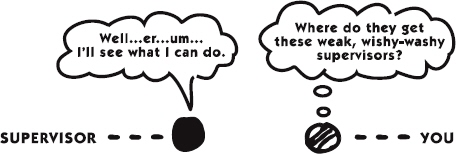
For example, you make what seems like a simple request of your supervisor, and instead of saying, “Sure thing, you can count on it, it’s coming your way,” your supervisor looks at his feet, shuffles around, and mumbles, “Uh . . . well . . . let’s see . . . er . . . well, I’ll see what I can do.” The supervisor’s reaction is stuff coming your way. Noxious and a mystery. And you react: It was just a simple request! Where do they get these weak wishy-washy supervisors?
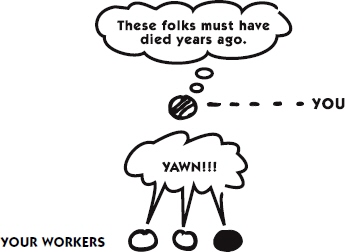
You go to your workers with a proposal you think they will be enthusiastic about, and instead, they put up a wall of resistance. Their resistance is stuff heading your way. Noxious and a mystery. And your reaction: I just don’t get it; what is the matter with these people?
You know that your customer is upset, so you make a gesture to soothe the customer’s feelings, and instead of appreciation, the customer replies with anger and sarcasm. More stuff heading your way. And your reaction: How did these customers get to be so nasty?

You send a memo to your Top Executive, making what you feel are valuable suggestions for improving the operation. Weeks go by, and there is no response to your memo. More stuff. (Physicists would probably refer to this as “minus stuff.”) And you react: Those Tops, they talk the talk, but don’t walk the walk.
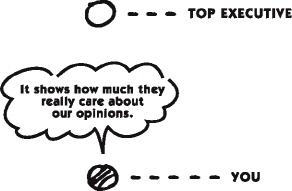
So stuff comes at us regularly—noxious stuff, mysterious stuff, minus stuff. And how do we react to stuff (not always, not everyone, but with great regularity)?
- We make up stories that explain the stuff. Our brains don’t like mysteries, so in the absence of knowledge about other people’s worlds, we quickly fill the void with our stories about them. We create our myths about their motives, and because we don’t see ourselves making up stories, we see our stories as the truth.
- We evaluate others. In our stories, we see them as malicious, insensitive, or incompetent.
- We take the stuff personally. We experience it as if it is aimed at us and intended to hurt or block us.
- We react to the stuff. We get mad, we get even, we withdraw.
- We lose focus. If we had started off with some good intention, we quickly lose interest in that good intention, and instead our focus is on the stuff, our stories about what lies behind the stuff, and our emotions.
- Our actions then become the stuff for others. They make up their myths about us—about our motives and competencies. They take our actions personally and react to us—getting mad, getting even, withdrawing—and on and on it goes when we do not see the worlds of others.
- And if there had been any hope of creating partnership with one another, those hopes are diminished if not evaporated.
Reflection: As you know yourself, when stuff happens that is noxious or a mystery, about how long does it take you to run through the above list? [Hint: Some readers measure their reaction time in nanoseconds.]