1
Introduction
Questions and Power
WHY?
Why is the first question most children ask. With this question we express, to the delight and the chagrin of our parents, our power.
In my life, questions have always been power. Asking them enabled me to overcome the challenges I faced as a young woman sitting at tables where I didn’t automatically belong.
The link between questions and power in our democracy is at the heart of this book. As the market reaches ever deeper into every aspect of our lives, as consumerism grows and as globalization shrinks the distance between countries and people, where will our power as citizens in a democracy come from?
I think it will come from our ability and willingness to ask why. To question our government, our schools, our communities, and ourselves. Inquiry is more than asking simple questions that come with yes or no answers. It is a process of discovery, asking, re-asking, synthesizing, and evaluating until we can get close to something that approximates truth.
Inquiry is more than an act; it is a value deeply embedded in our notions of democracy. Democracy—which in this book I use to mean not only our representational form of government but also a system that values equality, justice, and the idea that each member of the group has something worthy to offer the whole—requires citizens who pay attention, who synthesize and analyze, who evaluate the information they have uncovered, and who are discerning about its source. Democracy needs citizens who can inquire.2
When I look at contemporary culture, however, I see an obsession with answers, not questions. I see an environment that prizes projections of certainty over the wisdom gained from questioning, and questioning again. I see us asking our media, our politicians, our self-help gurus for the answer, any answer, to help us understand the world around us. We live in a country where The Secret, a self-help phenomenon, was on the Publishers Weekly best-seller list for one hundred weeks.1 We want the answer to making money, the answer to the proper way to raise our children, the answer to understanding in simple terms this complicated world of ours.
The Internet makes our addiction to answers even easier; all we have to do is plug a few words into the search engine and, like Columbus, discover what was already out there and pretend that it is ours. Our very definitions of curiosity are changing as Google becomes the lightning-speed mediator of our inquiries. We are less concerned with interpreting what we find online because we believe that the Internet understands what we want and will deliver it to us. We are less committed to discovering truths than to locating them.
Our schools send the message to children that the answer is all that counts. We test students to death, conveying the idea that correctly filling in the bubbles is the same as learning. Our classrooms become dedicated to the cause of test preparation, as science and its guiding philosophy—that we must discover, ask questions, accumulate evidence, make determinations—become optional. Although we proclaim ourselves a model of democracy, justifying our international aggression, we do not trust that young people can question the way their communities work, so we underinvest in civics. Instead, we look to financial literacy education and teach our children to navigate the market, not to question it—so that they will choose better, not so that they will participate in the creation of those choices.3
This addiction to answers affects our democracy, too. We have the mistaken belief that even the most pressing challenges facing our country—climate change, globalization, health care, poverty—are problems to be “fixed” once and for all, if only we can find the right solution and the right person to implement them.
What we need to acknowledge, now more than ever, is that we do not know everything. We cannot know everything. Knowledge changes. Absorbing and acting on today’s answers is simply not enough. The future is a moving target, and the ground beneath us will never be still. The only thing we can count on to see us through an uncertain future is our ability to ask questions.
I’ll admit right now that I spend my days trying to change the world and have been doing so since I was a young person, when I represented the voice of over a million of my fellow students on New York City’s Board of Education. I have come to understand, however, that no matter how hard I try, I cannot fix things today for forever. We cannot “solve” the debate between globalization and national interest. We cannot “solve” the debate over the appropriate role of government. There is no one answer to settle the ongoing conversation about the social contract that each generation has had with its successors since the beginning of our nation. No matter how hard I try, I cannot fix any of those things so that my grandchildren won’t have to. What I can do is ensure that the generations to come are prepared to ask the questions that will force the constant reexamination that is at the heart of America’s democracy.
Good educators understand the limits of absolute knowledge; they don’t try to teach everything there is to know. The best they can do for their students is to teach them how to inquire so they can navigate whatever course they encounter throughout their lives. Yes, young Americans must know the difference between fact and fiction, between what is real and what is unreal. But the best way for them to learn and internalize these distinctions is by discovering them for themselves. We can cultivate in them the habits of mind of inquiring, critical thinkers. They won’t get critical thinking skills through memorization, ideology, or groupthink, no matter how Web savvy they are. They won’t get there if we send them the message that the answer is out there and Google has it. Answers cannot simply be retrieved; they must be constructed.4
Are we teaching our children to question? Are they growing up believing that inquiry should be valued?
I don’t know the answer definitively. Nor can I offer a how-to for emphasizing inquiry where it currently goes under-valued, for encouraging questions where intellectual and technological shortcuts prevail. In fact, to do so would be contrary to the values that have driven my investigation. This book is not an answer; it is my question.
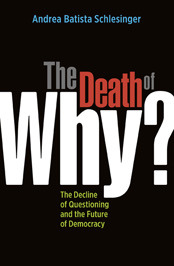
It seems fitting, therefore, that questions would guide the exploration in The Death of “Why?”. In part I, I ask, Does our society value questions or answers? I discover that all too often the latter takes precedence, and I offer quick snapshots of the ways in which our obsession with answers manifests itself in contemporary culture. Our increased ideological rigidity, reflected even in Americans’ growing preference for living only among those with whom they agree, offers protection from the risks of inquiry, disguised in a collective cloak of self-righteousness. Why question when you just know—and everyone in your town, everyone in your social network, really knows—that something is true? We encourage the media to do more opining and less reporting because we want to be told how to interpret events as they unfold—preferably if that interpretation squares with our political ideology.
The Internet is as much a part of our culture as it is a tool. More than a medium such as television or radio, the Internet is a place where young people live. It may seem strange to wonder whether the Internet, where so much knowledge resides, encourages inquiry. It may seem counterintuitive to wonder whether the Internet, where we can become “friends” with someone on another continent, leads young people to ask more questions about their world.5
Yet these are questions that we must ask, because what I have heard, read, and observed challenges conventional wisdom. Young people are substituting search engines for an inquiry process. They plug in their terms and press Enter, print the first three articles that come up, rinse, and repeat. This automated search cycle is not inquiry. They do not think carefully about the question they are asking; they do not refine that question based on preliminary exploration; they do not consider the credibility of the sources they encounter; they do not synthesize what they read. The coping mechanism for unlimited information is superficial exploration and expedited searches for certainty.
If Google took the day off, would we have any idea how to find information? It is a profound irony that, just when so much information is available to us, we are raising children who are so poorly equipped to critically engage with it. If they only learn to retrieve, and not to interpret, when and where will they think new thoughts?
It is in our schools, however, that the lack of questioning should trigger the greatest alarms about the future of our democracy, and this is where I spend the most time in this book. In part II, I ask, Are our schools aspiring to prepare citizens or consumers? I argue that the focus on answers rather than questions demonstrates a changing understanding of the purpose of the public school system, that schools have moved from preparing young people who can question their democracy to preparing workers for our economy. The spokespeople for the latter approach say that it is in our nation’s best interest. The evidence suggests otherwise.6
America’s employers aren’t interested in test scores; they are interested in people who can think, question, adapt, and perform. On these scores, in survey after survey, employers register disappointment with the talent pool. We have created an educational environment devoid of curiosity, creativity, and inquiry, all in the name of coping with changed times that, in actuality, would be best served by graduates with those criteria in abundance.
Finally, in part III, I ask, When it comes to our political process, are we teaching our young people to be connected or engaged? I explore whether young people are learning enough about the world around to them to participate effectively in their democracy. They are constantly connected to one another and to the latest breaking news, but they do not read the newspaper. The youth who seek out the news online are snackers, grazers. They skim headlines on online news sites or get updates via text message. They are constantly in the know, but they are not more aware. They zero in on the news that already interests them.
As is true of the American appetite, excess does not mean fulfillment. Technology has certainly allowed young people to tell their own stories as a way of challenging the limitations of our corporatized and consolidated mainstream media. But without a shared knowledge about current affairs, without rigorous attention to the credibility of our sources, without the ability to read for meaning and not just consumption, how can we ask the questions that form the basis of collective decision making for our democracy?
I look at our presidential debates, powerful vehicles that are so important to our decision making but that are too scripted to demonstrate any kind of genuine questioning. I worry about the message that these closed, elite, and heavily negotiated sessions send to our young people. The current structure of our political debates doesn’t give any citizen much hope that their questions remain central to our politics.7
In some places across our country, such as in Hampton, Virginia, we see the promise of engaging young people in local politics. With the support of adults who realize that their best hope for a healthy community is the involvement of young people in deciding their own fate, Hampton’s young people learn to ask questions. They have a role in the decision-making processes of their town. They experience the relationship between smart questions and effective public policy, and as they experiment with democracy, their community becomes a better place for everyone to live.
Hampton is not the only positive note. Much in The Death of “Why?” inspires even this naturally cynical New Yorker, such as the community discussion and decision making facilitated by AmericaSpeaks, or New York City’s School for Democracy and Leadership, where every student is required to participate in a “change project” in their local community and where over 90 percent of the senior class graduates.
When I encounter college students who proclaim themselves activists despite only a vague awareness of what is going on in the world, I ask them, How can you change the world when what you know of it comes from content provided in text messages, headlines skimmed on the Internet, and updates to Facebook pages? I teach them how to read the newspaper critically, how to ask questions about what they read, and how to identify and locate the information that would enable them to act. I see them awaken and transform. They have the potential for effective citizenship, a characteristic that places them ahead of the one out of three of their peers who have no connection with the news on any given day. And they have fun in the process. I know, because I have seen it firsthand.
Unfortunately, however, these examples are exceptions. Abundant in our culture, intrinsic to our education policy, predominant on the Internet, are incentives, expectations, and penalties that favor answers, not questioning.8
One note to guide the reader: The research on “inquiry” as such is limited. Therefore, this book offers few psychological or educational theories about inquiry or how it is developed. In addition, although there is contemporary research on the effects of civics education, there are few definitive reviews of its role in history. Neutral, nonindustry research on financial literacy is limited as well. When there was no formal research, I interviewed practitioners and psychologists. I visited schools and talked to educators. I did my best to synthesize the available research on a topic that is remarkably unexplored—but perhaps that is precisely the point.
Fundamentally, this book tells stories about how current conditions do or do not inspire children to learn the value of asking questions. Naturally, I hope that these stories will inspire further questions.
Societies rightly fear that inquiry challenges the established order of things. Questions beget change. And despite its political utility during election years, change is a scary idea. I see a country mitigating the risk of inquiry. We numb inquisitiveness with consumerism. We fool ourselves into devaluing it in our public schools. We escape it through technology. Questions are a risky business. There’s a reason Socrates was sentenced to death, after all.
A colleague of mine asked why I would write a book about inquiry and children. Why not write about one of the issues on which I’ve focused directly in my work—urban policy, the economic health of the current and aspiring middle class, education, or the preservation of access to the courts so that regular Americans may hold corporations accountable?
Yes, those are all issues that intrigue me. Addressing them has motivated my work, from my beginnings as a student activist, to directing a campaign to engage college students in the conversation about Social Security reform, to working as an education policy analyst for a New York City public official and mayoral candidate, to my current position as the executive director of the Drum Major Institute for Public Policy (DMI), a progressive think tank, where I’ve been since 2002.9
But the issue that is the focus of this book underlies them all. If we do not have a populace prepared to question, a populace that is engaged through the very process of questioning, the issues that concern me have no future. How easy will it be to concretize legal obstacles that tilt the scales of justice in favor of corporations if no one is asking questions? What kinds of public schools will we have if the vast majority of Americans are disconnected and disengaged from their local institutions?
Whether young people are prepared to question events as they unfold, to question their democracy and the status quo—all of the issues I care about depend on this.
I’ve read countless books that claim to know the right answer or to explain how other people got the wrong answer; to demonstrate why some people don’t get the right answer, no matter how hard we try to convince them, or how we used to get the answer right but now don’t because of where we live, who we are, what we eat, who we love; to tell me which words are used to describe the answer, which impulses these words trigger, and whether we vote with this answer in mind. Underlying the “correct answer” approach is the mistaken idea that the health of our democracy depends on our ability to know the answers and to act on those answers, rather than on our ability to ask questions.
Inquiry is natural for us; infants inquire even before they have language. But they will only engage in it if they have the safety of attachment to at least one person. A child’s explorations are cued by this person. Approving looks mean “explore more,” whereas disapproving looks mean “danger.” Children trust their caregivers unconditionally and, as a result, they feel safe to begin a life of inquiry. Trust and inquiry go hand in hand.10
If we want our children to grow up inquiring, we will need to restore trust in one another and in the institutions of our democracy. It is surreal to live in a time when citizens who question their democracy are considered unpatriotic, whereas those who wish to slowly unravel the civic purpose of our public institutions in favor of the commercial purposes of our private institutions are said to have our best interests in mind. It stretches the imagination that teachers who encourage young people to question their local institutions would be attacked on editorial pages as propagandists, even while we trust commercial search engines to understand and deliver what we want to know.
Our democracy can handle inquiry. It can handle a citizenry asking complicated questions. In fact, such questioning is essential. It is entrenched power, feeding off ignorance and resignation, that our democracy cannot abide.
My question is not, Do we inquire more or less than we used to? The question I ask is, Are we teaching our children to inquire as much as the times demand?