


Download PDF Excerpt
Rights Information
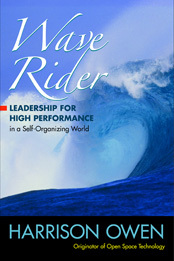
Wave Rider
Leadership for High Performance in a Self-Organizing World
Harrison Owen (Author)
Publication date: 10/01/2008
• By the author of Open Space Technology (over 35,000 copies sold)
• Shows how to achieve extraordinary levels of innovation, insight, and productivity by applying the principles of Open Space Technology to day-to-day management
• Defines eight essential steps to leverage the principles of OST and includes real-world examples of these principles in action
Find out more about our Bulk Buyer Program
- 10-49: 20% discount
- 50-99: 35% discount
- 100-999: 38% discount
- 1000-1999: 40% discount
- 2000+ Contact ( [email protected] )
• By the author of Open Space Technology (over 35,000 copies sold)
• Shows how to achieve extraordinary levels of innovation, insight, and productivity by applying the principles of Open Space Technology to day-to-day management
• Defines eight essential steps to leverage the principles of OST and includes real-world examples of these principles in action
Harrison Owen, the originator of Open Space Technology, is the president of H.H. Owen and Co. and the author of six previous books including Open Space Technology: A User's Guide, The Power of Spirit, and Expanding Our Now: The Story of Open Space Technology.
Since the mid-1960s, Owen has worked with a variety of organizations including small West African villages, urban (American and African) community organizations, the Peace Corps, regional medical programs, the national institutes of Health, and the Veterans Administration.
To learn more about Harrison and his work, please visit him online here
—Dr. Arthur L. Jue, Director, Global Organization and Talent Development, Oracle Corporation, and coauthor of Leadership Moments: Turning Points That Changed Lives and Organizations
“Shows us why almost everything we think we know about planning, organizing, directing, and controlling is wrong…and what we need to do instead.“
—Rodney Plimpton, PhD, former Senior Vice President, Human Resources, American Electric Power
“The current economic downturn has focused business discourse on efficiency, measuring systems, downsizing, and other linear top-down measures, but Owen draws from decades of his grassroot experience to prove that passion, responsibility, and self-organizing are the main ingredients of long-term performance.'
—Sari Stenfors, PhD, Associate Director, Scandinavian Consortium for Organizational Research, Stanford University
“With characteristic humility Harrison has issued an invitation for authentic leaders to recognize the true nature of how effective organizations work. We have only to decide whether we try to convince ourselves we are still in control or get on the board and become a `wave rider'"
—Phelim McDermott, Co-Artistic Director, Improbable theatre company, London
Introduction Wave Rider
Part I: Preparation for Wave Riding
Chapter 1: The Holy Grail: Superior Performance
Chapter 2: High Performance Systems Defined
Chapter 3: Getting from Here to There
Chapter 4: The Anomalies
Chapter 5: The Open Space Experiment
Chapter 6: Self Organization: The Key to High Performance Systems?
Chapter 7: How Do We Deal with the Pain?
Chapter 8: A Spanner in the Works
Part II The Wave Rider's Guide to the Future
Chapter 9: Becoming a Wave Rider: Care and Feeding of Self Organizing Systems
Chapter 10: Step One - Do your Homework before you Start
Chapter 11: Step Two - Extend an Invitation
Chapter 12: Step Three - Come to The Circle
Chapter 13: Step Four - Welcome Passion, Responsibility and Authentic Leadership
Chapter 14: Step Five - Remember the Four Principles
Chapter 15: Step Six - Observe the Law of Two Feet
Chapter 16: Step Seven - Keep Grief Working
Chapter 17: Step Eight - Formalize the System
Chapter 18: A Day in the Life of. . .
Conclusion
Index
About the Author
Introduction Wave Rider
Wave Riders are curious people possessed of an innate capacity to go with the flow, constantly seizing upon opportunity when others see no possibility or even disaster. Their level of performance is consistently high, and projects are often completed in breathtakingly short periods of time, with a degree of excellence that may seem unbelievable. Not always, not in every instance——but with a regularity that sets them apart, but never alone. Together with their fellows, Wave Riders create the critical community bonds, essential for productive activity. And they bring a special gift——Leadership. Their passion and responsibility for a cause inspire others to make common cause. Not by domination and control, but through invitation and appreciation, the efforts of many coalesce as one.
Saying that Wave Riders go with the flow is not to say that they have a light regard for planning, logic, and hard work. In fact the Wave Rider may be a fanatic for planning, logical to a fault, and a total workaholic. But what sets them apart is that they also possess a clear understanding of the limitations of all three: planning, logic, and hard work. For them the Plan is the map and not the territory. Necessary, useful, but never to be confused with the facts on the ground, and certainly never to be given preeminence.
Likewise with logic. Good and useful for sure, but when the daily course of experience appears to behave in an illogical fashion, usually referred to as counterintuitive, the Wave Rider will understand that there are multiple “logics,” and it may well be that the one employed is simply inappropriate to the situation. A classic case of this phenomenon comes from the world of physics at the point where quantum mechanics made its appearance. Traditional Newtonian physicists were logical to a fault, perceiving the elegant coherence in the cosmos to be an exquisite clockworks. However, as the world of subatomic physics became the object of study, the traditional logic faltered. And those who were crafting the emerging quantum physics used the sense of illogic to advance their work. Werner Heisenberg, the originator of the Uncertainty Principle, is said to have remarked, “Your theory is crazy, but not crazy enough to be true.”
On the subject of work——Wave Riders do indeed work very hard. They are often sticklers for detail and devote amazing amounts of time and energy to enterprises for which they have a genuine passion. When they care, they care deeply, and the effect of this caring is a devotion to their cause that others may find disturbing.
But there is another aspect to a Wave Rider’s relation to work that many will find strange. On occasion, all of their busy doing simply stops. The task lists are put away, the goals and objectives are all placed on hold. The Wave Rider is content to be there in that present moment. An outside observer might legitimately conclude that the Wave Rider has given up, but the truth is rather different. She or he has simply let go. Not to be confused with a fatalistic withdrawal from life——this letting go has a very different quality. The commitment to the original passionate concern remains unshaken, and if anything, is deepened and intensified. Rather than fatalism, there is profound awareness and trust in the deep forces which drive toward completion and fulfillment. And of equal importance is a recognition that any “doing” in the sense of organizing, managing, forcing——will not only be ineffective, but may well be counterproductive.
Wave Riders may be found in all times and places. Some will be remembered as major historical characters, the names of others will never be recorded in the pages of history. Gandhi, for example, confounded the British Empire not only with his tireless efforts and articulate strategy (plans), but also, and perhaps more importantly, with his presence and capacity to simply be there in the present moment, apparently doing nothing. Dee Hock comes from a very different environment, the corporate world. As the founder of VISA International, Dee Hock surely did a lot, but he also well understood the need to let go and simply be there. Not the controlling/directing chief executive, but rather the appreciator of an evolving organic entity which has become one of the largest global corporations——and over which he had no control.
Wave Riders are not limited to global or corporate heros. The mother of a growing family, shepherding her brood toward adulthood, will ride the waves of her complex and confusing world——multi-tasking we call it. To be sure, she has plans and tasks in abundance, to-do lists without end. But at the end of the day, and indeed on every day, she will be remembered not so much for what she did, which may be truly awesome, but rather for the power of her singular presence.
Wave Riders show up on the shop floor and the executive suite, athletic fields, and the halls of government. They appear at every level and station in life, but never are they to be confused with the great man version of The Leader, even though some may bear the most exalted of titles. The power of their presence comes from a very different place. It is not bestowed as a divine right, nor is it claimed in a decisive act of control. It is a power that comes from powerlessness and the full recognition that they will never be in control. They do not command; they invite. They do not envision themselves at the apex of a hierarchy but rather in a circle with their peers and colleagues. The source of their power comes from their own unique passion linked to responsibility which attracts others to join a common venture. A venture which is at once productive and personally fulfilling for those who care to join. Wave Riders are leaders who enable individuals and organizations to fulfill their potential——with distinction.
Needed: More Wave Riders
Wave Riders have been with us always, usually unnoticed, or if noticed then treated as a curious exception to the rule. And indeed it often seemed that they were playing by very different rules. There was doubtless a time when we could afford to smile sympathetically at the behavior of the Wave Riders in our midst. When good things happened (the difficult was handled with dispatch, and the impossible achieved with a little more time), we could scratch our heads and wonder at the fabulous run of luck which the Wave Rider obviously enjoyed. It would never occur to us that there might actually be a method in their madness. In fact such thoughts could not occur to us if only because virtually all of our training and experience told us otherwise. Wave Riders were clearly the exception, and we all knew the proper way to do business, whatever that business might be. The critical point was to seize and maintain control in the manner of the Great Man Leader. Only then could good and useful things happen. Or so many of us thought.
The times have changed. The anomalous behavior of the Wave Rider holds a critical clue to new ways of surviving, and indeed thriving, in our chaotic world, enabling all of us to achieve levels of excellence and high performance previously unknown.
The search for high performance has typically been a major concern of businesses and other organizations in their quest for efficiency and effectiveness. However, the stakes have risen dramatically. Achieving optimum levels of human performance is no longer just an issue of organizational effectiveness, but now a matter of global survival. The list of threatening possibilities is virtually without end: climate change, nuclear disaster, pandemics of various sorts, to name a few. Any one of these, taken by itself, would constitute a real problem, but everything is coming together in a dizzying maelstrom of complex interaction. Even just thinking about all of this is sufficient to produce the maximum headache. The good news is that for the past several millennia, human beings have successfully negotiated the terrain. Not always perfectly, and perhaps less than elegantly, but so far we have made it. However, more than a few disturbing signs indicate that our good luck may be about to change, signs which appear as organizational dysfunction, and individual fatigue and disorientation.
The simple fact of the matter is that our institutions, major and minor, are stretched to the breaking point. Even with the best efforts in the world, the stuff accumulating in the Global Inbox is getting out of hand. The impact on our individual lives is equally obvious and severe. Stress, breakdown, alienation, exhaustion——we know them all. Rather like the mad Queen in Alice and Wonderland, we are discovering that the faster we go, the “behinder” we get.
Doubtless the end is not yet, and for sure we have a few more tricks up our sleeves. However, the time may well have come when the consideration of alternatives would be useful. Typically, we have attempted to deal with our multiple dilemmas by trying harder and harder to do more and more of what we have always done. If our organizations lack purpose and power, it is obviously time to reorganize——and reorganize again. And when events show every indication of spinning into oblivion, we redouble our efforts to assert, or regain, control——layering controllers upon controllers upon controls. I propose that it is not that we are doing something wrong, but rather that we are doing the wrong thing. Or put somewhat differently: Going the way we are going we are not likely to reach our destination. It is time for a change of course.
The argument of the book is that we must now recognize that we, our organizations, as indeed the entire cosmos——are all self-organizing systems. Not just a little bit, not just in some special part, but from beginning to end, top to bottom. It is all self-organization. The implications of this recognition, should it prove to be valid, are twofold (at least). First, a large part of what we currently devote a good deal of time and energy to——organizing things——is wasted effort, for our systems, left to their own devices, will take care of that business pretty much all by themselves. Second, our efforts at organization and control are not only of questionable value, but also destructive. By imposing our view of organization on a self-organizing system we essentially throw a spanner in the works, thereby reducing organizational function and our own levels of performance.
Stated in more positive terms, were we to recognize, and fully appreciate, the power of self-organization we could be relieved of an enormous task, freeing time and energy for the many other pressing issues of our day. Even better, we might learn how to leverage the power of self-organization for our benefit, thereby achieving levels of performance which presently lie beyond our wildest dreams. We will ride this primordial power, compensating for our own powerlessness. Wave Riders for sure.
Secret of the Wave Rider
The Wave Rider’s secret is a deep awareness of the fundamental self-organizing nature of our world. This awareness may be largely intuitive or very conscious, but the net effect is the capacity to align oneself and one’s work with the primal force of self-organization, thereby leveraging its enormous power. Concurrently, the Wave Rider is keenly aware of the limitations of his or her own powers, particularly the power of control. Recognizing the mind-boggling complexity of the chaordic forces at play (thank you, Dee Hock) the Wave Rider understands that total control, at least of the sort that many seem to seek, is but a fond hope, verging on the delusional.
The image of the Wave Rider comes from the world of surfing, providing a vivid picture of the interrelationship of human beings and the self-organizing world. To see the point, we must set the scene as a surfer might experience it. At the simplest level there is a lot of ocean, more than a few waves, and a very small board——with the beach lying ahead. The objective is quite simple. Ride the wave on the board until you reach the beach. Although there may be many mis-steps, mishaps, and false starts along the way, when The Wave comes it can be the experience of a lifetime.
For somebody sitting on the beach, particularly a non-surfer such as myself, the setting looks like simplicity itself——waves, board, beach, and sky. An experienced surfer will see all this rather differently, beginning with the wave(s).
The elegant simplicity of the forming wave is a monster of complexity with quite a history. For a West Coaster (U.S.) the story begins in the vastness of the Pacific. A gentle wind ruffles an otherwise smooth surface and a wavelet is born. As more and different winds transverse the surface, wavelets coalesce in a complex process of cancellation and amplification. And curiously enough the water itself hardly moves, it is only the force passing through, modified by intervening islands and continents. And so the forming wave has a history which vastly exceeds the time from the first puff of wind. The movement of tectonic plates and violent volcanic events from millennia past also make their mark.
When the wave force swells the waters off the California coast, local powers and conditions add their imprint to the complex stew. Bottom types of differing sorts shift and form the surfacing wave until it rises from the surrounding sea and comes into the view of the waiting surfer. Simple on the surface, but containing a churning mammoth of complex, interacting forces with a very long history.
When the instant arrives that rider, wave, and board unite——all of the history, complexity, skill, surging power, and random chaos coalesce in a mindless moment of sheer exhilaration. Speeding down and across the broad face of the advancing wave with the curl steaming spray just behind and above——the rider, board, and wave are one in a timeless moment. Sooner or later that moment comes to an end, as all things do in this life. But for that moment an image of high performance is accelerated by the leveraged power of an enormous self-organizing system, otherwise known as the Pacific Ocean.
What can we learn from the surfer that may assist us in our own efforts to ride the waves of our time with excellence, manifesting true high performance? The two primary lessons may appear largely negative but no less important. First, if we ever thought that the road forward might be viewed solely as a rational project which we might think our way into, we clearly have a second thought coming. The level of random complexity, to say nothing of chaos, confusion, and conflict is more than sufficient to blow the superior mind. We simply can’t think that sort of stuff, and certainly not to the point where we could identify, isolate, analyze, and understand the myriad critical elements.
This does not mean, of course, that good, hardheaded fact gathering, analysis, and “intentioning” (used to be called Planning) are irrelevant. Such efforts have their place, but they need to be kept in their place. All of that is, and remains, a map of the territory, never to be confused with the reality of the wave face and the incredible timeless moment of hanging out there.
The second lesson relates to the subject of control. Stated bluntly, any surfer who ever thinks, even for an instant, that he or she is in charge of the wave, is in for a profound shock, delivered in a most memorable way. Assuming, of course, that there is any memory left to capture the moment.
And yet perfect rides on perfect waves do take place——despite the mind-numbing complexity of the moment, and the ultimate lack of control. It might appear to be dumb luck, but if so, the luck is not randomly distributed. Very clearly, some surfers “really get it” and others do not do so well. Obviously technique and experience play a significant part, but when the ride begins, there is no time to run through the checklist of the 42 critical points for a great ride. Once on the wave face and the descent begins——the rules have definitely changed. In the instant technique and experience are included but also radically transcended.
The metaphor of the Wave Rider, like all metaphors, has its limitations. I am hopeful, however, that it will serve to carry us into the world of self-organizing systems not as helpless pieces of flotsam and jetsam tossed about in a chaotic world, but rather as conscious and sensate human beings capable of bringing the human adventure to interesting and fulfilling conclusions.
The fundamental limitation of the Wave Rider image is that it may take us back into the troubled waters of rampant individualism, and the notion that leadership for high performance is the private preserve of The Great Man. But the solo rider coursing down the face of a giant wave, the Mavericks1 for example, is but a moment in time. And behind and ahead of this moment lie innumerable rides by countless individuals over time. Surfing is a community activity, and each individual who stands for the moment in splendid isolation on the wave face is supported by the skills and enthusiasm of thousands of colleagues. It is true. One person surfs alone, expressing his passion for the ride and taking full responsibility for the consequences. But it is only a moment, and a shared moment at that. Fellow surfers share the wave face, and others will follow on succeeding waves.
The big secret is that we are all Wave Riders, but some do better than others. As long as human beings have inhabited Planet Earth, we have existed in a self-organizing world. Quite probably the majority are simply unconscious of this fact, and their adjustment to the forces of self-organization are equally unconscious. Others are unwilling Wave Riders, who take deep umbrage at the uncontrollable forces at play, seeking their defeat and claiming to be in charge. This effort may appear successful in the short term, but ultimately the powerful waves of our world pass on by undiminished, leaving those who thought they were in charge looking a little silly. There have also been more than a few who truly understood the situation, if only intuitively, and learned to ride the waves to their benefit and to the benefit of their fellow human beings. We are all Wave Riders, and the purpose of this book is to enable each one of us to become intentionally and competently what we already are——riders on the waves.
Invitation to an Experiment
I recognize that the propositions stated above represent somewhat of a departure from the conventional ways of viewing organizations and our place in them. Therefore I have no hope or expectation that these propositions will be easily or quickly accepted. In fact, doing so would be counterproductive. There is much to think about, rigorously examine, and test before anything approaching proof can be claimed. Therefore, you are invited to join an experiment, which in fact (at least as far as I am concerned) is already under way.
The experiment comes in two phases, the first part began some 21 years ago with the creation of Open Space Technology (OST)2 , which as you may know is credited to my account. I believe that credit to be largely undeserved as I rather stumbled into OST, but telling that story must wait until later in the book.
OST, for those unfamiliar with the approach, is simplicity itself. Groups of people sharing a common concern for a complex issue are invited to sit in a circle, identify the relevant sub-issues by posting them on a bulletin board, work out the time and space arrangements for their discussions in a marketplace setting——and then go to work. There is no prior training, or “warm-up activities,” little obvious facilitation, and for all pretenses and purposes, the whole thing runs all by itself. I hasten to add that this is not just another book about Open Space Technology, although it is certainly about open space, which in my lexicon describes the special circumstances and conditions necessary for the initiation and sustenance of self-organization.
The utter simplicity of OST contrasts starkly with the results commonly achieved. Very large groups of people (2000+) are enabled to deal with massive, conflicted, and complex issues in a respectful and productive fashion——all in a very short period of time. From the point of view of conventional meeting and organizational management theory and practice——the demonstrated results simply could not happen. But they do, and continue in thousands of situations around the world. In seeking to understand this phenomenon the only adequate theoretical base that I have discovered is that provided by the work of various disciplines with the process of self-organization.
It is my intention to use the collective experience with OST as the point of departure for the deeper discussion of self-organization, our human systems as self-organizing, and the ways in which we may support and optimize their levels of performance. Ultimately this is about learning (remembering) and exercising our roles as Wave Riders, the true leaders in a self-organizing world. In this context, the 21-year experience with Open Space Technology becomes a natural experiment with all the strengths and limitations of such experiments.
Natural experiments, by definition, are unplanned, and in the case of OST that is definitely the case. The unplanned nature of such experiments means that many, if not all, of the standard controls are simply not in place, rendering confidence in the results open to question——until the sheer number of iterations tend to compensate for the possible effect of odd variables. Open Space Technology has now been run in excess of 100,000 times in 136 countries with comparable results. The experiment continues; however, my personal comfort level with the results to date is such that I believe we are in a position to gather up the lessons learned about life in self-organizing systems and move on to the next phase of the natural experiment. We will use these lessons from OST as a basis for scaling up the enterprise——moving from the rather narrow confines of time/space limited events to the expanded and more critical realm of real, live organizations, large and small.
Preview of Coming Attractions
The book is divided into two parts. Part I, Preparation for Wave Riding, details the basic argument of the book (There is no such thing as a non-self-organizing system) and suggests the means and methods which will be of assistance when living and working in our self-organizing world. Part II, The Wave Rider’s Guide to the Future, converts the more general and theoretical discussion of Part I into a practical approach. If your natural predilection is toward the practical, you may do well to reverse the order. Your choice.
In Part I, we begin with a consideration of the Holy Grail of all Wave Riders, and just about everybody else: Superior performance at the individual and organizational level. Peter Vaill, whose seminal work in this area initiated the contemporary discussion, referred to all of this collectively as a High Performing System (HPS). Curiously, he declined to actually define an HPS, however this omission is understandable since we always seem to recognize such creatures when we meet. Quite simply they do what they do with distinction, and in any event, outperform the competition. What Vaill chose not to define, he could clearly describe, which he did in a short, but nevertheless watershed paper bearing the title, “Towards a Behavioral Description of High Performing Systems”3
Rushing in where Vaill chose not to go, I propose a possible definition of High Performance as the absence of its (apparent) opposites: Chaos, Confusion, and Conflict. The suggestion being that if only we could eliminate this troublesome trio, the high performance of our systems would be a surety. Unfortunately it seems that all three (especially the first——Chaos) are essential to life, and thus their elimination would not only fail to usher in high performance, but would usher out life. Which leaves us with the interesting problem of defining (understanding) high performance as including, but somehow transcending, chaos, confusion, and conflict.
My formulation goes as follows:
High Performance is the productive interplay of diverse, complex forces, including chaos, confusion, and conflict, characterized by wholeness, health, and harmony. It is harmonious, including all elements of harmony both consonance and dissonance, in that multiple forces work together to create a unitary flow. It is whole in the sense that there is a clear focus, direction, and purpose. It is healthy in that the toxins of its process (metabolic byproducts in organisms) are eliminated effectively, and without prejudice to itself or environment. High Performance can never be sustained at the cost of a fouled nest. A High Performing System is one that does all of the above with excellence, over time, and certainly better than the competition.
Presuming that this definition, combined with the behavioral characteristics identified by Peter Vaill, is sufficient to indicate the object of our inquiry, the next question is simple: How do we get there from here? How do we bring our systems to the level of high performance?
For many of us the answer has come in terms of what might be called the Problem/Solution approach. When it is perceived that performance levels are declining, this is determined to be a problem for which a “fix” must be found. The simple and obvious logic of the approach has much to commend it, and in truth it is quite effective, at least in the short term. However, over time difficulties arise, usually in terms of unintended consequences. The identified problem is fixed, but a host of new problems are generated which are as bad, or worse, than the original situation.
More recently, it has become apparent that the difficulty with the approach derives from the narrowness of the view. By concentrating on a single problem and searching for a single fix, the larger aspects of the system and its environment are essentially ignored. And this ignorance comes back to bite us.
Enter Systemic Thinking. When searching for enhanced performance, we must consider the whole system, including all of its relations with the surrounding environment. This marvelous idea has enabled us to begin to comprehend the mind-blowing complexity of the human systems of our lives. However, when it comes to the successful conclusion of our search for high performance, the systems approach in its various manifestations (e.g., Business Process Re-Engineering) leaves something to be desired. In fact it might actually be seen as an exercise in futility.
The more precisely we identify the operative elements and relationships in our systems, the more it becomes clear that we confront a level of complexity that has no end. And when it comes to redesigning (re-engineering), the task is daunting. However, a daunting task could turn into a wonderful opportunity if we only had the time to complete our system’s analysis before everything changed again. And here the cookie crumbles.
In our restless world, every thing is connected and everything is moving. Even worse, most of that connection and movement lies beneath (beyond) our capacity to apprehend. To add insult to injury, the chaos and complexity theorists tell us that the root of our problem lies with a funny little butterfly flapping its wings in Thailand, thereby changing the weather patterns in California. To date that butterfly remains at large, hidden in an undisclosed location.
We might note that the conventional “Great Man” theory of leadership fits very naturally with the Problem/Solution approach, as well as its latter day reincarnation in Systemic Thinking where the “problem” becomes the whole system, and the fix becomes more complicated. The Great Man will define the problem and then decisively administer the fix, which is precisely why he is known as The Leader. However, to the extent that both approaches struggle or fail, so also does the Great Man theory of leadership.
Given the level of effort and our success to date, a monumental state of depression could well be justified——except for the fact that High Performing Systems continue to show up in our experience, but rarely where we expect them, and definitely not according to The Plan. Ordinary people do extraordinary things, under the most unlikely circumstances. We consider such manifestations as anomalies, funny little exceptions to the rules.
By definition, an anomaly is something that happens “outside the law” (Greek a nomos, “without law”)——outlaws, so to speak. These are the sorts of things that everybody knows could not, or should not happen——but they did. Upon closer examination it usually turns out that the anomaly was no outlaw. Either our perception was flawed, and we failed to see how the law applied or (much more rarely), the anomaly was totally within the law, but it was just a different law than we were used to. The latter situation can be a matter of real discomfort, particularly if we have a major attachment to the old law. But the learning opportunity is profound, for we may be at the edge of discovering a totally new way of looking at our world. According to Thomas Kuhn, this is the moment of Paradigm Shift.
Now for The Open Space Technology Experiment. For more than 20 years, thousands of groups of people have gathered around issues of common concern which manifest such levels of complexity and conflict as to make resolution appear impossible. Following a 15-minute introduction, the group defines its issues, deals with the practicalities of time and place of meeting——and goes to work. There is no prior agenda setting, only a single facilitator who never intervenes in the discussions——and at the end of the day (or more usually two days) the accomplishments are real, and very often quite unbelievable. Perhaps most remarkable, there is not a sign of The Leader, great man or woman. Nobody is in charge.
For example, a $200,000,000 structure was designed, starting with a blank sheet of paper, and ending with working architectural drawings. Actually this was a re-design, occasioned by major changes in plans and circumstances. The previous effort had taken 10 months, and thus the group had managed to do in two days what they knew, on the basis of prior experience, would take 10 months. Figuring roughly, this comes down to a 15,000% increase in productivity, and the executive responsible described the outcome as “magic.”
In fact it was not magic, but rather a significant (but not unique) application of Open Space Technology. This is definitely an anomaly within an anomaly. What the people accomplished represents a severe challenge to credibility, and certainly the participants found it incredible (“magic”). But how they managed to achieve their results doesn’t make any sense at all. Indeed it would seem to violate virtually every principle and procedure of group management and probably management practice as well. Talk about different rules!
If this book were simply about Open Space Technology, the tale might end right here and I could accept whatever accolades, as the originator of OST. In fact I know those accolades would be undeserved, and the tale has only just begun.
Searching for the how behind, or beneath, Open Space Technology takes us directly into the emerging science of chaos and complexity, and most particularly into the world of self-organizing systems. Of particular interest is the work of Stuart Kauffman, a biologist from the Santa Fe Institute, who has proposed that given certain very simple preconditions, order happens. The correlation between Kauffmann’s preconditions, and what I had described as the essential conditions for the use of OST, is virtually 100%, and so it is a natural step to the conclusion that the operative force beneath OST was none other than the primal power of self-organization.
Should you ask——is this true, my response can only be, I think so. At the very least the identification of OST with self-organization provides the only rational explanation I have encountered for an otherwise completely anomalous occurrence. If OST is not magic, it must be self-organization, or so I propose.
Going forward, the logic is clear and simple. If superior performance (HPS) is the common result of OST, and OST itself is a manifestation of the power of self-organization, it would make sense to remove the “middle man” (OST). Or put somewhat differently, if we were able to initiate and sustain the force of self-organization, it should be possible to achieve high performance on some regular basis. We might call this, The Care and Feeding of Self-organizing Systems. At this point we arrive at the core realization of all Wave Riders. Not only do we live in a self-organizing world, but our job——or perhaps better, our opportunity, is to leverage this force for our purposes and so ride the waves of self-organization as an intentional and conscious act.
In developing the material which appears in Part II, The Wave Rider’s Guide to the Future (Chapter 9 and following), I have kept in mind the interests of a younger friend. I’ll call him Steve. After reading the manuscript of this book, Steve said that while he loved all the stuff about self-organizing systems, he still had a business to run, bills to pay, and product to get out the door. And he wasn’t at all sure that any, or all, of this could be accomplished through self-organization. He didn’t say it, but I think he was asserting that, “Somebody simply has to take charge.”
It occurred to me at the time that I should wish him a great deal of luck, but not much encouragement. For after all, if my major premise is correct (There is no such thing as a non-self-organizing system), Steve, and all the other “Steves” in the world really don’t have any choice. It’s all self-organizing. And the notion of “taking charge,” as in running that system (his business)——just doesn’t quite fit.
That said, I take his point and feel his concern. In fact there are multiple concrete steps Steve can take which will enable (but by no means guarantee) that bills are paid and product leaves the premises. I have outlined these steps, along with a number of examples from my own experience and the experience of colleagues. I would hasten to add that none of the material should be confused with the final version of The Wave Rider’s Guide. The experiment continues, and the final word has yet to be spoken.
The book concludes with an imaginary tale describing a Day in the Life of a Wave Rider, along with a tale from a genuine Wave Rider, Dee Hock of VISA International. The Day in the Life is imaginary only in the sense that it is described from the point of view of you the reader; however all the reported events and strategies actually took place in my own experience or the experience of friends and colleagues. Dee Hock and VISA are definitely not imaginary.