



Download PDF Excerpt
Videos by Coauthors
Follow us on YouTube
Rights Information
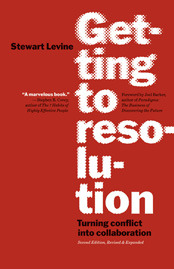
Getting to Resolution 2nd Edition
Turning Conflict Into Collaboration
Stewart Levine (Author)
Publication date: 11/01/2009
Bestseller over 20,000+ copies sold
Find out more about our Bulk Buyer Program
- 10-49: 20% discount
- 50-99: 35% discount
- 100-999: 38% discount
- 1000-1999: 40% discount
- 2000+ Contact ( bookorders@bkpub.com )
Stewart Levine
Stewart improves productivity while saving the enormous cost of conflict using “Agreements for Results” and “Resolutionary” conversational models. As a lawyer he realized fighting is ineffective in resolving problems. At AT&T he learned why collaborations fail: people do not create clarity about what they want to accomplish, and how they will get there. He has worked across the organizational spectrum – Fortune 500, small, government and non-profit. His “Cycle of Resolution” is included in the “Change Handbook, 2d Edition.” His book "Getting to Resolution: Turning Conflict into Collaboration” (Berrett-Koehler 1998, 2009) was an Executive Book Club Selection; Featured by Executive Book Summaries; named one of the 30 Best Business Books of1998; and called “a marvelous book” by Dr. Stephen Covey. It has been translated into Russian, Hebrew and Portuguese. “The Book of Agreement” (Berrett-Koehler 2003) has been endorsed by many thought leaders, called “more practical” than the classic “Getting to Yes” and named one of the best books of 2003 by CEO Refresher (www.Refresher.com). Along with David Coleman he wrote “Collaborate 2.0” that was released in February 2008. He teaches communication, relationship management and conflict management skills for The American Management Association, the University of California Berkeley Law School and Dominican University Graduate Business School. www.ResolutionWorks.com
--Marvin E. Johnson, JD, Executive Director, Center for Alternative Dispute Resolution
“Getting to Resolution is a clear and practical guide to the secret of success — how to create and leverage collaborative advantage. It is a must read for leaders seeking to strengthen relationships and get positive results.”
--Diana Whitney, PhD, President, Corporation for Positive Change, and coauthor of The Power of Appreciative Inquiry, The Appreciative Inquiry Summit, and Appreciative Inquiry: A Positive Revolution in Change
“It is impossible to read this book and not grow in understanding of conflict, resolution, and self. Every page offers wisdom and practical tools.”
--Arnie Herz, Esq.
“Stewart Levine has written a very practical book about one of life's vexing problems — how to reach agreement with others when differences must be resolved. He does so with the intent of fostering collaboration and creativity as the outcome.”
--Alan Briskin, author of The Stirring of Soul in the Workplace and coauthor of The Power of Collective Wisdom
“This book is practical, mind-altering, and life-changing. It's hard to achieve those in one book, but Getting to Resolution does that. It fills you with inner peace and the wisdom to untangle the thorniest conflict.”
--Noah Blumenthal, author of the Wall Street Journal bestseller Be the Hero
“If you want to resolve conflict and build relationships while connecting at a profound level, read Getting to Resolution. It gives you new language and practices for transforming your communication so you can lead at a higher level.”
--Victoria Halsey, PhD, Vice President of Applied Learning, The Ken Blanchard Companies, and coauthor of The Hamster Revolution and The Hamster Revolution for Meetings
Preface
Part I
The Value of Resolution
Chapter 1 Resolution: Getting Beyond Conflict, Compromise, and Settlement
Chapter 2 ROI and The Costs of Conflict: Pay Now or Pay Later
Part II
A Better Way of Resolving Conflict
Chapter 3 Two Brothers: Their Story of Resolution
Chapter 4 The Craft of Resolution: A Road Map for Resolving Conflict:
Part III
Resolution: Ten Principles of Resolutionary Thinking
Chapter 5 PRINCIPLE 1 Believing in Abundance
Chapter 6 PRINCIPLE 2 Creating Partnership
Chapter 7 PRINCIPLE 3 Being Creative
Chapter 8 PRINCIPLE 4 Fostering Sustainable Collaboration
Chapter 9 PRINCIPLE 5 Becoming Open
Chapter 10 PRINCIPLE 6 Forming Long-Term Collaborations
Chapter 11 PRINCIPLE 7 Relying on Feelings and Intuition
Chapter 12 PRINCIPLE 8 Disclosing Information and Feelings
Chapter 13 PRINCIPLE 9 Learning Throughout the Resolution Process
Chapter 14 PRINCIPLE 10 Becoming ResponseAble
Part IV
The Craft of Resolution: A Step-by-Step Guide
Chapter 15 STEP 1 Your Attitude of Resolution
Chapter 16 STEP 2 Stories: Telling and Listening
Chapter 17 STEP 3 Listening for a Vision of Resolution
Chapter 18 STEP 4 Getting Current and Complete
Chapter 19 STEP 5 Reaching Agreement in Principle
Chapter 20 STEP 6 Crafting the New Agreement
Chapter 21 STEP 7 Resolution
Chapter 22 Applying the Principles: The Craft of Resolution
Chapter 23 Benefits and Utility: The Cycle of Resolution
Part V
When You Need Professional Help
Chapter 24 Using the Power of the Legal System
Chapter 25 Choosing a Professional: The Resolutionary
Part VI
The Power of Resolution
Chapter 26 Building a Culture of Agreement and Resolution
Resources
Notes
Bibliography
Index
About the Author
1 Resolution: Getting Beyond Conflict, Compromise, and Settlement
Through dialogue even the most un-resolvable conflicts can be worked out and everyone wins. The process did not include litigation or the emotional roller coaster ride that accompanies most conflicts. It was a delightful experience.
Bill Brown, President, Influence Communications
I remember being surprised when told that settlement of a lawsuit is often characterized by thinking that “if both sides are unhappy, you probably have a good settlement.” Resolution is much better than settling! Resolution provides relief and completeness. The situation no longer gnaws at your gut.
The most fitting dictionary definitions of resolution are: (1) the act of unraveling a perplexing question or problem; (2) solution; and (3) removal or disappearance, as in the disappearance of a tumor.
The third is the most important, even though often aspirational. It means “as if it never happened.” The gnawing effect I call “internal chatter” has disappeared. The lack of chatter frees you to focus energy and attention on the present. If you’ve ever had a back injury, poison ivy, or a broken bone, you know what I mean. Something is resolved when the injury or illness does not impede the present moment.
This is important. You don’t want to keep dealing with the current impact of yesterday’s conflict. The effect may consist of holding anger or resentment, or thinking the result or compromise was unfair. Perhaps you compromised to get the situation behind you, or you deferred to someone else’s decision.
Although at times I have tried not to, for more than 25 years—as a lawyer, mediator, consultant, and trainer—I have practiced a resolutionary3 attitude, one that looks for the fair outcome from everyone’s perspective. Whether you are a hired advocate or you have a personal stake in the outcome, you can adopt an “attitude of resolution.” Evaluating the situation through the lens of resolution, you become an observer of what might be fair to everyone in the situation, even if you are directly involved. Standing in other’s shoes provides the critical perspective. The attitude of resolution is a skill you can cultivate by being aware, reserving your own judgments, and asking yourself if there is another solution that would serve everyone’s long- and short-term interests. It takes practice to develop this new habit of thinking, but I have found this orientation far more useful than trying to win.
Why Resolution?
Have you ever met someone who could not stop talking about something that happened in the past? It pervades their life as if it happened yesterday, although it may have taken place 20 years ago. They are stuck in the past, cut off from the ability to fully participate in their unfolding life.
Conflict has an emotional cost that remains after the battle is over. Win or lose, the scars may be with you for the rest of your life. Some people spend their lives focusing on the promotion they “lost,” the business they “lost,” the divorce they “lost,” the project they “lost.” This tunnel vision keeps them locked in the grip of their own anger.
They might even have “won,” but they have not healed the real cause of the conflict—a breakdown in a relationship that was valuable enough for them to invest emotional energy in a battle. They never completed grieving and they still carry the emotional suffering. They never “resolved” the real issue. They may never even have identified it! Our current ways of thinking that focus on winning guarantee a cost: suffering. The small battles between partners, parents and children, and employees and bosses take a significant toll.
Productivity and satisfaction, in business and personal relationships, come from our ability to collaborate with others. When you are resolved, you can fully focus on the tasks at hand. Your efforts are undiluted. Unresolved conflict, on the other hand, is an impediment to productivity and to satisfying, functional relationships. In today’s world of “knowledge work,” focus and creativity are essential. It’s impossible to be fully productive when you are angry. That’s why resolving the situation that’s sapping your strength and attention is very important.
It is equally important to have a sense of resolve when you start any new collaboration or relationship. You collaborate with others by reaching agreements. Your dependence on others is based on an intricate, pervasive web of agreements. Sometimes these agreements are explicit, but often they are implicit. Your collaboration will be stronger when you can recognize the implicit agreements within it. When you start out with uncertainty, or come into conflict during a project, you experience the cost of not being resolved from the outset. You also realize how inadequate your agreement-making and conflict-resolution tools are. Even though making agreements and resolving conflicts are essential life skills for working with others, they have not been taught to most of us.
Many current practices for resolving conflicts and starting collaborative relationships hinder us because of the way we were programmed to think, and because of the standard systems and practices in place. This book provides you with the following new tools:
1. Ten Principles of a new paradigm—a new way of thinking about conflict resolution.
2. The Cycle of Resolution, a seven-step model for preventing and resolving conflict that is a road map of new behaviors.
These ten principles and this seven-step model will maximize your ability to resolve conflict and achieve desired results in any business or personal relationship.
The Value of Resolution at Work
As organizations cut costs, differentiate products, and streamline productivity, people need to work within increasingly complex webs of face-to-face and virtual collaboration toward common goals. They need tools that foster collaboration in the face of distance and differences of opinion and “culture.” Rather than being angry and stuck, you must learn skills that foster resolution and quickly return you to productivity. This book presents the model for collaborative conversations that result in getting more done with fewer resources. This book reveals how agreement—the final step of resolving a conflict or the first step in the beginning of a new relationship—is an ongoing process, and that conflict and diverse opinions are opportunities for creativity and innovation. You will learn how to establish agreements based on deep heartfelt connection— agreements based on covenant.
Some of the benefits of establishing agreements based on covenant include:
Establishing shared vision of senior management
Improving teamwork
Creating partnership
Motivating participation
Including diverse perspectives and opinions
Using differences productively
Coordinating with external teammates
Using resources efficiently
Communicating more effectively
Building self-managing, high-performance teams
Forging consensus quickly
Fostering an environment of learning and growth
Promoting continual improvement
Capitalizing on the advantages of virtual organizations
Providing a more formal model of communication
essential for effective virtual collaboration.
The Value of Resolution at Home
In addition to their applications in workplace settings, the tools in this book will unlock more satisfying and intimate personal relationships within marriages, families, and less traditional partnerships that are part of our diverse social fabric. Because we usually think about personal relationships from an emotional and romantic perspective, it is difficult to accept that a linear process for resolving conflict and constructing agreements with specific promises about behavior will be helpful in producing more satisfying intimate relationships. My own experience leads me to suggest you bring the tools of this book into your personal life.
The Big Picture
One primary challenge in getting to resolution is reaching an agreement in principle—a broad understanding of what the resolution will be. Once you have an agreement in principle, the heavy lifting is done. Filling in the details of a new agreement can be an enjoyable exercise in visionary thinking. You get to an agreement in principle when you cross a self-imposed emotional barrier and can let go of a position you have taken. For most people, this is not easy. It may require going against a lifetime of dealing with conflict in a different way. The steps of the model are designed to get you beyond this hurdle.2
Getting beyond the emotional barrier is not like personal therapy. The internal work is accomplished as a result of new thinking (adopting the values of the ten principles) and new actions (following the steps of the model). Every step of the model contributes to resolution by making you speak your thoughts, feelings, and perceptions about the conflict. Once your story is articulated and no longer purely emotional, you and others can deal with it.
Although the steps of the model seem linear, getting to resolution is not a linear process. Mechanically going through the steps will not lead to resolution unless you have embraced the values of the ten principles. Once you embrace the principles, you have embraced the model’s first step, the Attitude of Resolution. Each successive step takes you toward resolution by making you go deeper into the personal, emotional, and human aspects of the conflict. You don’t have to say yes to the principles because they feel good, seem right, or are morally or politically correct. It’s fine to buy in because the cost of remaining in the conflict is too great. What is important is to get into the personal, emotional, and human aspects of the conflict. Regardless of what you say the conflict is about, the conflict is held as an emotional presence between you and at least one other person.
The new model provides a systematic approach. When you learn something new, it is important to have standard practices to follow. Standards provide guidance as you learn the new skill. When you learn to ski, drive a car, or fly an airplane, you put in place fundamentals that become unconscious habits. The model provides these fundamentals. Using the model develops habit and competence, and you discover the value of the principles. When you gain competence you will start to develop your own artistry—innovations within the standard practices. Once you internalize the principles and steps, resolution can happen quickly!
Personal Responsibility for the Value of Resolution
Most of us avoid taking personal responsibility for conflict resolution. Even though our culture is litigious, we lack the courage to connect deeply with others and we personally avoid confrontation. If we have a disagreement in a business transaction or with a neighbor, we may let a lawyer take care of it. If we have emotional conflict, we may visit a therapist or counselor who (we hope) will tell us what to do.
The symptoms of conflict are stress, pain, and discomfort. When you take personal responsibility, you can impact the cause of the pain much faster than if you ask someone else to resolve the situation for you. Being responsible requires being open and vulnerable. If you are unwilling or unable to be authentic about your feelings, you may be quick to give up responsibility, and instead take false safety and security behind a more sterile, professional process. In doing that, you give up the potential of addressing your real concerns, getting to the core of the conflict, and reaching resolution.
Delegating conflict resolution to professionals who know how to diagnose and resolve your problems is a culturally learned response. But delegation compromises us when the professionals believe they are experts better equipped to make the key decisions that affect the core of our lives. Conflicts are filled with our feelings, and the professional to whom we hand the conflict does not have to live with the results of the resolutions.
This book is a call for personal responsibility. It asks you to adopt new practices, and to assume a new attitude in the world. It requests that you take personal responsibility for dealing with conflicts, differences, and disagreement, and that you become ResponseAble. Giving the process away deprives you of the satisfaction of “getting to resolution.” You are uniquely capable of designing the best resolution and you will have the energy for follow-through because you own the solution. By being involved you derive value, strength, and the sense of self that full participation provides. Of course, there will be times when you need help. This book provides the guidance you may need.
Learning New Behaviors
This book is a learning tool. My overriding concern is that you learn new thinking and new behaviors, new practices that will improve your professional and personal life. If you keep doing the same thing, you will keep getting the same results. Learning is the ability to take new actions to achieve new results. Unless you implement new behaviors, you have not learned anything.
Resolution is simple, but it is not easy. This book will not be hard to understand. Your life experience has taught you many of the skills you need to master the art of resolution. The challenge is implementation—developing the habit of living the principles and behaviors on a daily basis.
In addition to my own experience, as background research for the first edition I spoke with more than a hundred senior conflict resolution professionals. Their insights validated many of the ideas in the book. And the ideas have been further validated by my experience over the last ten years. The stories in the book are true, although some of them are composites. They have been disguised to cloak the identity of individuals and organizations. You can be both facilitator and participant by internalizing the model and learning to become an observer of your situation. A goal of the book is for you to become “meta” to the situation—that is, you are outside or above it. I do it all the time, and you can too. The resolution principles and model can also be used for third-party interventions—when you try to help friends or co-workers resolve a conflict in which you are not personally involved, or as manager when you have direct responsibility.
I am inspired by the aim of resolution. I hope to inspire you. Getting to Resolution will teach you about patience, inquiry, learning, and expanding your perspective. The power and integrity of resolution leads to outcomes you cannot invent yourself. It’s the difference between the sound of one hand clapping and two!
Getting to Resolution helps you understand what you already know about conflict. It shows you a simpler, more effective approach to reaching, modifying, and maintaining collaborative agreements, a key to your professional and personal success.
Summary
 Resolution is taking care of conflict so that there are no lingering aftereffects. It is better than compromising because the cost of the aftereffects is less.
The key challenge is reaching agreements in principle. This becomes easier when we adopt the principles of Resolutionary Thinking and engage in the dialogues that the Cycle of Resolution prescribes.
Resolution has great value at work, at home, and within yourself. It is a skill you can learn by developing the habit of the new practices.
Reflections
How was conflict handled when you were a child?
Have you adopted, without consciously choosing, the patterns you saw as a child? Do those patterns serve you?
How do the ways you handle conflict make difficult situations worse?
What would it be like if you could behave in ways that lead to the results you really wanted? How might your life be different?