



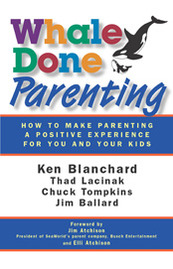
Whale Done Parenting
How to Make Parenting a Positive Experience for You and Your Kids
Ken Blanchard (Author) | Thad Lacinak (Author) | Chuck Tompkins (Author) | Jim Ballard (Author)
Publication date: 11/01/2009
Bestseller over 30,000+ copies sold
“How is it they can get a killer whale to urinate on cue, and we can't get our son to pee into the toilet?”
Amy Sheldrake, young mother and killer whale trainer-in-training, marvels at the complex behaviors her superiors at SeaWorld are able to coax out of these enormous beasts, while she and her husband struggle to make their beloved—and much smaller—son Josh obey the simplest rules. Using the story approach popularized by Ken Blanchard in his many bestsellers, this unique parenting book draws on the experiences of two of the coauthors—as both pioneering marine mammal trainers and as parents—to show how the same principles that induce killer whales to leap into the air can persuade young children to go quietly to bed.
Like Amy and her husband Matt, once you get the hang of the three Whale Done principles, you'll see a dramatic difference in overcoming challenges like following bedtime routines, dealing with tantrums, introducing new foods, sharing, avoiding overuse of the word no, learning to care for a pet, and instituting time-outs.
Amy Sheldrake, young mother and killer whale trainer-in-training, marvels at the complex behaviors her superiors at SeaWorld are able to coax out of these enormous beasts, while she and her husband struggle to make their beloved—and much smaller—son Josh obey the simplest rules. Using the story approach popularized by Ken Blanchard in his many bestsellers, this unique parenting book draws on the experiences of two of the coauthors—as both pioneering marine mammal trainers and as parents—to show how the same principles that induce killer whales to leap into the air can persuade young children to go quietly to bed.
Like Amy and her husband Matt, once you get the hang of the three Whale Done principles, you'll see a dramatic difference in overcoming challenges like following bedtime routines, dealing with tantrums, introducing new foods, sharing, avoiding overuse of the word no, learning to care for a pet, and instituting time-outs.
Formats
Paperback - $24.95$9.95
Paperback - $24.95$9.95
PDF eBook - $24.95 - Members: $17.47
ePub - $24.95 - Members: $17.47
Find out more about our Bulk Buyer Program
- 10-49: 20% discount
- 50-99: 35% discount
- 100-999: 38% discount
- 1000-1999: 40% discount
- 2000+ Contact ( [email protected] )
Orders of 10+ copies shipping to one address receive free ground shipping
within the U.S. Shipping to separate individual addresses via USPS media mail will be applied a handling fee:
Book Details
Overview
“How is it they can get a killer whale to urinate on cue, and we can't get our son to pee into the toilet?”
Amy Sheldrake, young mother and killer whale trainer-in-training, marvels at the complex behaviors her superiors at SeaWorld are able to coax out of these enormous beasts, while she and her husband struggle to make their beloved—and much smaller—son Josh obey the simplest rules. Using the story approach popularized by Ken Blanchard in his many bestsellers, this unique parenting book draws on the experiences of two of the coauthors—as both pioneering marine mammal trainers and as parents—to show how the same principles that induce killer whales to leap into the air can persuade young children to go quietly to bed.
Like Amy and her husband Matt, once you get the hang of the three Whale Done principles, you'll see a dramatic difference in overcoming challenges like following bedtime routines, dealing with tantrums, introducing new foods, sharing, avoiding overuse of the word no, learning to care for a pet, and instituting time-outs.
Amy Sheldrake, young mother and killer whale trainer-in-training, marvels at the complex behaviors her superiors at SeaWorld are able to coax out of these enormous beasts, while she and her husband struggle to make their beloved—and much smaller—son Josh obey the simplest rules. Using the story approach popularized by Ken Blanchard in his many bestsellers, this unique parenting book draws on the experiences of two of the coauthors—as both pioneering marine mammal trainers and as parents—to show how the same principles that induce killer whales to leap into the air can persuade young children to go quietly to bed.
Like Amy and her husband Matt, once you get the hang of the three Whale Done principles, you'll see a dramatic difference in overcoming challenges like following bedtime routines, dealing with tantrums, introducing new foods, sharing, avoiding overuse of the word no, learning to care for a pet, and instituting time-outs.
About the Authors
Endorsements
Table of Contents
Excerpt
We also recommend