



Download PDF Excerpt
Videos by Coauthors
Follow us on YouTube
Rights Information
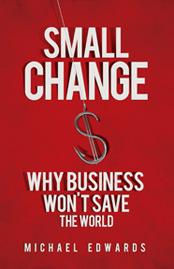
Small Change
Why Business Won't Save the World
Michael Edwards (Author)
Publication date: 01/11/2010
Find out more about our Bulk Buyer Program
- 10-49: 20% discount
- 50-99: 35% discount
- 100-999: 38% discount
- 1000-1999: 40% discount
- 2000+ Contact ( bookorders@bkpub.com )
Michael Edwards is widely recognized as one of the world's leading authorities on civil society, philanthropy, and social change. For the past thirty years, he has worked to strengthen the contributions of ordinary citizens to their communities as a grant giver, writer, advocate, organizer, and activist.
Michael graduated from Oxford University with a ""congratulatory"" first-class honors degree in geography, and was awarded a Ph.D. by the University of London for his work on housing the urban poor in Latin America. Dissatisfied with academic research, he entered the world of nongovernmental organizations (NGOs) in 1982 and spent the next fifteen years as a senior manager in international relief and development NGOs, including Oxfam GB, Save the Children UK, the Prasad Foundation, and Voluntary Service Overseas.
During this time, Michael became known for his innovative thinking about NGOs and development, and in 1998 he was invited to join the World Bank in Washing, D.C. as a senior adviser on civil society, where he led a program to improve the agency's engagement with a wide range of nongovernmental groups. Two years later, heh was appointed as director of the Ford Foundation's Governance and Civil Society Program in New York, overseeing grants totaling more than $900 million between 1999 and 2008, when he left to become a distinguished senior fellow at Demos, a Network for Ideas and Action, in New York; a senior visiting scholar at New York University's Wagner School of Public Service; and a senior visiting fellow at the Brook's World Poverty Institute at Manchester University in the UK.
Michael is the author of thirteen books and hundreds of articles and op-ed pieces, and his writings have changed the way we think about voluntary action and the transformation of society.
—Robert Kuttner, coeditor of The American Prospect and author of Everything for Sale
“There are all too few people in today's complex and confusing world who have either the courage or the clarity to speak truth to power. Michael Edwards has both, for which this well-researched, solidly argued, and levelheaded book provides ample evidence.”
—Gita Sen, Professor, Indian Institute of Management Bangalore; Adjunct Professor, Harvard School of Public Health; and Research Coordinator, Development Alternatives with Women for a New Era (DAWN)
“Anyone who wants the truth of philanthropy in America should read this book.”
—Robert B. Reich, Professor of Public Policy, University of California, Berkeley and author of Supercapitalism
Chapter One: Irrational Exuberance: the Rise of "Philanthrocapitalism"
Chapter Two: The Good the Bad and the Ugly: When Business Thinking Advances Social Change--and When It Doesn't
Chapter Three: Missing Evidence: The Change Philanthrocapitalism Doesn't Make
Chapter Four: The High Cost of Mission Drift: Why Human Values and Market Values Don't Mix
Chapter Five: The Difference That Makes the Difference: The Decline of Philanthrocapitalism and the Rise of Citizen Philanthropy
Acknowledgments
Notes
Index
CHAPTER ONE
Irrational Exuberance
The Rise of “Philanthrocapitalism”
It is six o’clock on a Saturday afternoon, and the Swan Lake Fire Department Ladies Auxiliary is cleaning up after its latest community rummage sale. Not much money changed hands today, but plenty of warm clothes did, much needed with the onset of winter in this upstate New York town. Prices varied according to people’s ability to pay, and those who couldn’t pay at all — like the mother who brought all her money in dimes, quarters, and pennies inside a plastic bag — were simply given what they needed, and driven home to boot. “Imagine what this would have cost me at Walmart,” she told her driver.
In some ways, there is nothing special about this story, which is repeated a million times a day in civil society groups that act as centers of solidarity and sharing. In another sense, it is profoundly important, because it represents a way of living in the world that is rooted in equality, love, and justice, a radical departure from the values of competition and commerce that increasingly rule our world. It is not that the members of the Ladies Auxiliary are free from concerns about money and what things cost — like everyone else, they have to make a living and raise funds to support their work, and they keep meticulous accounts. But when it comes to their responsibilities as citizens, they play by a different set of rules, which are grounded in rights that are universal, not restricted by access according to one’s income; they recognize the intrinsic value of relationships that can’t be traded off against production costs or profit; and they live out philanthropy’s original meaning as “love of humankind.” Over many generations, community groups and social movements have protected these principles in their work to attack discrimination and injustice, alleviate poverty, and protect the natural world.
Across the universe, meanwhile, a very different form of philanthropy is taking shape. It has been nicknamed philan-throcapitalism by Matthew Bishop and Michael Green1, and its followers believe that business thinking and market methods will save the world — and make some of us a fortune along the way. Bobby Shriver, Bono’s partner in the Red brand of products, hopes that sales will help “buy a house in the Hamptons” while simultaneously swelling the coffers of the Global Fund to Fight AIDS, Tuberculosis and Malaria.2 Larry Ellison, who founded Oracle, thinks that “the profit motive could be the best tool for solving the world’s problems, more effective than any government”3 — until government has to bail you out, of course, as it did for large swaths of American finance and industry in the aftermath of the financial crash in September 2008.
“If you put a gun to my head and asked which one has done more good for the world, the Ford Foundation or Exxon,” says Charles Munger, vice chair of Berkshire Hathaway, “I’d have no hesitation in saying Exxon,”4 though I can’t think of any oil spills that my old employers have dumped into the Pacific. “This,” says Jeff Skoll, who co-created eBay, “is our time.”5 There are philanthrocapitalists outside the United States, too, like Carlos Slim, the owner of most of the Mexican economy; Nandan Nilekani, of Infosys in India; and Shi Zhengrong, of Suntech Power in China, who are all “hyper-agents,” according to Bishop and Green, smashing through the barriers that have obstructed previous efforts to solve global problems. In this book, I won’t be focusing on non-U.S. examples like these because so little rigorous information is available on their efforts, but it is clear that the influence of philanthrocapitalism is spreading from the United States to other parts of the world, just as in earlier generations of philanthropy. The four richest people in the world are philanthrocapitalists — Bill Gates, Warren Buffett, Carlos Slim, and Larry Ellison, with combined assets of $135 billion, more than the gross domestic product of some of the world’s most populous countries, including Nigeria and Bangladesh.6Not all philanthrocapitalists are rich (we’ll meet some of them in chapter 2), and not all rich philanthropists subscribe to these methods and approaches, but the basic message of this movement is pretty clear: Traditional ways of solving social problems do not work, so business thinking and market forces should be added to the mix.
Actually, these traditional ways, like the Ladies Auxiliary and social movements dedicated to human rights, have often worked, though imperfectly, and if we gave them more support and recognition, they could work even better — but that’s not what the philanthrocapitalists want to hear. Instead, “the real scandal,” says Harvard’s Michael Porter, “is how much money is pissed away on activities that have no impact. Billions are wasted on ineffective philanthropy.”7 “Charities have failed for decades to deliver … do we want to continue with the status quo or apply some fresh, inherently efficient [my italics] and potentially very effective thinking to find new solutions?”8 This statement comes from Kurt Hoffman, director of the Shell Foundation, in a letter to the Guardian in London, though I could have picked from any number of statements that are constantly repeated as though they represent a simple and straightforward truth. In fact, if I had a dollar for every time someone has lectured me on the virtues of business thinking for foundations and nonprofits, I’d be a philanthropist myself.
This is a very odd way to talk about groups that have cared for the casualties of every crisis and recession for a hundred years or more, kept communities together in the good times and the bad, brought democracy alive in places very large and very small, protected the environment from continuous corporate degradation, pushed successfully for the advancement of civil and women’s rights, and underpinned every successful social reform since slavery was abolished. As far as I can tell, the people who make such statements have never worked in groups like these, nor have they studied the achievements and history of civil society organizations, nor have they experienced the difficulties of tackling power and inequality on a shoestring and in the face of constant opposition. On these grounds, maybe community organizers should go work for Lehman Brothers.
Come to think of it, that’s not such a bad idea: It might have saved us from the colossal mismanagement and risk taking by banks and hedge funds that led to the financial crisis — companies that were so successful and well managed that, like Lehman Brothers and its foundation, they collapsed overnight, leaving hundreds of nonprofits to face financial ruin — or it might have spared us Bernard Madoff with his massive Ponzi scheme, who defrauded Jewish charities of huge amounts of money and caused whole philanthropies like the JEHT Foundation to vanish without a trace.9 “In investment banking, it is taken for granted that decisions about how to use capital are based on rigorous research into performance,” say Bishop and Green in their love poem to philanthrocapitalism; or as we now know, such decisions could be based on raw speculation at everyone else’s expense. What is “inherently efficient” about business thinking and the market? That’s just ideology — pure, simple, and absolutely incorrect.
Not all philanthrocapitalists talk or feel this way, but the mix of arrogance and ignorance revealed in these quotations sure takes some explaining. What lies behind the rise of this phenomenon? The philanthrocapitalists are drinking from a heady and seductive cocktail, one part “irrational exuberance,” as Robert Shiller puts it,10 that is characteristic of market thinking; two parts believing that success in business equips them to make the same impact on society at large; a dash or two of the excitement that accompanies any high-profile new solution; and an extra degree of fizz from the oxygen of publicity that is created when philanthropists get the chance to mix with the world’s richest and most famous people. “The new rich have often made their money very fast, and get intoxicated by their own brilliance into thinking that they can quickly achieve results in the non-profit sector. They forget that their success may be due to luck, and that the non-profit sector may be far more complex than where they have come from,” says Mario Morino, head of Venture Philanthropy Partners, in a welcome dose of common sense.11
Shiller used the word irrational in the title of his famous book for a very good reason, since he knew that stock market bubbles and corrections are caused less by facts and fundamentals than by a popular consensus that becomes disconnected from what is happening on the ground. In similar fashion, the philanthrocapitalists have latched on to something potentially important — that business and the market can have more social impact — but have become so caught up in the buzz surrounding their ideas that they are ignoring the costs of what they are recommending and exaggerating the benefits.
The advance of capitalism brings many material and technological rewards, but it also dismantles the social ties and sense of common purpose that are essential to healthy and well-functioning societies; and in its present form, it promotes inequality and individual alienation. The philanthrocapitalists see more capitalism as the answer to the problems that capitalism has already created, but is this going to be enough? Especially at times of economic crisis, questions are always asked about the undue influence of businesses and wealthy individuals, the encroachment of the market into every aspect of our lives, and the erosion of older traditions of service and civic engagement. It is no coincidence that discussions of Bill Gates’s ideas on “creative capitalism” have taken off just when conventional capitalism is experiencing such a loss of public trust. To prosper in the future, capitalism must be the servant, not the master, of democracy and the public good. That will require more government and civil society influence over business, and not the other way around: more cooperation, not competition; more collective action, not individualism; and a greater willingness to work together to change the fundamental structures that keep most people poor so that all of us can live more fulfilling lives.
The tide of public opinion in many countries is already turning back toward the benefits of strong government, market regulation, democratic accountability, and civil society activism (whether it stays there is, of course, another matter). High levels of grass-roots participation in Barack Obama’s presidential election campaign were, perhaps, a harbinger of things to come, as civil societies begin to recover their sense of purpose and self-confidence. If these trends continue, philanthrocapitalism will face increasing questions about its relevance and reach — most important, does it actually work? Can these new approaches transform societies, or do they simply treat the symptoms of social problems in more efficient ways?
Philanthrocapitalism vs. Social Transformation
“Since 2005, commitments made through the Clinton Global Initiative (CGI) have already affected more than 200 million lives in 150 countries.” In Asia alone, “more than 3.5 million people will gain greater access to health services, an estimated 715,000 children will benefit from better education opportunities, over 260,000 adults will learn new job skills, over 250,000 girls and women will be empowered with better opportunities for sustainable livelihoods, nearly 24,000 hectares of forest land will be protected by empowering local residents to manage their own natural resources, the equivalent of more than 40,000 tons of CO2 emissions will be cut, and over 700,000 people will better learn to cope with environmental stress and natural disasters.”12
These statistics, taken from the CGI Web site, which acts as a clearinghouse for many business-savvy philanthropists and social entrepreneurs (defined in chapter 2), say little about the quality and sustainability of the improvements that are claimed, but they are undeniably impressive. There is justifiable excitement about the possibilities for progress in global health, agriculture, and access to microcredit among the poor that have been stimulated by investments from CGI members, the Gates Foundation, and others. This kind of work — using business and the market to get socially and environmentally useful goods and services to more poor people — has become the largest and most visible project of the philanthrocapitalists over the last five years. As Pierre Omidyar, one of the founders of eBay, puts it, you can begin by investing $60 billion in the world’s poorest people “and then you’re done!”13
Well, not quite, Pierre. New loans, seeds, schools, and medicines are certainly important, but there is no medicine that can combat the racism that denies land to dalits (or so-called untouchables) in India, no technology that can deliver the public health systems required to combat HIV, and no market that can reorder the dysfunctional relationships between different religions and other social groups that underpin violence and insecurity. And that’s the crucial point. Philanthrocapitalism may well produce a vaccine against malaria, but there’s no vaccine against greed, fear, poverty, inequality, corruption, lousy governance, personal alienation, and all the other things that plague us. Few areas of business expertise translate well into the very different world of complex social and political problems, where solutions have to be fought for and negotiated — not produced, packaged, and sold. And, so far at least, there aren’t many philan-throcapitalists who are prepared to invest in the challenges of long-term institution building, the deepening of democracy, or the development of a different form of market economy in which inequality is systematically attacked.
In most of the literature from philanthrocapitalists, the goal is saving lives, or promoting access for lower-income groups to goods and services that are productive and beneficial. “The Gates Foundation is seen as a venture capitalist,” says Erik Iverson, the foundation’s associate general counsel. “In return, what we want is lives saved.”14 Capitalism is philanthropic, says Matthew Bishop, because “sooner or later everyone benefits through new products, higher quality and lower prices.”15 As Jacqueline Novogratz concludes, “We should see every poor person on the planet as a potential customer”16 — not exactly an inspiring vision to get you out of bed, but entirely logical for business.
Staying alive is certainly a necessary condition for social transformation, but it is hardly sufficient for living a life that is fulfilling, loving, and productive, and neither is increased consumption. That level of fulfillment requires changes in systems and structures, institutions and relationships, and norms and values, so that everyone can participate fully in the benefits of social, economic, and political life — and care for themselves, each other, and the planet in the process. And completing this job rests on much more than market forces. Philanthrocapital-ism focuses on building up the health, skills, and assets of individuals, and I have some sympathy for this approach, which is born out of a desire to avoid the paternalism that infects traditional philanthropy and foreign aid. For those who benefit, it builds security and self-confidence, and enables people to make their own choices about how they want to spend their money and participate in society.17
But the problem is that this approach can only ever reach part of the population (usually the already better-off), because there will never be enough money in the system to get services to everyone who needs them on a one-by-one basis; it often imposes hidden costs on some members of society at the expense of many others (especially the less powerful and women, whose workload is often increased); and it leaves the structure of economic, social, and political life largely unchanged, thereby maintaining or increasing inequality even if absolute poverty goes down. If you wait to tackle injustice and discrimination until everyone has more assets, it will already be too late, since as history shows, economic growth rarely removes these problems by itself. Sadly, deep-rooted patterns of greed, corruption, racism, sexism, homophobia, and hatred do not disappear as incomes and other assets grow, so unless philanthrocapitalism digs more deeply into the fabric of social change, it is in danger of replicating, not transforming, existing patterns of power and inequality, even if more people have access to the loans, medicines, tools, and textbooks that they so desperately need.
“We literally go down the chart of the greatest inequities and give where we can effect the greatest change,” says Melin-da Gates of the Gates Foundation,18 except that some of the greatest inequities are caused by the nature of our economic system and the inability of politics to change it. Global poverty, inequality, and violence can certainly be addressed, but doing so requires the empowerment of those closest to the problems, as well as the transformation of the systems, structures, values, and relationships that prevent most of the world’s population from participating equally in the fruits of global progress. The long-term gains from changes like these will be much greater than those that flow from improvements in the delivery of better goods and services, but only the most visionary of philan-throcapitalists have much incentive to transform a system from which they have benefited hugely.
Business is certainly innovative in finding more efficient and profitable ways of doing the same kinds of things within the constraints and opportunities of the existing economic system, and these innovations will have some social impact, but business rarely innovates in the areas that lead to social transformation. They require a much more fundamental questioning and reimagining of how things are done. And the individual approach fails to recognize the power of collective action (whether organized through civil society or government), which can change the horizons of whole communities by implementing new laws and regulations, changing values and relationships, and cementing political coalitions and alliances from which everyone can benefit.
Indeed, when we look at examples of philanthropy that really make a difference, we see that they can’t be measured at all by the yardsticks of business and the market. I’m thinking of groups like SCOPE (Strategic Concepts in Organizing and Policy Education) and Make the Road New York, both in the United States, which build grass-roots organizations, leadership, and alliances in communities that are most affected by social and economic injustice in Los Angeles and New York. Established after the Los Angeles riots in 1992, SCOPE addresses the “root causes of poverty” by nurturing new “social movements and winning systemic change from the bottom up.”19 It has involved almost one hundred thousand low-income residents in community action to secure a $10 million workforce development program with the DreamWorks Entertainment Corporation; developed a regional health care program funded by local government; initiated the Los Angeles Metropolitan Alliance to link low-income neighborhoods together in order to influence regional solutions; and launched the California State Alliance, which links twenty similar groups throughout the state to develop new ideas on environmental policy, government responsibility, and reforms in taxation and public spending.
Make the Road New York opened its doors in 1997 in the Bushwick section of Brooklyn to build the skills and strength of immigrant welfare recipients, but soon expanded its focus to combat the systemic economic and political marginalization of residents throughout New York. Since then, it has collected over $1.3 million in unpaid wages and benefits for low-income families through legal advocacy and secured public funding for a student success center to meet the needs of immigrants.20 Both organizations are part of the Pushback Network, a national collaboration of community groups in six states that is developing a coordinated strategy to change policy and power relations in favor of those they serve from the grass roots up.
Outside the United States there are lots of similar examples. Take SPARC (the Society for Promotion of Area Resource Centres) in Mumbai, India, which has been working with slumdwell-ers since 1984 to build their capacity to fight for their rights and negotiate successfully with local government and banks.21 SPARC — whose motto is “Breaking rules, changing norms, and creating innovation” — sees inequality as a “political condition,” the result of a “deep asymmetry of power between different classes,” not simply “a resource gap.” SPARC has secured large-scale improvements in living conditions (including over fifty-five hundred new houses, security of tenure for many more squatters, and a “zero-open defecation campaign”); but just as important, it has helped community groups to forge strong links with millions of slumdwellers elsewhere in India and across the world through Shack/Slum Dwellers International (SDI), a global movement that has secured a place for the urban poor at the negotiating table when policies on housing are being developed by the World Bank and other powerful donors.
Housing is just a concrete expression of a much deeper set of changes that are captured in the following quotation from Arif Hasan, who works with SDI from his base in Karachi, Pakistan. “Traveling in different parts of the city as I did,” he wrote after the unrest that followed Benazir Bhutto’s assassination in December 2007, “you see nothing but burnt-out cars, trucks and trailers, attacked universities and schools, destroyed factories and government buildings and banks, petrol pumps and ‘posh’ outlets — all symbols of exploitation: institutions where the poor cannot afford to study; businesses where they cannot get jobs; government offices where they have to pay bribes and where they are insulted and abused. This is not a law and order situation, but an outpouring of grief and anger against corruption, injustice and hunger…. This is a structural problem that requires a structural solution.”22
Groups like these do deliver tangible results such as jobs, health care, and houses, but more important, they change the social and political dynamics of places in ways that enable whole communities to share in the fruits of innovation and success. Key to these successes has been the determination to change power relations and the ownership of assets, and to put poor and other marginalized people firmly in the driver’s seat — and that’s no accident. Throughout history, “it has been the actions of those most affected by injustice that have transformed systems and institutions, as well as hearts and minds,” as the Movement Strategy Center in California puts it.23
Symptoms vs. Causes
What do these stories have to tell us? First, that it is perfectly possible to use the market to extend access to useful goods and services. Second, that few of these efforts have any substantial, long-term, broad-based impact on social transformation. The reason is pretty obvious: Systemic change involves social movements, politics, and government, which these experiments generally ignore. One route alleviates the symptoms of some social problems more efficiently but leaves the deep structures of society pretty much intact; the other attacks the causes of social problems and tries to transform the systems that produced them. When you think about it, the latter is actually the most cost-effective route to social change, even if it takes longer and has many detours along the way.
Best of all are efforts like Shack/Slum Dwellers International and the others described above, which address both short- and long-term needs by linking together individual and collective action, service provision, asset building, advocacy, and empowerment. We “don’t have to die in service to some abstract concept of social justice,” as someone once put it to me when discussing philanthrocapitalist investments in getting drugs to people suffering from HIV; instead, we can address the production and distribution of these things in ways that also address social inequalities, build local economies, and strengthen the capacity of national health systems for the future. This is especially important where governments are weak and people lack access to essential services, as in much of the developing world, because immediate relief may be an essential precondition for their participation in long-term social action. But it is that long-term social and political action that matters most of all.
No great social cause was mobilized through the market in the twentieth century. In the United States, the civil rights movement, the women’s movement, the environmental movement, the New Deal, and the Great Society were all pushed ahead by civil society and anchored in the power of government as a force for the public good. Business and markets play a vital role in taking these advances forward, but they are followers, not leaders, instruments in the orchestra, but not conductors. No lasting change has been successful without large numbers of people acting consciously and collectively around human values of solidarity and social justice, not market values. Markets are a great way to do some things, but not to fashion communities of caring and compassion.
Would philanthrocapitalism have helped to finance the civil rights movement in the United States? One hopes so, but it didn’t fit any of the criteria that are at the top of the philan-throcapitalists’ agenda: It wasn’t data driven, it didn’t operate through competition, it couldn’t generate much revenue, and it didn’t measure its impact in terms of the numbers of people who were served each day — yet it changed the world forever. Real social change happens by deepening this kind of broad, democratic movement and when disadvantaged groups gain enough power to effect structural changes in politics and economics.
Will societies be better placed to solve their problems when social activists are replaced by social entrepreneurs, when collective action is replaced by household asset building, when politics is replaced by technocracy, when mutuality is replaced by individualism, and when cooperation is replaced by competition? Such shifts are not inherently or always wrong, but they are certainly inappropriate as generalizations about social change and how best to support it, because business thinking and social transformation operate on entirely different logics.
To put it very simply, civil society and the market are asking different questions, not simply finding different answers to a question they hold in common about providing goods and services with more social impact. The failure to recognize this distinction undermines the long-term impact of market-based solutions to social and political problems. Is philanthrocapitalism a boundary-breaking movement or a symptom of a disordered and profoundly unequal world? It hasn’t yet demonstrated that it provides the cure for global problems, that’s for sure, but its proponents could argue that such judgments are severely premature. Nevertheless, changing the deep dynamics of poverty and dispossession is the test that all revolutionary ideas must pass.