



Download PDF Excerpt
Videos by Coauthors
Follow us on YouTube
Rights Information
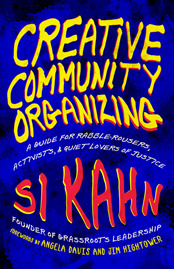
Creative Community Organizing
A Strategy Manual for Rabble-Rousers, Activists, and Quiet Lovers of Justice
Si Kahn (Author) | Angela Davis (Foreword by) | Jim Hightower (Foreword by)
Publication date: 02/15/2010
Si Kahn's impromptu song at BK Author Day Lunch Meeting
Find out more about our Bulk Buyer Program
- 10-49: 20% discount
- 50-99: 35% discount
- 100-999: 38% discount
- 1000-1999: 40% discount
- 2000+ Contact ( bookorders@bkpub.com )
Si Kahn's impromptu song at BK Author Day Lunch Meeting
-Jay Harris, Publisher, Mother Jones
Si Kahn's latest book is a great addition to strategic community organizing, offering nuanced insights into the difficult and often life saving fights organizers wage on a daily basis for social justice, human rights, and progressive change.
-Rinku Sen, President and Executive Director, Applied Research Center; Publisher, ColorLines; and coauthor of The Accidental American
Creative Community Organizing reminds us of the power of music and storytelling for deep transformation. Magic happens when we bring together creativity with strategy. Si gives us the recipe for moving to a future where human rights for all can become possible.
-Mallika Dutt, Executive Director, Breakthrough
Si Kahn is a Renaissance man for the social movements of our generation. He is a troubadour, a poet, and a lyricist; a thoughtful and reflective writer; a committed organizer and institution builder; and a carrier of his family's and his faith's deepest values. Most of all, he is a passionate believer in social justice and the power of ordinary people to stand up and determine their destinies. Reading this beautifully written and uplifting narrative will give faith and hope to all who read it and take it to heart.
-Miles Rapoport, President, Demos
Creative Community Organizing documents Si Kahn's career of working for justice in ways that are deeply affecting, personally and culturally. Si is truly Democracy's Troubadour, bringing us not just the songs and stories of democracy and justice but also the practical strategies to deepen our democratic roots.
-Congresswoman Tammy Baldwin
Si Kahn is an organizer and an activist. He's also a poet, a songwriter, a preservationist, a historian, a documentarian in song. He's a stark realist and simultaneously an unflinching optimist. The tender reverence he holds for the people whose struggles he has facilitated spills over into his writing, keeping their stories alive, connecting us to them-and ultimately, ourselves.
-Kathy Mattea, Grammy-winning singer
Over a lifetime of social justice activism-much of it spent on the front lines-Si has kept the faith with courage, creativity, and humor. His bedrock belief in the power of people working together to create a just world is the spirit that guides this remarkable book.
-Alan Jenkins, Executive Director, The Opportunity Agenda
The true moxie of Creative Community Organizing comes from Si Kahn's brilliant storytelling and his own distinguished career as an organizer, folksinger, and all-around rabble-rouser-exemplifying all that is great about fighting for justice and working for progressive social change. This book is a great primer for organizers, activists, and those dedicated to movement building.
-Pronita Gupta, Director of Programs, Women Donors Network
Si Kahn has been my mentor, song leader, and conscience since I started organizing two decades ago. From his strategic wisdom, I've learned about organizing smart campaigns, about winning and losing and never giving up. From his songs and stories, I've been connected to the beauty and pain and shared vision that make it possible to keep on fighting. Si combines the brass tacks of organizing with the soulful, collective, creative yearning for the world-as-it-should-be.
-Brad Lander, New York City Councilmember, 39th District (Brooklyn)
In this marvelous book, Si Kahn leads us through his own history as an organizer for progressive social change and in the process provides an education for future generations to get involved in bringing justice to more of the world's people. His insights on the importance of integrating artistic expression into strategies for change are invaluable.
-John Stocks, Deputy Executive Director, National Education Association
Classic recipe: Mix classic storytelling with 2 cups autobiography, 3/4 cup textured folk/movement/gospel poetry set to music, 1/2 cup U.S. history, 2 spoons tested advice, a dash of nostalgia, and a smidgen of medieval history and literature. Blend well with love, encouragement, rejuvenation, faith, and a lifetime of commitment. Get Si Kahn's classic book, Creative Community Organizing: a great lesson plan for teaching organizers but also a must-read for anyone who cares about progress and how to make it happen.
-Congressman Mel Watt
Si Kahn has the heart of a poet, the wit of a comedian, the hands of a seasoned political operative, and the ability to explain to the rest of us how to translate dreams into day-to-day reality. This is one of the most illuminating and personal books ever written by a real-life progressive hero.
-Danny Goldberg, author of Bumping into Geniuses
There is so much hope in Si Kahn's new book: it is filled with stories spanning four decades of his creativity tackling some of our country's toughest problems. He may not have invented the term creative community organizing,' but he has certainly shaped its past and future.
-Geraldine Laybourne, founder, Oxygen Media
In Creative Community Organizing, Si distills forty-five years of experience for another generation that is already picking up the fight for a just and democratic future. Poet, songwriter, and storyteller par excellence, he weaves memoir and organizing manual into a unique and inspiring tapestry. This book is a gift to the rest of us, a challenge never to lose faith in human possibility or to back off from doing the work of joining with others to build a better world.
-Sara M. Evans, author of Born for Liberty
My union brother Si Kahn and I have been friends for over thirty years. His first book, How People Get Power, was my introduction to organizing and my initial inspiration for what has been a wonderful life working to build collective action and to struggle together for the common good. What better hope for Creative Community Organizing than that it will help create that dynamic in the lives of others.
-Stewart Acuff, Assistant to the President, AFL-CIO
Si Kahn's compelling portraits remind us that creative community organizing is all about people real-life individuals who use their skills to take on enormous challenges and those whose lives are made better as a result. This is an inspiring and instructive read.
-Congresswoman Jan Schakowsky
Si writes with a calm passion. This book is a kind, caring friend and mentor for we who are engaged in the struggle to help our country live up to the promise of what America was meant to be.
-Ben Cohen, cofounder, Ben & Jerry's Homemade Ice Cream
Si Kahn's powerful, stirring story of his lifelong journey for justice and lessons learned will captivate and energize all who care about equal justice. This is the handbook for rabble-rousers everywhere!
-Ada Deer, Distinguished Lecturer Emerita, School of Social Work and American Indian Studies Program, University of Wisconsin-Madison; former Assistant Secretary of Indian Affairs; past chair, Menominee Tribe
In his forty-five years as a labor, civil right,s and community organizer, Si Kahn has maintained his unshakeable faith in the capacity of working people to shape their own destiny and his passionate belief that what this country needs more than anything else is a strong progressive labor movement. His work and his songs are a testimony to the power of the union.
-John McCutcheon, President, Local 1000, American Federation of Musicians, AFL-CIO
Organizing is not simply a toolbox of strategies, charts, and tactics. Organizing for social and economic justice demands deep relationships, core unshakeable values, humility born of experience, and appreciation of the creative spirit in all of us. Si Kahn, a marathon runner for justice, crams a lifetime of experience and wisdom into this highly readable and inspirational book-a must read for anyone in the trenches or thinking about joining the struggle for justice.
-Kim Bobo, Executive Director, Interfaith Worker Justice
Si Kahn's unique combination of folk songs and prose provides a riveting memoir and analysis of class struggle as well as an inspirational organizing tool. This book will become a cornerstone of the movement for social justice.
-Stephen Nathan, editor, Prison Privatisation Report International, London, England
Reading a Si Kahn book is like listening to his music-organizing stories come alive and we learn while listening and imagining. This is an equally great read for community and workplace organizers.
-Larry Cohen, President, Communications Workers of America
Si Kahn, the grandchild of immigrants, is a gifted storyteller who conveys the story of community organizing in a way it's never been told. His account of the campaign to abolish so-called immigrant family detention leaves the reader with hope and inspiration.
-Daranee Petsod, Executive Director, Grantmakers Concerned with Immigrants and Refugees
Creative Community Organizing provides the reader with an opportunity to listen and learn from one of the field's legendary practitioners. As someone who has benefited firsthand from Si's insight and inspiration, first as an organizer and more recently as the CEO of the Jewish Funds for Justice-the foundation Si helped create to fund community organizing-I commend this book to anyone seeking to understand what organizing at its best can look like.
-Simon Greer, President and CEO, Jewish Funds for Justice
Si, master organizer, storyteller, and musician, uses his poetic, lyrical prose to teach and inspire. This is a book you'll read in one sitting and remember the lessons because the stories will stay with you forever.
-Jackie Kendall, Executive Director, Midwest Academy
Si Kahn beautifully weaves poetry, song, stories, remembrances, analysis, and prescriptions into a rich tapestry. He transports the reader through forty-five years of community and labor organizing, from roots with the Student Nonviolent Coordinating Committee in 1965 through recent decades as founder and executive director of Grassroots Leadership. This is a deeply personal book, firmly planted in his religious Jewish upbringing by his father, a very musical rabbi, and his mother, who taught him the love of poetry. Read this book to learn from a consummate organizer, educator, and cultural worker.
-Neil Tudiver, Assistant Executive Director, Canadian Association of University Teachers/
If the arc of the moral universe bends toward justice', as Martin Luther King said, then Si Kahn has devoted his life to riding that arc. His powerful impulse to service, combined with deep compassion, is a force of nature. I put Si in the same category as Woody Guthrie, as Pete Seeger, and in a strange way, as my dad, who shared his righteous sense of humanity and his love of the meek,' who he truly believed would 'inherit the earth.'
-Rosanne Cash, writer and musician
Foreword by Angela Davis
Introduction
1: United the Divided, Divide the United
2: If You Don't Fight, You Lose Every Time
3: Check Your Stereotypes at the Door
4: Don't Just Study History-Make It .
5: Recognize Risks
6: Lift Every Voice
7: Strengthen the Story
8: Start at the Finish Line
9: Be For, Not Just Against
10: Find the Glue
11: Learn Your Limits
12: Expect the Impossible
13: Know When to Raise the Stakes
14: Keep the Faith
Conclusion: Pull Your Shift
Creative Community Organizing's Top 20 Resources
Thanks
Index
About the Author
Introduction
I have been a radical for fifty years and more
Stood against the rich and greedy
For the workers and the poor
From Canada to Mexico I traveled everywhere
Wherever trouble called me, I was there
Like stitches in a crazy quilt that women piece and sew
Wherever there was suffering, I was bound to go
With angry words for cowardice, comfort for despair
Whenever help was needed, I was there
I was there in the depressions
When times were at their worst
But we had them where we wanted
Like a dam about to burst
With fire in our bellies, revolution in the air
For a moment we saw clearly—I was there
There were times I saw the issues
In quite a different light
And old friends turned against me
But I never left the fight
When stones were in my passway
And the road was far from clear
Whether I chose right or wrongly, I was there
On a day when hope goes hungry
And your dreams seem bound to fall
You may see me at the mill
Or just outside the union hall
When the clouds are empty promises
The sky a dark despair
Like an eagle from the mountain, I’ll be there
And you, my brave young comrades,
When the future sounds the call
Will you be there for the battle,
Will you answer, one and all
When the roll is called up yonder
When the roll’s called anywhere
Will you stand and answer proudly, “We’re still here”
Will you stand and answer proudly, “I was there”
I wrote this song some years ago as a tribute to Mother Jones, the great labor radical, famously called “the most dangerous woman in America.” But, aside from the hyperbole (Mother Jones was not exactly renowned for her modesty, and I would never describe myself, as I believe she might easily have done, as “an eagle from the mountains”—totem animal-wise, I’m more of a stubborn dog that won’t let go of a bone), it could easily be about me.
I have indeed been a radical “for fifty years and more,” and proudly so. For forty-five of my almost sixty-six years, I’ve made my living as a professional civil rights, labor, and community organizer.
It was my great good fortune to begin my organizing career as a volunteer with the Student Nonviolent Coordinating Committee (SNCC), the militant student wing of the Southern Civil Rights Movement. SNCC (pronounced “SNICK”) was nothing if not creative. Drawing on old traditions of African American resistance, shaped by veterans of the civil rights, labor, and peace movements, it developed not only ways of thinking about how community organizing can change the world for the better, but also strategies to make that real in the world. The great movements of the last forty-five years—among them those of women, workers, welfare recipients, peace lovers, students, lesbian, bisexual, gay, transgender and queer/questioning activists, union members, and environmentalists—would not have been what they were without the influence and lessons of the Southern Civil Rights Movement.
Most organizers spend their entire hard-working lives without ever being lucky enough to take part in a campaign or movement that gets noted by history. I have had the great good fortune to have been involved with five of them: In the 1960s, I joined the Southern Civil Rights Movement. In the 1970s and early 1980s, I was involved in the Brookside Strike, led by the United Mine Workers of America (UMWA) in Harlan County, Kentucky; the J. P. Stevens Campaign for unionization in the southern textile mills, led by the Amalgamated Clothing and Textile Workers Union (ACTWU); and the Brown Lung Movement, in which cotton mill workers disabled by the deadly disease known medically as byssinosis fought for compensation and to clean up the mills. Since the mid-1990s, Grassroots Leadership, the organization I’ve worked for over the last thirty years, has led the national campaign to abolish all for-profit private prisons, jails, and detention centers, and to put an end to immigrant family detention, the appalling recent practice in which children as young as infants are imprisoned together with their parents.
I don’t deal with all these campaigns and movements in this book. Rather, I’ve chosen to write the way my grandmothers cooked, “a little of this, a little of that,” to create a smorgasbord rather than a history, either of organizing or of my own life and work.
As with any trade, there is an established way to do community organizing, basic principles and skills that you’ll find in any organizer’s toolbox. A number of handbooks and strategy manuals lay all of this out, including my own earlier books How People Get Power and Organizing: A Guide for Grassroots Leaders. Pick up any of them, and you’ll learn the common wisdom of generations of organizers, along with the shoptalk of the trade: one-on-ones, door knocking, strategy sessions, shift meetings, tactics, actions, accountability sessions, free media, negotiations.
That’s not what this book is about. Rather, it deals with creative variations on the general theme of organizing. What distinguished the campaigns and movements in which I was involved was their creativity. I’ve spent my working life learning from the best—literally hundreds of civil rights, labor, and community organizers who brought not just passion and courage but great freshness and innovation to everything they did.
That’s why this book is titled Creative Community Organizing. It’s a tribute to all of the wonderful organizers with whom I’ve worked and shared stories over these forty-five years, a praise song to the traditions of activism and resistance we share, and that we work to pass on to the next generations of “rabble-rousers, activists, and quiet lovers of justice.”
Because I’m not just an organizer, but also a historian, songwriter, and storyteller, I believe that a straight line is often the longest distance between two points. It’s true that, as the saying goes, “If you don’t know where you’re going, any road will get you there.”
But even if you have a clear destination in mind, it doesn’t necessarily follow that the best way to get there is the shortest. You’ll find that attitude reflected in the winding road that is this book, with lots of detours and side trips along the way. But, as creative community organizers, we do know where we’re going— and we will get there.
In my own work as an organizer, I’ve tried to “keep my eyes on the prize,” to stay focused on the goal, the victory that will give the people I’m working with changes for the better that they can see and feel. But I’m also concerned with what people learn on the way to that victory: about themselves, each other, history, justice, community, friendship. I want them to love the struggle for justice, not endure it.
So I’ve written this book the way I organize. Think of creative community organizing as a highway leading to somewhere you passionately want to go, but with lots of interesting side roads and paths to explore along the way. When in the course of this book you hit a song, a story, a poem, a bit of oral history, think of it as a chance to turn off the main drag for a little while, to rest yourself from the journey, to feel as well as to think.
As a historian, I tend to pay attention to the path behind as well as the road ahead. Because I want history to be accessible to a wide range of people who have different relationships to reading, I’ve used songs in my organizing as a way to tell stories. I am always moved and inspired when everyday people decide not just to read history but to make it, so it’s their stories that so many of my songs are about.
The lyrics you’ll encounter are taken from songs I wrote. If someone else wrote one of the poems or songs that salt the book, I’ll tell you in the text who they are.
Why did I write this book? Almost every day, I encounter people who have a passionate desire to make a difference in the world, to do whatever it takes to change it for the better. Like the phototropic plants that grow towards the light, they lean towards doing what is right, often at considerable risk and cost. Dr. Martin Luther King Jr. said that “the arc of the moral universe . . . bends towards justice.” So do individual people—and they are the salt of the earth.
My greatest hope is that when one of these natural-born activists says to someone who’s been organizing for years, “So do you think I should become an organizer?” they’ll tell them about this book and say, “Read it, then come back and talk with me.”
I can’t tell you whether you should become an organizer, full time or volunteer, although I hope many of you who read Creative Community Organizing will decide it’s something that makes sense for you. I will just say that I cannot imagine any work that would have given me a better life and a stronger sense of having done my best to make a difference, not just for those with whom I’ve worked, but for myself.
As Mother Jones says in the song, “Whether I chose right or wrongly, I was there.”